Verse 41854aa))e;Nkyaa
G14
| References | |
|---|---|
| Arshi, Imtiyaz Ali | Ghazal# 46 |
| Raza, Kalidas Gupta | 448-449 |
| Hamid Ali Khan | Open Image |
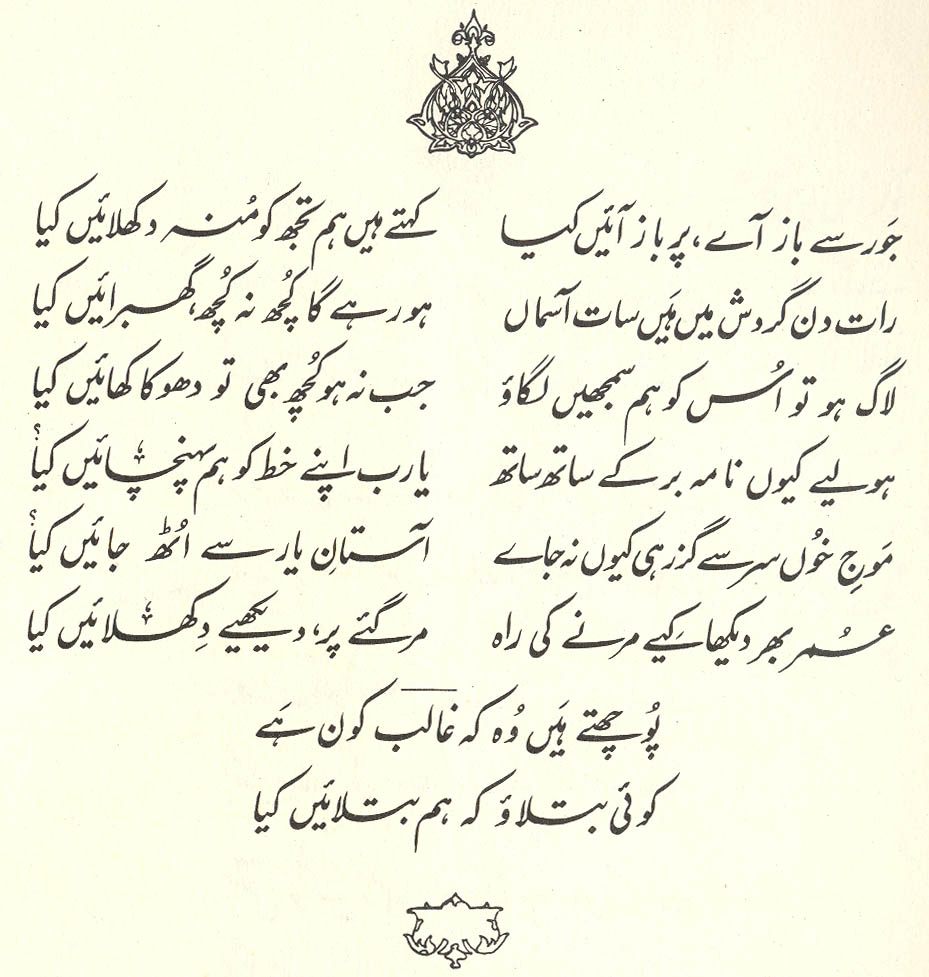
In this verse 'oh Lord' is not for the vocative, but rather for the expression of surprise. (42)
== Nazm page 42

Urdu text: Vajid 1902 {46}
The ardor for an answer to his letter has increased to such an extent that he goes off along with the Messenger, and he's so absorbed in this ardor that he doesn't even remember that he's gone off with the Messenger. In the second line there's an indication of surprise-- oh Lord, would I deliver my own letter? This is an embarrassing thing. The pleasure of this expression is in no need of commentary. (84)
What can I say of the excellence of the theme and the inventiveness []! (117)
Ghalib has taken the theme of this verse from Qais 's style of behavior. One day Qais met a camel-rider. Upon inquiry, he learned that he was going to Laila 's village. Qais began to go along with him: tell Laila this, and tell Laila that. So much so that he reached the village. (389)
[Compare his discussion of Mir's M 686,1 .]
This is a verse in which tone is everything. The rueful realization of his own absent-minded, obsessive folly, the self-mockery-- all expressed in the form of two questions. Ghalib's talent for vigorous speech once again energizes and complicates a simple verse.
Why did the speaker go along with the Messenger? and would/might he deliver his own letter? Both of these exclamations of course express surprise and (probably) dismay, but they're also questions. To try to answer them is to unpack, as always, the lover's essentially out-of-control situation. Compare 17,3 , in which he finds himself constantly, compulsively going 'in that direction', and is constantly astonished [] at his own behavior. Here the main difference is that the humor of his plight receives more emphasis than the helplessness.
It's even possible to read the second line as a genuine question-- perhaps it has just now occurred to the mad lover that perhaps he should try to deliver his own letter. Indeed, why not? Why should he arrange for the Messenger to come into the presence of the beloved, perhaps even to speak with her-- why shouldn't he himself experience this glorious good fortune?
Another study in excessive eagerness to communicate: 176,4 .
A traditional carrying-case in which a rolled-up letter would be conveyed by a messenger:
graphics/lettercase.jpg