Verse 11854aa))e;Nkyaa
G14
1 a
she left off tyranny-- but would she leave off?
1 b
she left off tyranny, but-- as if she would leave off!
2 a
she says, 'Would we (be able to) show our face to you?'
2 b
she says, 'What-- would we show our face to you?!'
'Wrong-doing, injustice, oppression, violence, tyranny'.
'To come or turn back (from), draw back (from); to leave off, desist, refrain, abstain (from); to give up, abandon, relinquish, renounce; to keep (from), avoid, shun'.
'To show one's face (to), to appear before (one) with confidence and satisfaction (e.g. ? 'how can I show my face?')
| References | |
|---|---|
| Arshi, Imtiyaz Ali | Ghazal# 46 |
| Raza, Kalidas Gupta | 448-449 |
| Hamid Ali Khan | Open Image |
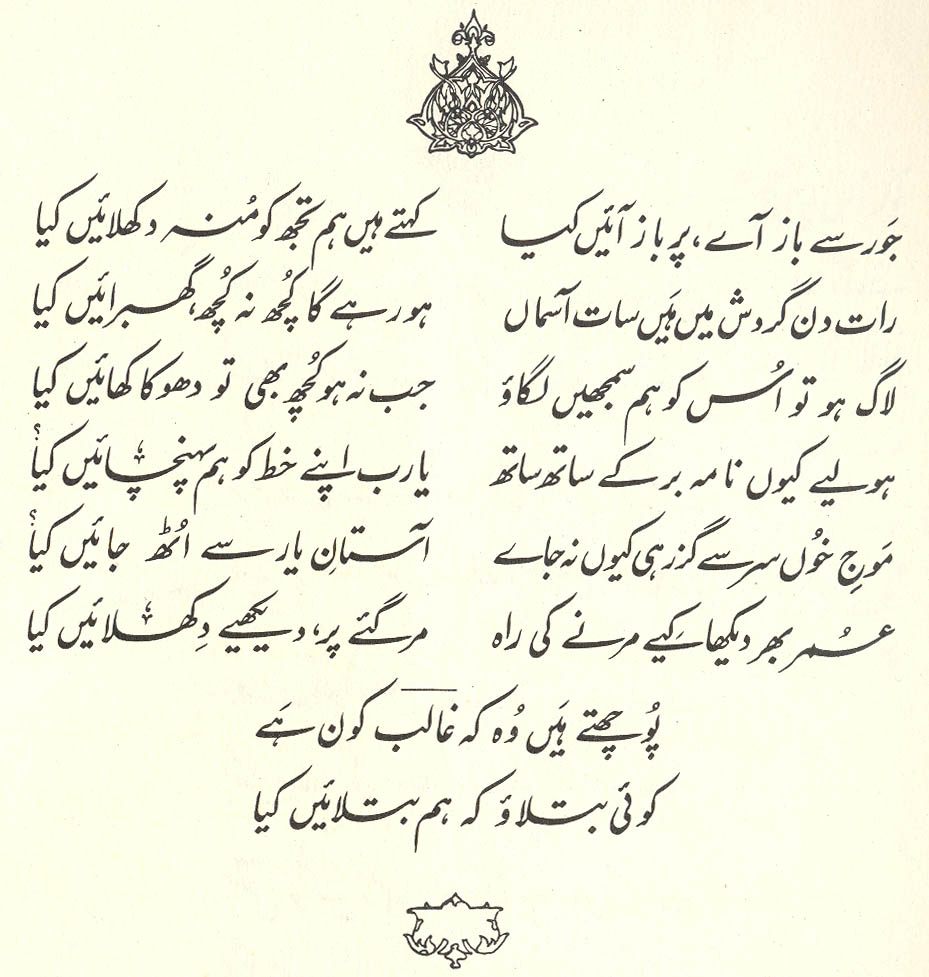
[1858, to Mihr:] I have sent out books by post to various places. Although I've heard that they have arrived, I haven't yet received any acknowledgements. Verse: 46,2 . Look, my friend, at what the opening-verse of this ghazal is: {46,1}. [He goes on to write out {46, verses 5, 3, 7}.]
==Urdu text: Khaliq Anjum vol. 2, pp. 716-717
==another trans.: Russell and Islam , p. 184
==another trans.: Daud Rahbar pp. 94-95
That is, now out of shame she doesn't show her face; this too is tyranny to me. (42)
== Nazm page 42

Urdu text: Vajid 1902 {46}
She is so tyrannical-- how can she give up tyranny? That is, she will absolutely, absolutely never leave off her tyranny. (83)
Compare 205,1 . (188, 293)
A classic example of the use of ; for more on its complexities see 15,10 . The first half of the first line tells us flatly that she gave up tyranny. But immediately that statement is called into question. In the second half of the line, we can't tell whether in fact she might really have given up tyranny (1a); or whether it's absurd to think she would do so (1b). The paradoxical effect of both repetition and contradiction between the two halves of the line makes for excellent sound effects too: only a single nasal ending separates the perfect ( ) and future subjunctive ( ) forms of the verb.
Then in the second line we learn that whether she says, or even thinks, that she's giving up tyranny, makes no difference anyway. For if she gives it up, she is then too shamefaced at the memory of her past cruelties to show her face to the speaker (2a). Or else it's equally possible that her irascible arrogance remains undiminished, so that despite her new (official) attitude she's indignant at the very thought that she'd show her face to him (2b).
No matter what, throughout all those permutations, the lover doesn't get to see her face. But such contradictory behavior on the beloved's part isn't surprising, after all: in 14,7 she tells the lover to spread his bedding at her door, then instantly reverses herself; and in 17,8 she first murders the lover, then at once repents and swears off murder. If she's perverse in her tyranny, he's equally perverse in his exasperated, amused, acceptance of it. If the beloved is tyrannical-- well, she's only doing her proper job in the ghazal world.
Note for grammar fans: In the second line, is just a variant form of . It has the advantage of scanning with an initial long syllable instead of a short one.
graphics/veiled.jpg