Verse 1after 1821aajaa))e hai mujh se
G2
1
if sometime even/also goodness/benevolence comes into her inner-self toward me
2
having remembered her own cruelties/oppressions, she feels ashamed before me
is an archaic form of in the first line, and in the second line ( GRAMMAR )
| References | |
|---|---|
| Arshi, Imtiyaz Ali | Ghazal# 189 |
| Raza, Kalidas Gupta | 362-63 |
| Hamid Ali Khan | Open Image |
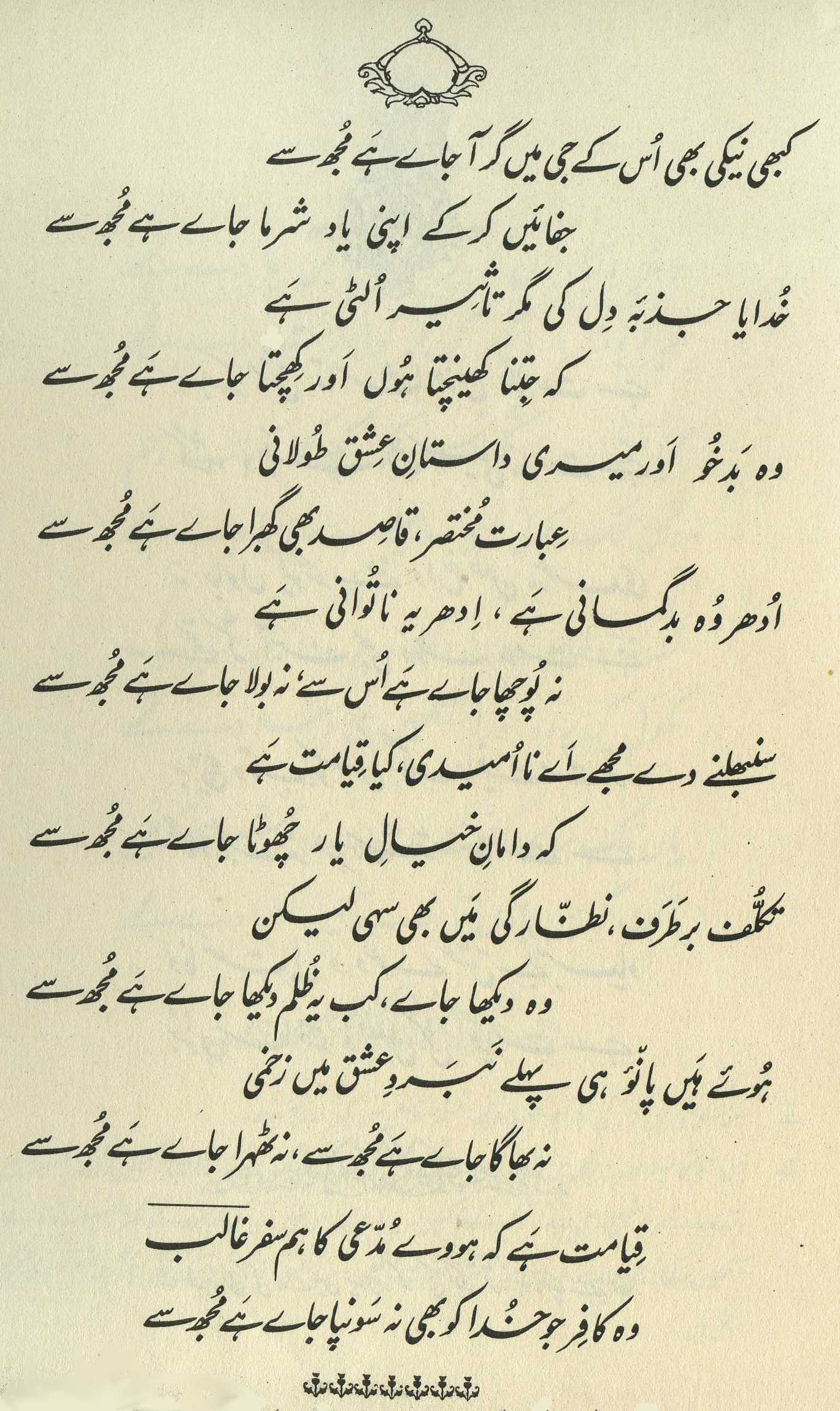
That is, the thought 'He's spent his whole life in this oppression, now what good can it do him to show him a small bit of kindness?' makes her unable to show goodness.
==Urdu text: Yadgar-e Ghalib , p. 162
That is, for me in that case too is wretchedness, for now out of shame she doesn't show her face. (231)
== Nazm page 231

First of all, she is never kind to me at all; and if in some way she even is, then having remembered her cruelty, she becomes ashamed. That is, we are very unfortunate: if no mercy comes, then we writhe with longing to see her face. And if mercy comes, then in shame she hides her face. In one more place he says, 46,1 . (409)
Compare 46,1 . (188, 293)
This ghazal has a remarkably long and complex refrain . It might be the longest in the divan , but I've never gone through and systematically checked. This ghazal has proven very popular among singers.
The beloved almost always feels hostile and disdainful toward the lover; as a matter of course, therefore, she refuses to see him. But if by some chance she has a momentary fit of compassion, she recollects her own cruelties toward him, and feels too ashamed to look him in the eye-- and thus she refuses to see him. The result is a 'damned if you do, damned if you don't' quandary-- a classic 'catch-22' situation.
The piquant 46,1 is, as Arshi proposes, an ideal verse for comparison. That verse is so much more mischievous, multivalent, and complex, however, that the present verse suffers a bit through the contrast: it looks prosy, over-explanatory, and one-dimensional. Other than setting up a 'catch-22' situation, does it have any other delights to offer us?
graphics/shame.jpg