Verse 6after 1821aajaa))e hai mujh se
G2
1
{to tell the truth / 'to put aside formality'}, even/also when [I am engaged] in spectatorship no doubt-- but still
2
that she would be seen-- when is this outrage/cruelty [to be] endured/'looked upon' by me?!
z:zaarah>> : 'Sight, view, look, show; inspection; --amorous glance, ogling'.
z:zaaragii>> : 'Seeing, looking at; sight; observation; --s.m. Beholder, spectator'.
is an archaic form of ( GRAMMAR )
| References | |
|---|---|
| Arshi, Imtiyaz Ali | Ghazal# 189 |
| Raza, Kalidas Gupta | 362-63 |
| Hamid Ali Khan | Open Image |
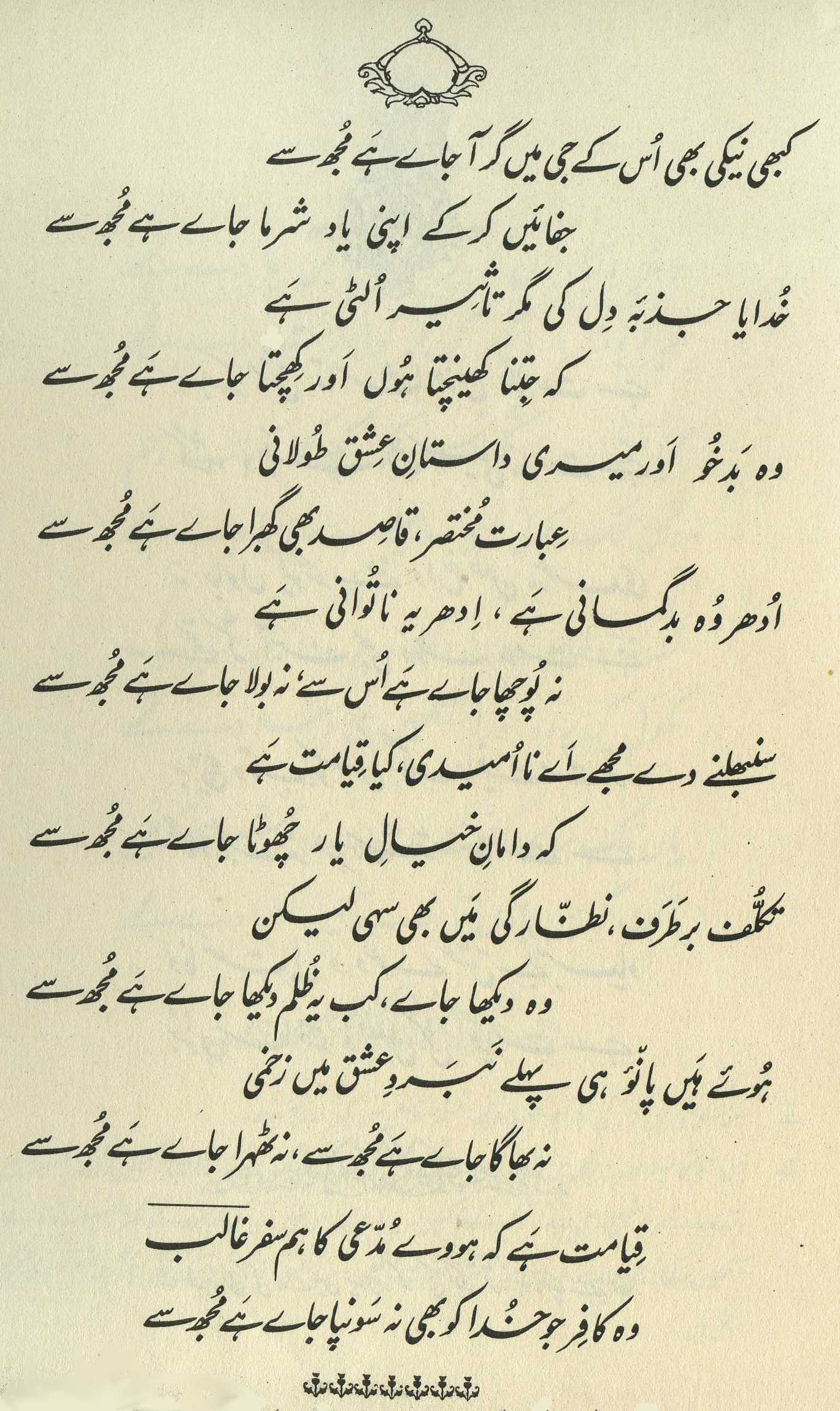
The meaning of is 'beholders'. That is, even if I too would be among the beholders, what of it? When will I be able to 'look upon' this outrage: that she would be seen; that is, that Other s would see her-- when would this be acceptable to me? (232)
== Nazm page 232

He says, 'I accept that I too am among her beholders. But this outrage will never be 'looked upon' by me, that people would see her. For goodness sake []-- how can this envy/jealousy be acceptable to me?' (290)
The truth is that even after the beholders are disgraced to whatever degree, we can't 'look upon' the outrage that we would see the beloved in such a situation, when other people too would be present. In such a situation we consent to remain deprived of a sight of her. (410)
Compare 153,1 . (287, 294)
Here's a spectacular (and what a perfect adjective!) display of word-play and meaning-play working together.In the first line, the common petrified phrase works almost the way 'to tell the truth' does in English, as a sentence-introducer that promises to 'cut to the chase' or get right to the heart of the matter; for more on this phrase, see 65,1 . And the rest of the first line continues to prepare us colloquially for something else: the concessive 'even in spectatorship, indeed' (on the colloquial use of see 9,4 ) is then followed by the 'but'. Thus we have a first line that is focused obsessively on the second line, preparing us in three different ways to pay attention to what is to come.
The second line then introduces a very clever obsession of its own: a 'repetition' of that is really only apparent. The first occurrence is straightforward: 'would be seen', a passive subjunctive. The second occurrence is part of , which is an archaic form of , a passive habitual. Its literal meaning is thus 'is (habitually) seen', but it has a strong colloquial sense of absolute refusal: this is not to be seen, not to be 'looked upon' by the lover. (For more on this idiomatic usage, see 205,4 .
What is it that can't be tolerated, can't be borne, can't be 'looked upon' by the lover? Why, that the beloved would be 'looked upon', of course. He naturally can't bear that she would be 'looked upon' by others-- and this is true even when he himself is among the others, the 'lookers'-- as we learned in the first line. And now that we're returning in our minds to the first line, we notice another and more literal reading of : it can also be taken as describing this appalling breakdown of proper lover-like decorum: that the beloved would be freely, informally, even perhaps discourteously, stared at, 'looked upon', by all and sundry.
The basic idea is thus a commonplace one: that the lover is so jealous that he can't stand to have anybody look at the beloved-- including himself. But what other poet can offer us such an ambivalent but enticing souffle of beholding, seeing, 'looking upon', spectatorship-- enhanced by our own 'participant observer' role in putting it all together?
graphics/eye2.jpg
graphics/eye.jpg