Verse 2after 1821aajaa))e hai mujh se
G2
1
oh Lord , perhaps/but the effect of the passion/attraction of the heart is reversed!
2
for, as much as I pull/draw/attract, she goes on being [by that much] more pulled/drawn [away] from me
'Drawing, attraction; allurement; absorption'.
'Passion, rage, fury; violent desire'.
'To draw, drag, pull; to attract, to draw in, suck in, absorb... ; --to draw away or aside (from), to hold aloof...; to withdraw, withhold'.
'To be drawn, dragged, or pulled, &c.; to be attracted; to be absorbed, be sucked in; to be drawn out, be extended, be stretched; to stretch; to be extracted; to be drawn tight, be tightened;—to draw aside or away (from), to hold or keep aloof (from), to fight shy (of)'.
is an archaic form of ( GRAMMAR )
| References | |
|---|---|
| Arshi, Imtiyaz Ali | Ghazal# 189 |
| Raza, Kalidas Gupta | 362-63 |
| Hamid Ali Khan | Open Image |
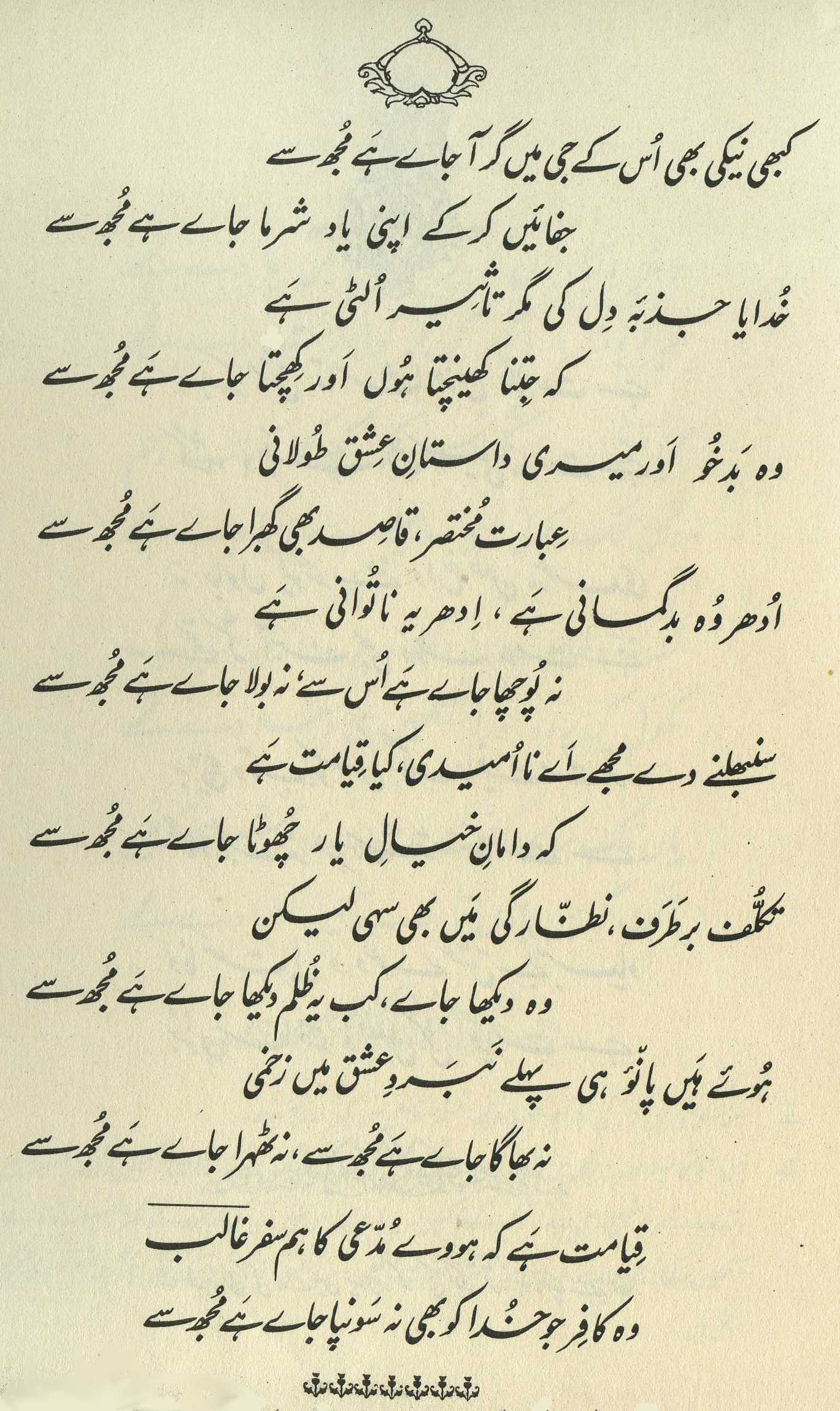
The meaning of is vexation and irritation-- that is as much as with the passion of the heart I draw/attract her, exactly that much she is vexed. (231)
== Nazm page 231

He says, 'Oh God, have you created in the drawing/attraction [] of my heart a reverse effect? --such that to whatever extent I draw/pull her with the attraction of my heart, to exactly that extent she becomes vexed at heart with me, and keeps becoming angry'. (289)
In a tone of astonishment he says, 'What is this? Is the effect of my attraction [] of heart reversed? As much as I desire that she would be kind, by that much she keeps becoming angry.' (409)
Here we have some lovely wordplay with in its double sense of either pulling toward, drawing, attracting; or else of pulling (oneself) away, withdrawing. Because is the intransitive form of (see the definitions above), we have two readings available. On one reading, the more the lover tries to draw the beloved toward himself, the more she is (passively) drawn away from him, by the force of his own attracting-power []-- an 'attracting' power that unfortunately seems to be working in reverse, as a kind of repelling-power (like similar magnetic poles). On the other reading, the more he tries to draw her toward himself, the more she draws herself (intransitively but deliberately) away from him, in a willed response to his attempts to attract her.
There's an undecideable, and very enjoyable, back-and-forth play between the literal meaning of 'attract' (like magnetic force) and the metaphorical meaning (like coquetry and flirtation). Along similar lines, the word appears here to be deliberately conflated with , which isn't surprising since they're both closely related derivatives from the same Arabic root; the merging of 'passion' and 'attraction' contributes to the same literal/metaphorical interplay (see the definitions above).
This verse is also a perfect example of the less common meaning of as 'perhaps' rather than 'but'. Though both are possible here, the former is surely the reading of choice: it makes the first line into a speculation about the cause of her unfortunate behavior. (The reading as 'but' becomes part of an exclamation of surprise and protest addressed to the Lord.)
graphics/magnet.jpg