Verse 4after 1821aajaa))e hai mujh se
G2
1
in that direction is such/'that' suspiciousness/conceit; in this direction is such/'this' inability/powerlessness
2
[it] {is not / cannot be} asked by her, [it] {is not / cannot be} spoken by me
'Doubt, distrust, suspicion; surmise, conjecture; (in comp.) thinking; suspecting (e.g. ) ... ; --opinion, fancy, notion, supposition, imagination; --presumption; probability; --conceit, pride, haughtiness'.
'Inability; impotence, weakness; ailment'.
is an archaic form of ( GRAMMAR )
| References | |
|---|---|
| Arshi, Imtiyaz Ali | Ghazal# 189 |
| Raza, Kalidas Gupta | 362-63 |
| Hamid Ali Khan | Open Image |
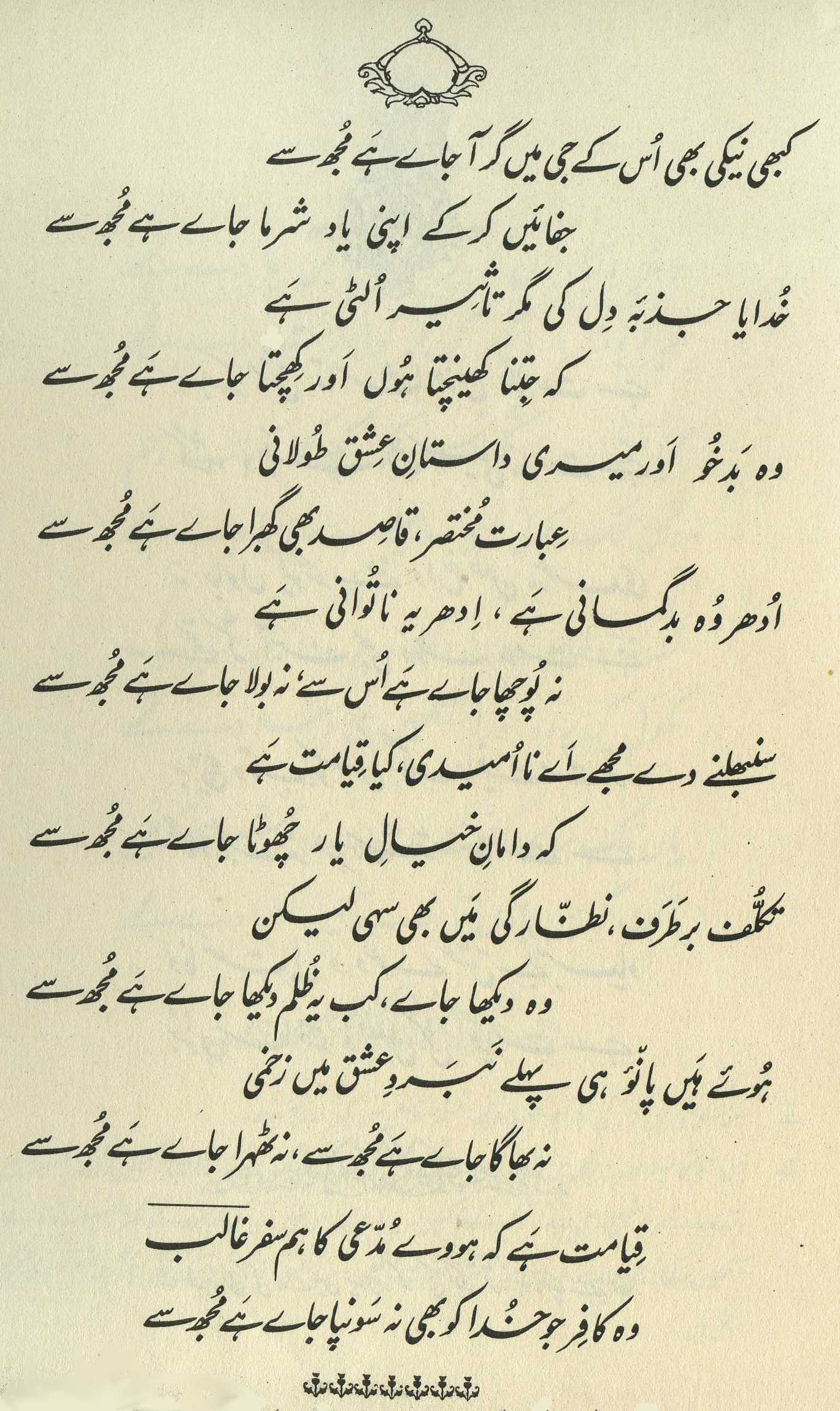
That is, from suspiciousness she considers my claim of love to be false, so that she doesn't ask about it. And I, in my love, am unable/powerless, so that I cannot speak to her. Through the similarity of the structure and the comparability of the words, he has created much beauty in the verse. (231)
== Nazm page 231

He says, she is so suspicious toward me that in no way is she convinced of my love: when I tell it to her, she says 'you're a liar'. And I have become unable/powerless to such an extent that I can't even present a proof of my claim. In a state of suspiciousness, why would she ask me about my condition; and in the state of inability/powerlessness, how would I be able to recount my difficulties to her in detail? The supreme excellence of the expression cannot be sufficiently praised. (289)
Because of the lover's grief, and the prolongation of separation, his condition has become so weak that it's difficult for him to speak. In such a state the beloved has come. He, because of inability/powerlessness, is silent; the beloved, because of suspiciousness, is silent. The lover says in his heart, 'Alas, what can I do-- my tongue doesn't move, and the beloved is thinking that I no longer care about her, and that's why I don't speak'. He's shown an extraordinary situation. (409-10)
As Nazm observes, the extreme parallelism of structure is a real charm in this verse; it is highlighted by the strong internal rhyme in the first line. The lover and the beloved are not even identified: it's 'over that way' and 'over this way' in the first line, and 'by that one' and 'by me' in the second line. The beloved and the lover are thus balanced like bookends: similar, repeatedly juxtaposed-- yet for that very reason eternally unable to come together. There's no similarity without difference, no comparison without contrast; our minds bounce around among the (im)possibilities.
But what is it that isn't, or even cannot be, asked by the beloved? And what is it that isn't, or even cannot be, spoken by the lover? The commentators generally arrange a particular little scene between the non-asker and the non-replier. But in fact the possibilities are wide open. For can have a whole range of meanings other than a suspicion of neglect: it can refer to a generalized negative 'suspicion' of any kind, or even to 'pride' or 'haughtiness' itself, with no particular thought-content (see the definition above). And the idea of 'asking' needn't even refer to a serious question put to the lover; it can also refer to a polite inquiry about someone's well-being or health, as in 71,9 .
Similarly, the lover's inability to speak may refer not merely to an inability to answer some one particular (non-asked) question because of physical weakness, but also to a more broadly-described state: the lover may be inhibited or rendered 'unable' or 'powerless' by respect, shame, strong emotion, general tongue-tiedness, the presence of other observers, etc. Compare the lover's complexly-motivated inability to communicate in 115,7 .
Note for grammar fans: The colloquial use of the passive in the second line, which is called the 'passive of impossibility', is also worth noting. Literally, the meaning is just declarative: '[something] is not asked by that one; [something] is not spoken by me'. But colloquially, the sense is that of a very strong impossibility: 'X is not done by me' means 'I absolutely cannot and will not do X', or 'X is just not going to happen'. Other such examples in this ghazal, for which the rhyme is very conducive: 205,6 , 205,7 , and 205,8 ; it forms a chief charm of these verses. The 'passive of impossibility' is very often made from non- verbs; this versatility too serves to set it apart in its special idiomaticness.
When I first traveled in India, one of my worst problems was an inability to convince generous hosts that I was not being coy or polite-- I truly, absolutely, positively, did not want, and could not eat, any more food. My Hindi teacher advised me to say politely but firmly, . That often did the trick, and taught me to value the 'passive of impossibility'. (Since then, however, I've learned an even better formula, which you may someday be grateful for, dear reader: , if accompanied by a sickly and ominous expression, works infallibly.)
graphics/zippedlips.jpg
graphics/zippedlips2.jpg