Verse 7after 1821aajaa))e hai mujh se
G2
1
only/emphatically the feet have initially/first become, in the battle of passion, wounded
2
neither can fleeing be done by me, nor can remaining be done by me
is an archaic form of ( GRAMMAR )
| References | |
|---|---|
| Arshi, Imtiyaz Ali | Ghazal# 189 |
| Raza, Kalidas Gupta | 362-63 |
| Hamid Ali Khan | Open Image |
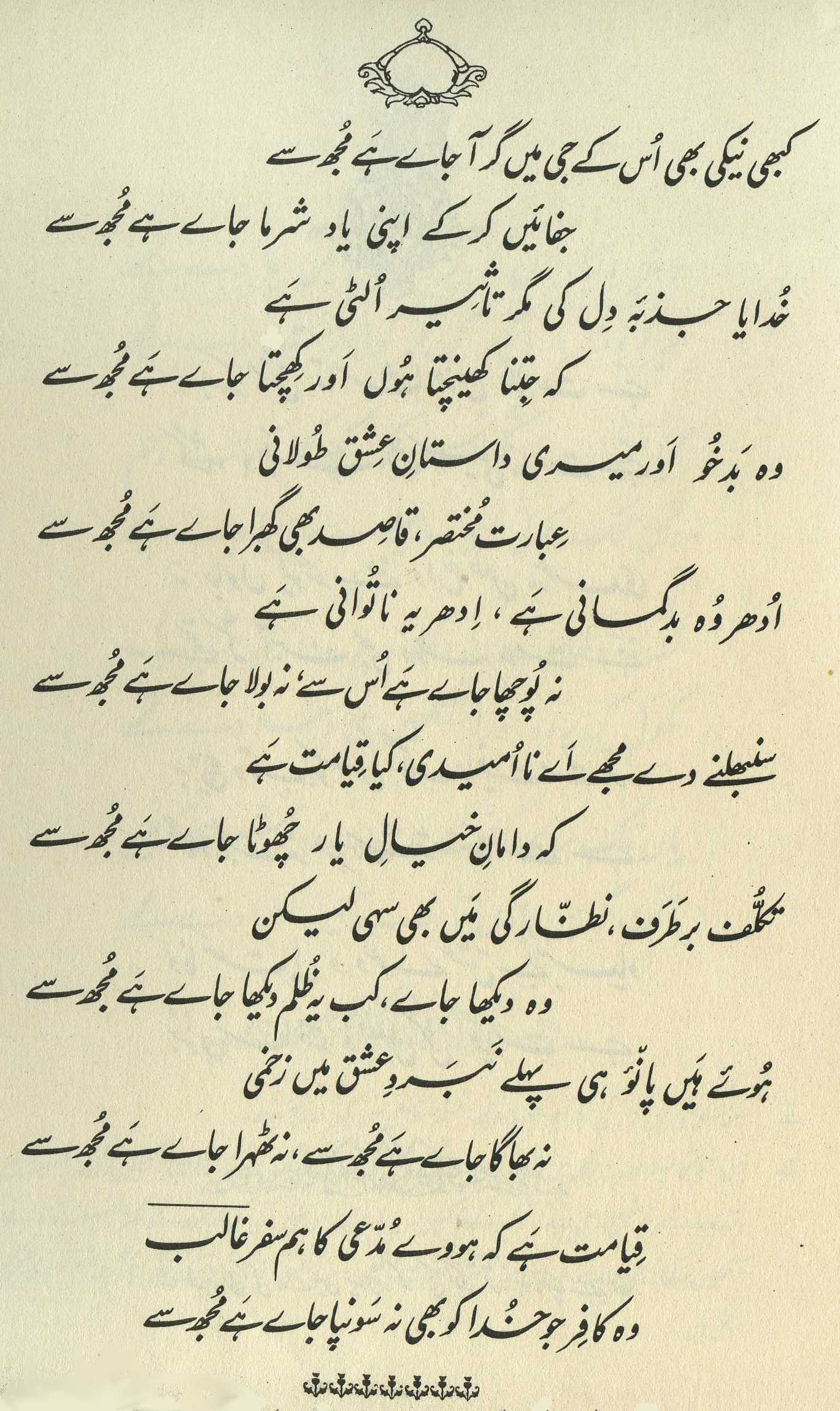
In this a creative image of a mood , with its emotions, has been given. The meaning is that the pair of feet, through the power of which passion could be abandoned or its severities could be borne, experienced an assault in the beginning of passion. Thus now neither can I abandon passion nor can I bear it with endurance and fortitude.
==Urdu text: Yadgar-e Ghalib , p. 162
The battle is so fierce that it's difficult to remain, and the feet are so wounded that it's hard to flee. (232)
== Nazm page 232

He shows two opposite moods of love: that the captivity of the heart is a thing so pleasurable, and the heart becomes so helpless for the sake of it, that to renounce love becomes impossible. And the suffering is such that it's impossible to bear it. (410)
Compare 152,3 . (261)
On the grammar of the second line, with its two parallel 'passive of impossibility' structures, see 205,4 .
This isn't quite what I call a 'Catch-22' verse, since it doesn't have that elegantly circular quality (you can only escape flying bombing missions if you're insane; but wanting to escape proves that you're sane). Here the problem is brutally simple, more of a worst-of-both-worlds kind: one primal problem, the wounded feet, removes all options both prudent and heroic.
The enjoyableness of the verse lies first in the excellent setup of the first line. The speaker seems to be reporting to us that in the early stages of the 'battle' of passion, only, or chiefly, his feet were wounded. This leads our imaginations off in several directions. Why were his feet wounded, and (almost) no other part of his body? Why were his feet wounded so particularly early in the battle that he felt inclined to tell us about it? How exactly did the feet come to be wounded? Are we going to be in thorns-and-blisters territory somehow? We're looking forward to hearing more about any or all of these questions in the second line.
Then of course the second line is totally uninterested in the feet, except as a non-functioning means to either of two impossible ends. The poor lover apparently lies collapsed on the ground, helplessly prey to the enemy, unable not only to flee but even to make a heroic last stand. While he waits to be captured or killed, all he can do is report on his predicament-- but in what tone? Ruefully? With self-mocking humor? Despairingly? With flat matter-of-factness? With a kind of vexed frustration? The tone will make the mood of the verse, and as usual we're left to decide on it for ourselves.
As Arshi suggests, 152,3 is indeed a good verse for comparison. To me it seems to have a sort of tongue-in-cheek, humorous effect. The present verse might also have such a tone-- but then again, it might not.
graphics/battle.jpg