Verse 8after 1821aajaa))e hai mujh se
G2
1
it's a disaster/Doomsday, that she would be the fellow-traveler of an enemy/conniver, Ghalib--
2
that infidel whom I cannot confide even to the Lord
is an archaic form of the subjunctive ( GRAMMAR )
'A claimant, suitor; plaintiff (in a law-suit), complainant, prosecutor, accuser; —an enemy; —(in Pers.) a pretender, pretentious man; a boaster'.
'To deliver over, to hand or make over, to consign, give, intrust (to), deposit (with); to give in charge, to commit; to give up, resign, surrender, cede'.
is an archaic form of ( GRAMMAR )
| References | |
|---|---|
| Arshi, Imtiyaz Ali | Ghazal# 189 |
| Raza, Kalidas Gupta | 362-63 |
| Hamid Ali Khan | Open Image |
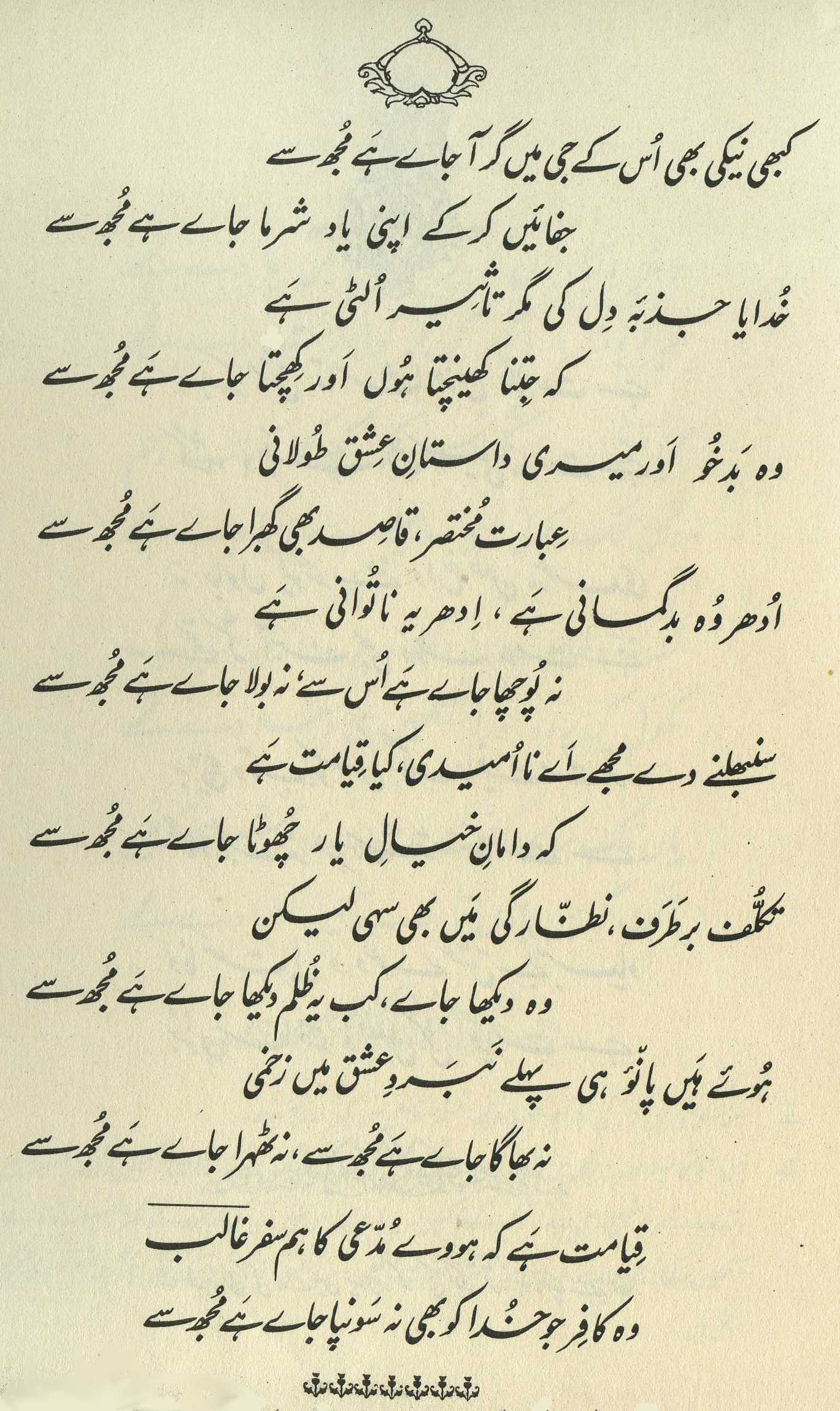
[Ghalib echoes the second line of this verse in a Persian letter, undated, to Muzaffar Husain Khan: 'my mistress [], whom, out of jealousy, at the time of departure I wasn't able to confide even to the Lord...'
== another trans.: Russell and Islam , p. 43
== another trans.: 139,1
That infidel to whom, at the time of parting, because of jealousy the words 'I confide you to the Lord' don't emerge from my lips-- what a Doomsday it is that she is the fellow-traveller of an enemy! In this verse, where the author has said , he ought to have said , or else he ought to have omitted . [He goes on to discuss this point.] (232)
== Nazm page 232

He says, it's a thing of Doomsday/disaster that when taking leave of that infidel, I would say 'Go, I confide you to the Lord, may the Lord protect you [], I give you over to the care and refuge of the Lord'. For goodness sake []-- jealousy doesn't make this acceptable. So just look at this tyranny, that she would be the fellow-traveler of an enemy! (290)
The beloved is going on a journey with the Rival . The lover slaps his head and says, 'Alas, that infidel (the beloved) at whose departure, through jealousy, even 'go, I confide you to the Lord' would not emerge from my lips-- that she would be the fellow-traveler of an enemy, it's a Doomsday/disaster! That is, what a calamity it is, and how great my helplessness. (411)
[See his discussion of Mir's M 480,4 .]
Formally speaking, the verb in the second line presents a 'passive of impossibility'; for discussion, see 205,4 . I've translated it a little freely, because 'of whom the confiding even to the Lord is not done by me' is too awkward even for me.
The first line sets us up to expect something more about the dire situation of someone-- presumably the beloved-- who is becoming a fellow-traveler of an 'enemy' or a 'conniver', a , literally someone with a 'purpose'. What is he up to, what devious plans is he making? How will the beloved cope with him? What disasters are to be feared? We wait with curiosity for the second line; and of course, under mushairah performance conditions, our wait is as long as can conveniently be managed.
Then in the second line the focus, and the whole mood of the verse, changes entirely. For the lover isn't really interested in the 'enemy/conniver' at all, he's obsessed with the beloved. His desperate possessiveness and jealousy are such that when parting from her he can't even 'confide her to the Lord'. The elaborate forms of farewell enumerated by Bekhud Dihlavi were common in Ghalib's day; nowadays they've been mostly simplified down to the stylized , '[may] the Lord [be your] protector'. (The recent Pakistani tendency to replace this form of farewell with is beside the point, for our present purposes.) In English too, 'goodbye' is a contracted form of 'God be with ye', though most users of this farewell don't even know its origin.
Thus in true mushairah-verse style, the second line remains uninterpretable until the last possible moment, until we hear the rhyme -word . Then, in an abrupt rush of meaning, we realize that the focus is only, obsessively, on the beloved after all; that she's such an object of jealousy that she can't be confided even to the Lord; and, finally, that this means that the lover can't say-- literally can't pronounce the utterance-- 'goodbye' to her. What a powerful rush of meaning, mingled with a vivid sense of the lover's unbearably strong feeling! The verse suddenly jabs you in the heart. It reminds you of the intolerable, unacceptable losses and farewells in your own life-- the times when you just couldn't let go, and yet the loved one was taken from you.
There's also of course the clever deployment of religious imagery: 'Doomsday', and the beloved as an 'infidel' who is nevertheless to be confided to the care of 'the Lord'. But the real appeal of this verse is the mood, the sudden outburst of suffering and pathos generated by the end of the second line. Far from being at the center of the verse, the 'enemy/conniver' by the end seems almost irrelevant. In this verse, the beloved is of course not God; for more on such verses, see 20,3 .
graphics/travelers.jpg