Verse 3after 1821aajaa))e hai mujh se
G2
1
that one, bad-tempered; and my tale/romance of ardor, lengthy--
2
'[to make a long] story short', even/also the Messenger is nervous/perturbed because of me
'Speech; a word, an expression, a phrase; a passage (in a book or writing); an explanation, interpretation; a word, or an expression, or a phrase for, or denoting (such a thing); diction; style, mode of expression; the construction or structure of sentence, composition; a trope or figure'.
'To be confused, confounded, flurried, or flustered (by, or in consequence of, - ); to be perplexed, bewildered, or embarrassed (by); to be perturbed, disturbed in mind, agitated, disquieted, distracted; to be alarmed, scared, dismayed'.
is an archaic form of ( GRAMMAR )
| References | |
|---|---|
| Arshi, Imtiyaz Ali | Ghazal# 189 |
| Raza, Kalidas Gupta | 362-63 |
| Hamid Ali Khan | Open Image |
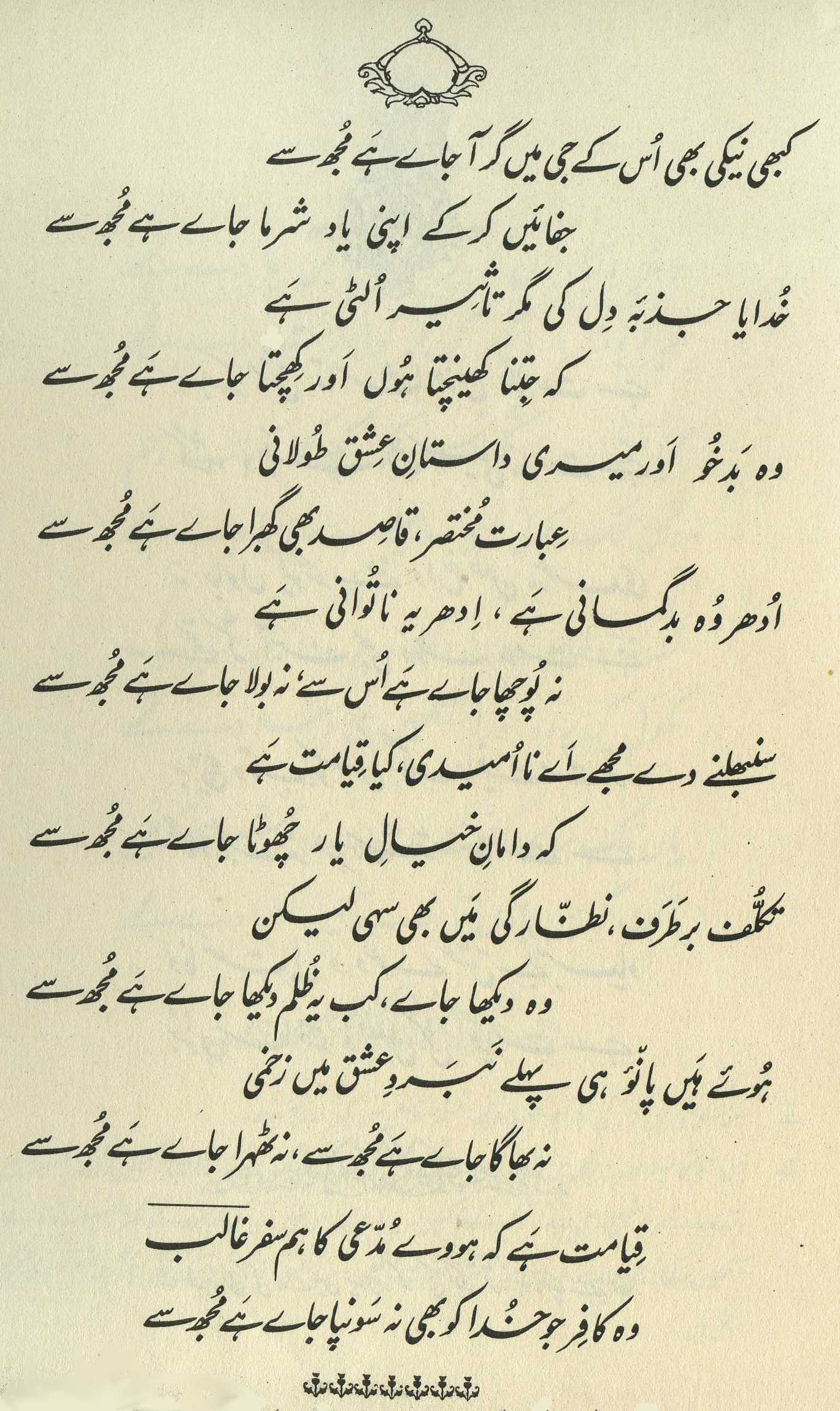
By 'that one' is meant the beloved. And they say and in place of 'the gist is' []. That is, when the Messenger becomes nervous, then what the hell []-- as if the bad-tempered beloved would ever listen to this tale! (231)
== Nazm page 231

He says, I have had to confront two difficulties. One is that that mischievous one is very bad-tempered and ill-natured. The other is that my tale of passion is so lengthy that it just won't in any way become finished. To make a long story short [], even/also the Messenger, listening and listening to my message, becomes nervous. So then, what the hell-- as if the bad-tempered beloved will ever consent to listen to such a long, rambling tale! (289)
The beloved is bad-tempered; and my narrative of passion, lengthy. To make a long story short [], when even/also the Messenger becomes nervous at my length of speech, then, obviously, why would that bad-tempered one start reading the letter? That is, I am compelled by my ardor: I can't stand not to write the whole situation. The beloved is bad-tempered. The gist is [], my life has fallen into an extraordinary difficulty. (409)
Some manuscripts, and some modern editions, have instead of in the first line. As always, I follow Arshi. See his discussion in his introduction, pp. 123-24.
Here's a verse that plays most cleverly and enjoyably with common expressions and literary genre names. Nazm presents both and as parallel forms of a petrified phrase very comparable to the English 'to make a long story short'. However, the latter form is far more common. Excellent evidence of its commonness can be found in the unselfconscious use of the phrase in the commentaries of both Bekhuds. Both of them use , and undoubtedly Ghalib meant for us to think of this form of the expression. We can be sure of this because of his use, in the first line, of .
Both and are names for a Persian and Urdu romance genre; for a detailed discussion see the introduction to ' The Romance Tradition in Urdu '. Sometimes the two names are used interchangeably, and sometimes refers particularly to longer narratives, pre-eminently (in Urdu) the 'Dastan of Amir Hamzah '. So a of passion might well be thought of as an almost interminable orally-narrated romance, full of 'battles and elegant gatherings, enchantments and trickery'. The name is already associated, invisibly but inevitably, with ; and through its idiom-play the verse links it also with , a word that calls attention to the literariness and rhetorical possibilities (see the definition above) through which the tale would be framed and told.
Why does the lover make the Messenger nervous (or embarrassed, or somehow otherwise upset, through the whole enjoyably complex range of )? Possibly because, as Bekhud Dihlavi suggests, the lover narrates his message orally, and insists on going on and on, so that the Messenger fidgets and grows impatient. Or of course, the Messenger may be thinking that if he himself is bored, how much more bored the ill-tempered recipient will be-- and how vigorously she'll wreak her displeasure on his hapless self ('Don't shoot the messenger!'). And the lover himself also realizes that the beloved will be vexed and impatient, so that he ought to curtail his tale of passion-- but he apparently can't. (Is he resigned to the situation? Despairing? Objectively reporting? Ruefully amused? As usual, we're left to decide for ourselves.)
The lover's problem of prolixity makes all the more amusing his use of 'to make a long story short' as he prepares to sum up his plight. For he does sum it up, evocatively and elegantly, in a single, piquant observation: that his behavior makes even the Messenger nervous (or makes the Messenger 'too' nervous, in another well-placed exploitation of ). The lover's problem is that he's unable to make his long story short-- but in the course of the second line, he does exactly that. He pithily expresses his inability to express things pithily. And we're luckily able to relish both his narrative tribulations and his sudden narrative success.
Here is Amir Hamzah 'disarming a Byzantine princess', from Akbar's famous Hamzah-namah album. Click on the image for an article that gives more background.
graphics/dastan.jpg