Verse 1after 1816aariihaa))e haa))e
G1
1
from my pain, you feel restlessness-- alas!
2
what became, cruel one, of your practice of heedlessness-- alas!
'Habit, custom, practice; method, manner'.
| References | |
|---|---|
| Arshi, Imtiyaz Ali | Ghazal# 136 |
| Raza, Kalidas Gupta | 297-98 |
| Nuskhah-e-Hamidiyah | 187-188 |
| Asi, Abdul Bari | 218 |
| Hamid Ali Khan | Open Image |
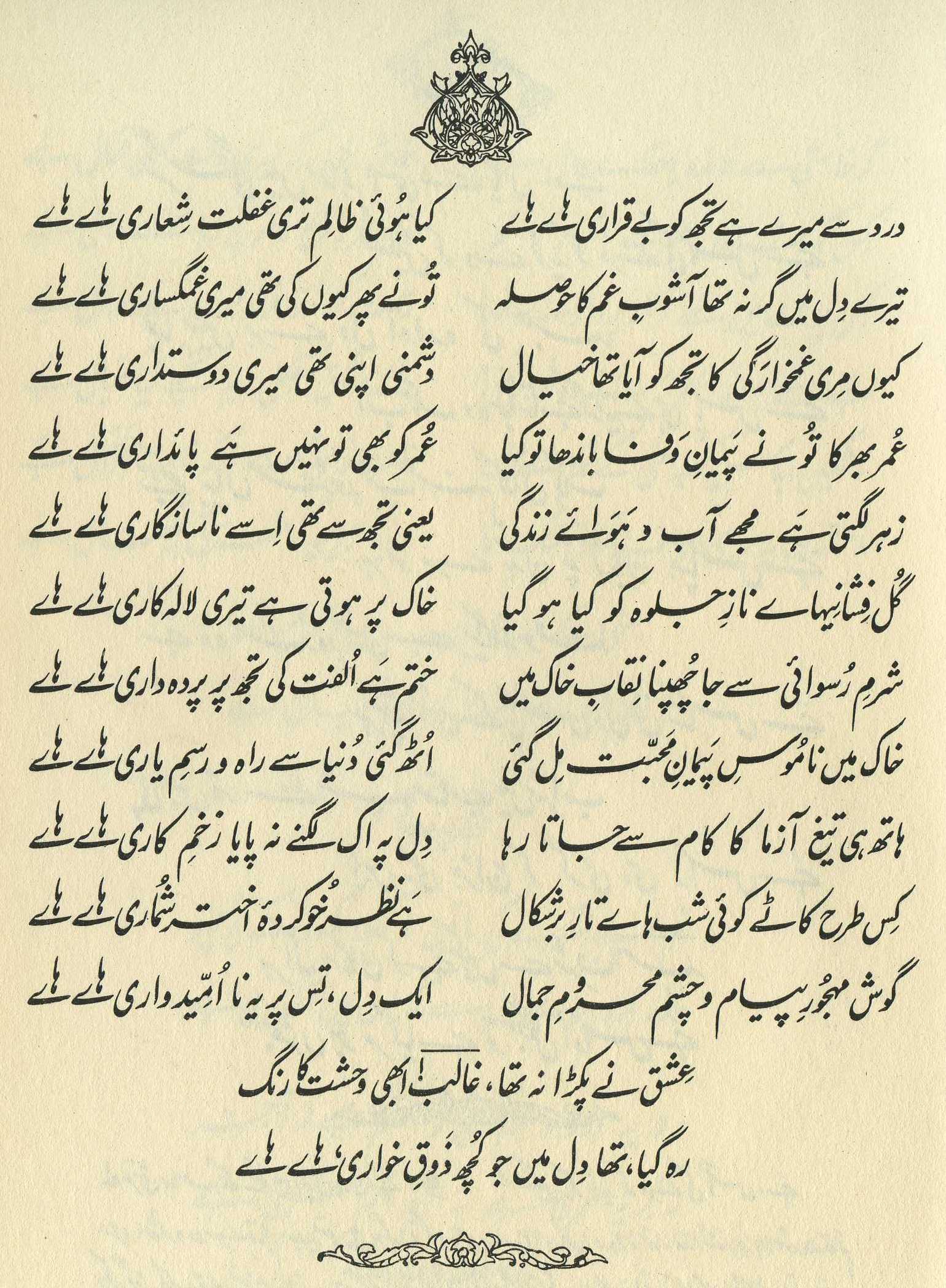
[Writing to Mihr in June 1860:]
Janab Mirza Sahib! Your saddening letter arrived. I read it. I got Yusuf Ali Khan 'Aziz' to read it. He told me about the relationship between the deceased lady and you. That is, her submissive-devotion [] and your love for her. I was severely grieved, and felt complete sorrow. Listen, my friend, among poets Firdausi , and among faqir s Hasan Basri, and among lovers Majnun -- these three men, in their three arts, are the heads and chiefs. The excellence of a poet is that he should become Firdausi. The limit for a faqir is that he should rival Hasan Basri. The token of a lover is that he should have a destiny like that of Majnun. Laila had died before his eyes. Your beloved died before your eyes-- or rather, you have gone beyond him, because Laila died in her own house, and your beloved died in your house.
My friend, we tavern-boys [] are a disaster-- the one whom we're dying for, we end up killing. I too am a tavern-boy. In my whole life I too have killed one very cruel dancing girl []. May the Lord have mercy on them both, and on you and me as well, who have suffered the wound of a friend’s death. This happened forty or forty-two years ago. Nowadays I've abandoned that path; I've become a mere stranger to that [lover's] art. But even now sometimes I remember those coquetries. In my whole life, I won't forget her death. I know what must be passing through your heart. Be patient, and now abandon the turmoil of worldly [] passion. A [Persian] verse:
'Sa'adi, if you would be a lover in your youth,
Love Muhammad, and the family of Muhammad.'
A small rhyming phrase: 'In God we trust, all else is lust' [].
(partial text: Arshi 258)
==Urdu text: * Khaliq Anjum, vol. 2, p. 723 *
==another trans.: Russell and Islam , pp. 248-49
==another trans.: Daud Rahbar , pp. 101-02
[Writing to Mihr in June 1860:] Mirza Sahib! I don't like all this. I'm sixty-five years old. For fifty years I've strolled around in the world of color and scent. In my early youth, an accomplished master [] gave me this advice: 'I don't seek asceticism and abstinence. I don't forbid immorality and licentiousness. Drink, eat, take your pleasure; but remember this: become a sugar-fly, not a honey-fly.' So my practice has been according to this advice. He who will not die himself is the one who should grieve for the death of another. What's this tear-shedding, whence this elegy -reciting? Give thanks for freedom! Don't grieve. And if you're happy with your captivity, then so what if there's no 'Chunna Jan'-- there's always a 'Munna Jan'! When I form a picture of Paradise, and reflect that if I am granted mercy, and am given a palace in Paradise and a Houri -- life in perpetuity, and with the very same excellent woman-- then this picture terrifies me, and my heart is in my mouth. Alas-- that Houri will grow tiresome! Why shouldn't I feel anxious? That same emerald palace, and that same branch of the Tuba tree; and-- may the evil eye be far from us!-- that same one Houri! Brother, come to your senses, and attach your heart somewhere else. A [Persian] verse: Take a new woman each returning spring, For last year's almanac's a useless thing. I saw your musaddas with the 'incorporation' [] of the verses of Mirza Maz'har. The thought is entirely pleasing; the expression, on the whole, is not pleasing. I handed over the letter you sent me, together with these verses, to Mirza Yusuf Ali Khan 'Aziz'.... [The rest of the letter is concerned with sending greetings and remarks to various people.] ==Urdu text: * Khaliq Anjum, vol. 2, pp. 721-22 * ==another trans.: Russell and Islam , pp. 248-49 (source of trans. of final verse) ==another trans.: Daud Rahbar , pp. 102-04
[A long undated Persian letter of the same kind.]
[Writing to Mihr in June 1860:] Mirza Sahib! I don't like all this. I'm sixty-five years old. For fifty years I've strolled around in the world of color and scent. In my early youth, an accomplished master [] gave me this advice: 'I don't seek asceticism and abstinence. I don't forbid immorality and licentiousness. Drink, eat, take your pleasure; but remember this: become a sugar-fly, not a honey-fly.' So my practice has been according to this advice. He who will not die himself is the one who should grieve for the death of another. What's this tear-shedding, whence this elegy -reciting? Give thanks for freedom! Don't grieve. And if you're happy with your captivity, then so what if there's no 'Chunna Jan'-- there's always a 'Munna Jan'! When I form a picture of Paradise, and reflect that if I am granted mercy, and am given a palace in Paradise and a Houri -- life in perpetuity, and with the very same excellent woman-- then this picture terrifies me, and my heart is in my mouth. Alas-- that Houri will grow tiresome! Why shouldn't I feel anxious? That same emerald palace, and that same branch of the Tuba tree; and-- may the evil eye be far from us!-- that same one Houri! Brother, come to your senses, and attach your heart somewhere else. A [Persian] verse: Take a new woman each returning spring, For last year's almanac's a useless thing. I saw your musaddas with the 'incorporation' [] of the verses of Mirza Maz'har. The thought is entirely pleasing; the expression, on the whole, is not pleasing. I handed over the letter you sent me, together with these verses, to Mirza Yusuf Ali Khan 'Aziz'.... [The rest of the letter is concerned with sending greetings and remarks to various people.] ==Urdu text: * Khaliq Anjum, vol. 2, pp. 721-22 * ==another trans.: Russell and Islam , pp. 248-49 (source of trans. of final verse) ==another trans.: Daud Rahbar , pp. 102-04
[A long undated Persian letter of the same kind.]
[Ghalib's inconsistent claims about his alleged long-ago Persian Ustad .]
This whole ghazal is an elegy for a beloved. In this verse, the meaning is that the sympathy I feel when I see you dying-- even in this state, you don't wish to see me endure grief, and you are becoming restless. Where are those days when we used to die, and you didn't even inquire about us! (148)
== Nazm page 148

This whole ghazal is a verse-set and an elegy for a beloved. Seeing her dying, he says, seeing you in this state I feel sympathetic; now you, even in this state, don't like my grief and sorrow, and from my writhing [in pain] you yourself are becoming restless. What has happened to your practice of heedlessness, when I sacrificed my life, and you didn't even inquire about me? (205)
The whole ghazal is addressed to a beloved. Alas, you are restless at my being sorrowful. What happened to your former heedlessness? If only you had remained careless toward me. Alas, from my anxiety you are becoming restless, and I can't bear to see this state. (271)
This whole ghazal is drowned in burning and melting, and a number of its verses seem to be of lamentation. He has written an elegy on the death of some beloved. (351-52)
All the commentators are in agreement that this ghazal is an elegy for a beloved. Every verse is drowned in burning and melting, because every verse is a mirror-holder of the emotions of separation. This is the reason why no verse is difficult. (234)
This whole ghazal of mourning is an elegy for some beloved. From various verses it seems that most of the verses are presenting the situation of the time when the beloved was dying. (469-70)
Well, here comes the second (and last) ghazal in the whole divan that can be argued to be personal-- that can be claimed to describe the real death of a beloved, and thus to be a counterpart to 66 with its poignant grief over the death of Arif. Arshi explicitly footnotes to this present ghazal part of Ghalib's first letter excerpted above; Russell and Islam assert, referring to the present ('post-1816') ghazal, 'A moving poem written at the time she died is included in his collected verse' (42); they then offer excerpts from the particularly ornate Persian letter presented as the third letter above. This letter too, like the two Urdu ones, was written much later in Ghalib's life (since in it he speaks of a former youthful time when his hair was black); it was also, like them, written under a particular set of circumstances (to console a grief-stricken friend for the death of a beloved). This Persian letter combines the elements of both the Urdu letters: its account begins with a vague and stylized depiction of grief at the death of a beautiful beloved, then continues to an elegantly argued conclusion that one ought not to show excessive loyalty to 'a dead body'.
As far as I'm aware (and I'd be delighted to learn of any other evidence!), these three letters, juxtaposed by commentators to this ghazal, are the SUM TOTAL of what we know about Ghalib's presumed (and otherwise entirely Bollywood-imagined) early love affair.
So let's especially consider the two Urdu letters, since they can be dated and are also more specific and less ostentatiously literary. Ghalib wrote them both in the same year, to the same friend, and to address the same situation: his friend's grief over the death of a beloved. It's not clear in which order they were written, since only one is dated by month; Russell and Islam present them in the order given above, Khaliq Anjum gives them in reverse order. The beginning of the first letter sounds more as if fresh news has been received, which is why I've used this order. The second letter has a good deal of wittily rhymed prose, with the playfulness increasing as the letter goes on; Russell and Islam have taken some clever liberties to capture something of the effect, but I have stuck to literalness as usual. (Though I was sorely tempted by their concluding sentence: 'Come to your senses, brother, and get yourself another'.) I did borrow their enjoyable translation of the final Persian verse.
It's surely clear from these two letters-- so close together, so apposite, and so opposite-- that Ghalib's chief purpose was to overcome his friend's melancholy at all costs. Let's call the one I've given first the 'been-there' letter, and the one I've given second the 'not-been-there' letter. Both letters have similar possibilities as potential bits of real autobiography. In the been-there one, he invokes an unidentified long-ago ('forty or forty-two years ago') beloved; in the not-been-there one, an unidentified long-ago (possibly fifty years ago, if we can tell at all) 'accomplished master' who apparently saved him from the 'been-there' fate. But the two letters are not nowadays given equal attention or credence. Because of the tremendous appeal of 'natural poetry' to Urdu critics over the past century, nobody pays much attention to the contents of the letter that seems to deny that Ghalib ever suffered over a real-life beloved; everybody is fascinated by the been-there one. Romantics and natural-poetry fans want to believe, because of the been-there letter, that this ghazal at least (if not most of the others) is 'real', 'natural', based on personal biography.
So great is the general eagerness to make this connection that nobody notices a striking implausibility right in the heart of the been-there letter: the fair cruel Domni reportedly dies not from some disease, or poison, or even a casual all-purpose fever, but only out of love for Ghalib himself. Since the been-there letter reports that he was dying of love for her too, the plot looks a bit peculiar. Even unrequited love is not all that common as a cause of death, but we could cut him some slack along those lines; this is the ghazal world, after all. But when was the last time we heard of a madly-loved beloved dying of requited love? If she were an aristocratic lady in pardah, we might even grant her the possibility of dying from the shame and disgrace of a Forbidden Love; but remember she's explicitly a 'Domni', a low-caste professional dancing-girl. Furthermore, she's habitually cruel/tyrannical [], so how does this square with the claim that she died of love?
Oh come on-- the natural-poetry defenders will say-- he's just speaking metaphorically: she must have died of a fever or something; and this being the ghazal world, he prefers to say that she died for love of him, or even that his love killed her, since that's so much more romantic; and he calls her 'cruel' as a stock epithet too. But then, I reply, if he's poetically and literarily reframing the whole incident (since their love and her dying of it are the whole incident, as he reports it), what makes us so sure he stopped there? Might he not have gone a bit further and simply invented the whole vague little anecdote, placing it safely out of reach many decades earlier, in order to comfort his friend with a show of solidarity? After all, we don't easily assume that he really had a long-ago 'accomplished master' who taught him some suspiciously convenient rules of life, as he claims in the not-been-there letter.
And while we're on the subject of Ghalib's inventions, he also equipped himself, in other letters, with a convenient even-longer-ago Persian Ustad who very possibly never existed (see Hali's account linked above); he also radically mis-described the amount of his own early poetry retained in his own published divan (on this see 155,3 ). Why then should we take it for granted, in this one case, that he really had one particular real-life fair cruel Domni who died of love for him?
Then the natural-poetry advocates will triumphantly say, all right, then how do you explain this ghazal, with all its burning-and-meltingness [] and elegiac-ness? It's so different from his usual style-- as Chishti points out, in it 'no verse is difficult'. Doesn't that show its sincerity, its naturalness, its true-to-life grief, etc.?
To some extent, such an argument makes a valid point: in the context of the divan , this ghazal does require some special explanation. Chishti is right-- no verse in it is difficult. Nor is any verse very interesting, or memorable in itself, or of much literary merit. If this were how Ghalib normally composed his ghazals, I would never bother to study his poetry; and neither, dear reader, would you. Let me vent my feelings further: I also dislike the refrain -- I think it sounds silly and faux-naïf . Fortunately for us all (and for Ghalib's reputation), this ghazal is unique in the divan.
Still, that doesn't answer the 'natural-poetry' question: how did Ghalib come to write such a plain and un-Ghalibian ghazal, if not because a fair cruel Domni actually died of love for him and unhinged his usual poetic practices? My own view is that for some now-unknowable reason, he consciously decided to try his hand at the elegy genre. An elegy can definitely be written in ghazal form (see , pp. 140-42), and can be composed for anybody (including even a vague or hypothetical anybody), not just for the martyrs of Karbala.
This particular elegy-ghazal is so conspicuously a unified whole, with so consistent a mood and theme, that it's surely asking to be read and enjoyed as such. Since the poet didn't adorn it with the literary devices and verbal complexities of which he was such a master, he must surely have felt that it had other merits and offered other kinds of enjoyment: it moves fast, it evokes its own mood, it has a kind of understated, semi-implicit narrativity, it creates the exquisite melancholy (shades of Poe's ' Annabel Lee' !) of the death of a beautiful young (and loving) woman.
But its stylization and abstractness are like an impenetrable shield, denying us any sense of any actual person it might have been about. To contrast this ghazal with a genuine lament, one that passionately mourns the loss of a real person, we need only turn to 66 , the lament over Arif's death. That one is powerful and raw, though also sophisticated in its craft; it's simple and poignant, but the very reverse of bland and vague. It cuts like a knife; it can surely bring tears to your eyes. It's hard to imagine that this one can do the same. Did this one receive its original impetus from some beautiful beloved's death? Maybe so, or maybe not; given the paucity of information we have available, who can possibly know? And really, what difference does it make? No matter who or what inspired it, this one feels like a stylized, generic exercise. It's worth remembering that the link between this elegy-ghazal from the early 1820's, and the been-there letter from almost forty years later, is made only by later critics, not by Ghalib himself. (And in the undated Persian letter, the stylization of the description of grief and loss is even more conspicuous, making the letter so vague that it's biographically just about useless.)
In any case, the commentators all read the ghazal as a unified elegy. Bekhud Dihlavi refers to it explicitly as a ' verse-set ', as does Nazm in 139,13x . Some of them are convinced that the beloved has killed herself (or simply died) out of shame and the fear of disgrace, because of her true passion for her lover. Others are merely sure that she's dying or dead. Nothing in the present verse suggests that the beloved is on her deathbed; yet the commentators generally put her there. (We know from the verse that she's sympathetically 'restless', but we have no reason to believe that she's dying.) The commentators treat the other verses similarly. Reading this ghazal as a unified elegy puts it into a legitimately different generic category from the rest of the ghazals in the divan. It means that an apples-and-oranges defense can be used to shield it from comparison to his real ghazals.
When Mir steps out of the real ghazal world (to make a petulant religious complaint), he too creates markedly inferior verses: see M 344,5 . And he too ventures to try a refrain of (though never the redoubled ): see M 1010 .
http://www.flickr.com/photos/jenanq8/403858513/in/set-72157594554453119/ graphics/lostheart.jpg