Verse 31821aabhai
G3
1
it's become wounded, the heel of the 'foot of stability'
2
there is neither the chance to flee, nor the strength/endurance to stand
The spelling is used for to make the syllable flexible so it can be scanned long, since in its normal spelling is always short.
'Permance, stability, endurance; constancy, firmness, steadiness, steadfastness; fixedness; resolution, determination'.
'Opportunity, advantage, occasion'.
| References | |
|---|---|
| Arshi, Imtiyaz Ali | Ghazal# 140 |
| Raza, Kalidas Gupta | 344 |
| Nuskhah-e-Hamidiyah | 193-194 |
| Hamid Ali Khan | Open Image |
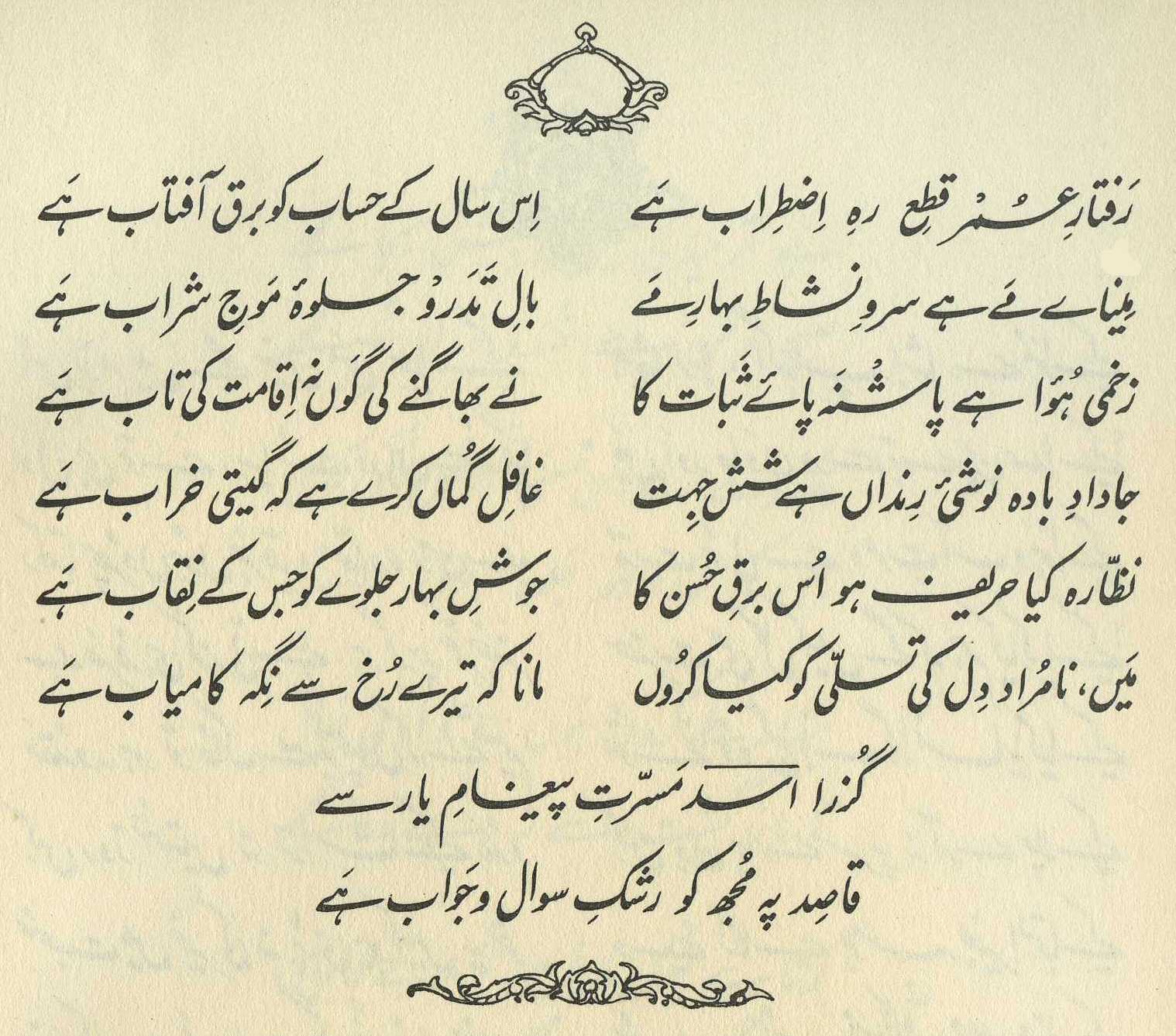
That is, while on the road, it came about that he injured his heel. In this verse the word is showing its freshness . (163)
== Nazm page 163

He says, the heel of the 'foot of stability' having been wounded, the difficulty has developed that now neither can I flee from the field of passion, nor can I stand. (219)
That is, his life has fallen into a great disaster. The difficulties of passion are so harsh that it is hard to bear them, and the captivity is so harsh that it's difficult to flee with one's life: 205,7 . It is a picture of different mood s. That is, the captivatingness of passion and the pain of love. (293)
Compare 205,7 . (261)
ABOUT 'FOOT OF' EXPRESSIONS: In the Indo-Persian literary culture, feet are tremendously inviting entities (as are heads and hands, for that matter), and are apt to give rise to fancy phrases. Here are just a couple of examples that happen to be at hand (so to speak). Abu'l Fazl says of the downfall of Baz Bahadur of Malwa, 'His foot was slippery from the wine of insouciance and could not convey him swiftly on the highway of obedience and service'; Aurangzeb speaks in a letter of 'placing the foot of fortune in the stirrup of victory'. I don't have any examples of the 'foot of stability' at the moment, but I'm sure there must be some. For a 'foot of speech', see 91,2 . In 321x,2 , Ghalib creates a both a 'foot of desire' and a 'hand of opposition'. In 321x,7 and 440x,3 , there's a 'foot of the gaze'. (There are also feet that have 'gone to sleep' in 194,7x , but that usage feels more directly physical.)
The point is that when in the ghazal world we see a phrase like 'foot of stability' we expect it to be an ornate, rhetorical, Persianized, -inflected sort of foot, possibly even part of a phrase of formal rhymed prose. We expect it, in short, to be a metaphor . We certainly don't expect it to be a real physical foot, with a sore heel! So the peculiar, slightly plaintive tone of the first line is enjoyable in itself. And of course it leaves us totally at a loss to guess where the verse might be going. Compare Mir 's use of the 'foot of seeking': M 441,7 . Along similar lines, compare the 'mirror of judgment' in 171,4x ; the 'knot' imagery discussed in 8,2 ; the 'road of speech' in 214,1 ; the 'road of inquiry' in 214,5 ; the 'thorn of searching' in 329x,2 .
The commentators capture the meaning all right, but they don't even try to describe the enjoyableness of this amusing little verse.
For in the second line, we discover how cleverly Ghalib has meshed all the literal and idiomatic gears. If a real, physical heel is badly wounded, naturally its owner can't run, and very possibly he can't even stand up, or 'make a stand' in any sense-- he's more or less 'hamstrung'. While if the metaphorical 'foot of stability' is wounded in its metaphorical heel, what will be affected is its firmness on the (metaphorical) ground. The owner of this metaphorical foot will lose his 'steadfastness', his courage and determination. He might wish to run away-- but he wouldn't have the resolve and energy to actually do it. He might half-heartedly try to remain at his post-- but he wouldn't have the will to 'stand fast'. So he'd be metaphorically or morally hamstrung, and fully as useless as his real-world counterpart with the sore heel.
Who else but Ghalib can amuse us in two ways at once, by superimposing two such visions of haplessness and incompetence? Two visions, physical and metaphorical-- and our minds keep going back and forth between them, and vehicles and tenors and other metaphorical apparatus crowd both lanes of the road.
For discussion of the unusual word , praised by Nazm for its 'freshness', see 100,5 .
Compare 205,7 -- the second lines are so similar, but that one has a more active and resonant first line.
graphics/heel.jpg