Verse 71821aabhai
G3
1
Asad , I passed through/beyond/over the joy of a message from/to the beloved
2
I feel envy/jealousy of the Messenger over the question-and-answer
is a variant spelling of .
'To pass, go, elapse; to come to pass, to happen, to befall; to pass (by or over, ); to pass (through, , or ); to pass (before, or under, or in review, ), to be put or laid (before, ), be presented; to pass (over, ), to overlook, to omit; to abstain (from), desist (from); to decline; --to pass (beyond), to surpass; to pass away, to die'.
| References | |
|---|---|
| Arshi, Imtiyaz Ali | Ghazal# 140 |
| Raza, Kalidas Gupta | 344 |
| Nuskhah-e-Hamidiyah | 193-194 |
| Hamid Ali Khan | Open Image |
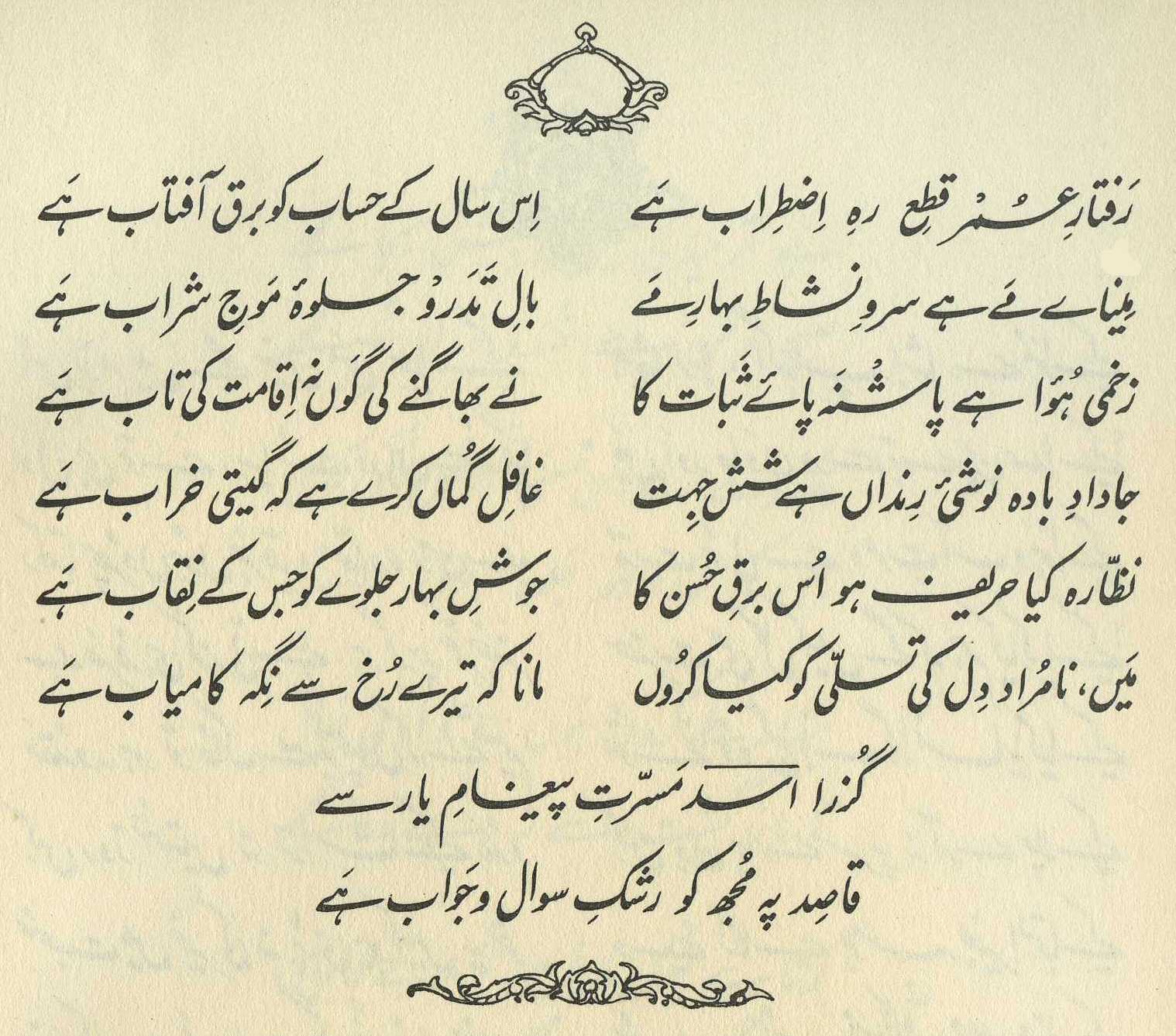
That is, oh Asad, I dispense with the happiness of the beloved's message; I feel envy/jealousy that the Messenger will go and speak with her. (164)
== Nazm page 164

He says, 'Oh Asad, what would I want with the joy and happiness of a message from the beloved? This envy/jealousy slays me, that if I send a Messenger, then the Messenger will go and speak to her, he'll converse with her, and I can't by any means approve of this.' (219-20)
Alas, that happiness just isn't in my destiny! Now the Messenger has come, bearing a letter. And this envy/jealousy slays me, that he must have conversed with the beloved. (295)
The different possibilities of (see the definition above) yield several possible readings:
=The speaker has now given up sending messages to the beloved, because of his increasing envy/jealousy of the Messenger.
=The speaker sends messages to the beloved, but they give him no pleasure because of his envy/jealousy of the Messenger.
=The speaker gets no pleasure when the beloved sends him a message, because of his envy/jealousy of the Messenger.
For similarly complex uses of , see 196,5 and 208,8 .
Are the messages written, as the commentators assume, or might they be oral? If they're written, then the contrast is between the dry, second-hand limitations of words on a page, and the lively immediacy of conversation-- even if the latter is only in the form of businesslike arrangements about the sending and receiving of letters. If the messages are oral, which seems equally possible from the wording of the verse, then the piquant contrast is between the one-way message, 'X says Y', and the liveliness of dialogue, or in fact literally of 'question and answer'.
Or is it that the beloved's messages to the lover are so brief, or so hostile, that even a businesslike 'question and answer' exchange, such as the Messenger has, would be more desirable? Or is it that his passion has reached such a state of wild excess that he's begun to be (self-defeatingly) envious/jealous of every form of access to her by everybody? (Along these lines, see 99,2 , or the even more extreme case of 153,1 .) Or does he feel convinced that that particular Messenger has actually fallen in love with her himself?
Obviously, we can't tell; we're trapped in a maze of variant possible readings of . Plainly, Ghalib has so arranged the verse that nothing is plain. (For more on the complexities of , see 53,4 .)
graphics/letterholder.jpg