Verse 1after 1821aajaa))e hai
G1
1
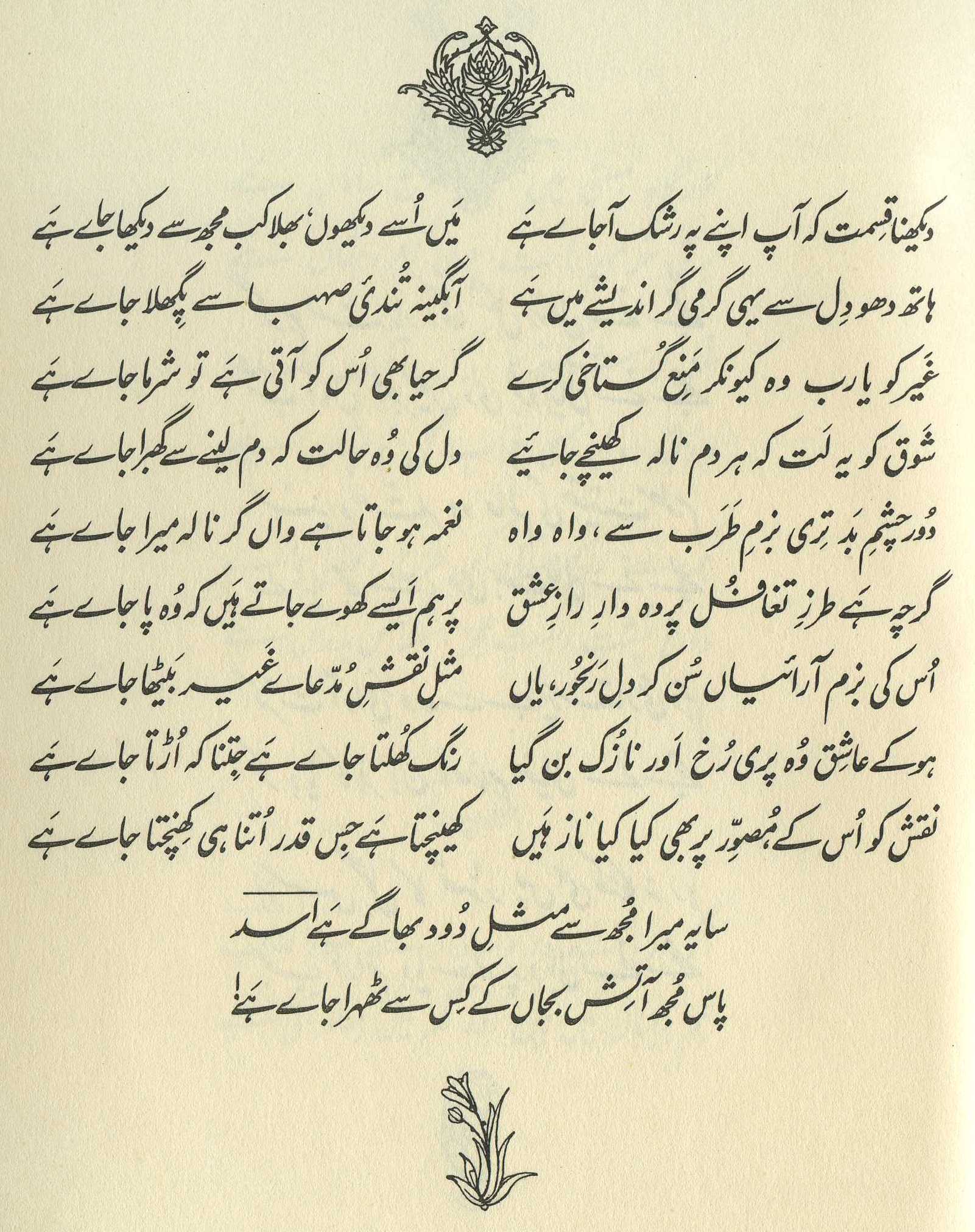
look at fate/destiny-- that I myself am jealous of myself!
2
that I would look at her? for goodness sake-- how/'when' is that endured/'looked upon' by me?!
is an archaic form of ( GRAMMAR )
| References | |
|---|---|
| Arshi, Imtiyaz Ali | Ghazal# 184 |
| Raza, Kalidas Gupta | 360-61 |
| Hamid Ali Khan | Open Image |
Compare 60,1 . (56)
The limit of jealousy is to keep even oneself deprived, just as the limit of miserliness is that the miser keeps even himself deprived. The author's supposition is accurate, because jealousy too is a form of miserliness. (164)
== Nazm page 164

He says, 'Look at my ill-fortune, that I am jealous of myself.' The limit of love is that in love suspicion would arise, and the limit of suspicion is that a man would be jealous of the prospect of success even for himself. In a state of jealousy, how can he stand to behold this? The meaning is that the limit of love keeps love itself deprived of success. (220)
The limit of jealousy can be recognized in that it doesn't enjoy even its own success. The way the limit of miserliness is that the miser himself doesn't make use of his own wealth-- not to speak of others' doing so. Alas for my ill-fortune, that when the beloved came near me, and the time came that there might be fulfillment of a lifetime's longing, jealousy became a mortal disaster. My heart can't endure that even I myself would see her. (295)
Compare 205,6 . (286, 294)
There's a sort of paradox at the heart of the verse, or rather what I call a 'catch-22': the lover desperately longs for something, but he also can't bear the idea of getting it. It's a very Ghalibian notion: the verses suggested by Nazm and Arshi are indeed close parallels.
What the commentators don't even deign to mention is the extremely conspicuous wordplay involving . The verb is used in three different senses within the two lines: as a neutral-imperative injunction to some listener to pay attention ('Just look at the workings of fate!'); as a proposed action ('That I would see her'); and, idiomatically, to express unendurableness ('How could I stand to see that?!', 'How could I look upon that?!'); does duty for both 'to look' and 'to see'). This third, exclamatory sense is at the heart of the verse. Its grammatical form is a passive present habitual-- literally, 'When is that looked upon by me?!'-- that idiomatically acts as a strong and absolute form of rejection.
Even more strikingly, Ghalib has included these three permutations of one verb in a way that feels completely unforced. The tone of the verse is in fact that of a lively, colloquial exclamation; the structure is so fluent as to be almost transparent, and the energetic emotion is what comes through. We notice at once that lover is exasperated, frustrated; we only later realize that he's using three forms to express it.
He seems to ascribe the whole conundrum to 'fate, destiny, fortune' []. The commentators tend to interpret this as 'ill-fortune', but that's to narrow it down unduly. He really seems to be wryly marveling at his own destiny, and his own self-defeating role in it. Yes, he's doing it all to himself-- but does he really have any control over it, or over himself?
For more on the idiomatic subtleties of , see 21,11 . For more on the complexities of , see 53,4 .
In addition to the ideal 205,6 proposed by Arshi, another helpful verse for comparison is 198,1 . And compare the similar thought, with very different wordplay, in 60,1 . There's also 314x,1 .
Note for grammar fans: seems to be a transposed form of the usual .
graphics/eye.jpg