Verse 6after 1821aajaa))e hai
G1
1
although the style of heedlessness is the veil-keeper of the secret/mystery of passion
2
we are [caused to be] lost in such a way that she/He {finds us / finds out}
'Unmindfulness, heedlessness, forgetfulness, neglect, negligence, inattention, inadvertence, indifference, listlessness'.
'Confidential, secret;... Kept, or remaining, behind a curtain; modest'.
is an archaic form of ( GRAMMAR )
| References | |
|---|---|
| Arshi, Imtiyaz Ali | Ghazal# 184 |
| Raza, Kalidas Gupta | 360-61 |
| Hamid Ali Khan | Open Image |
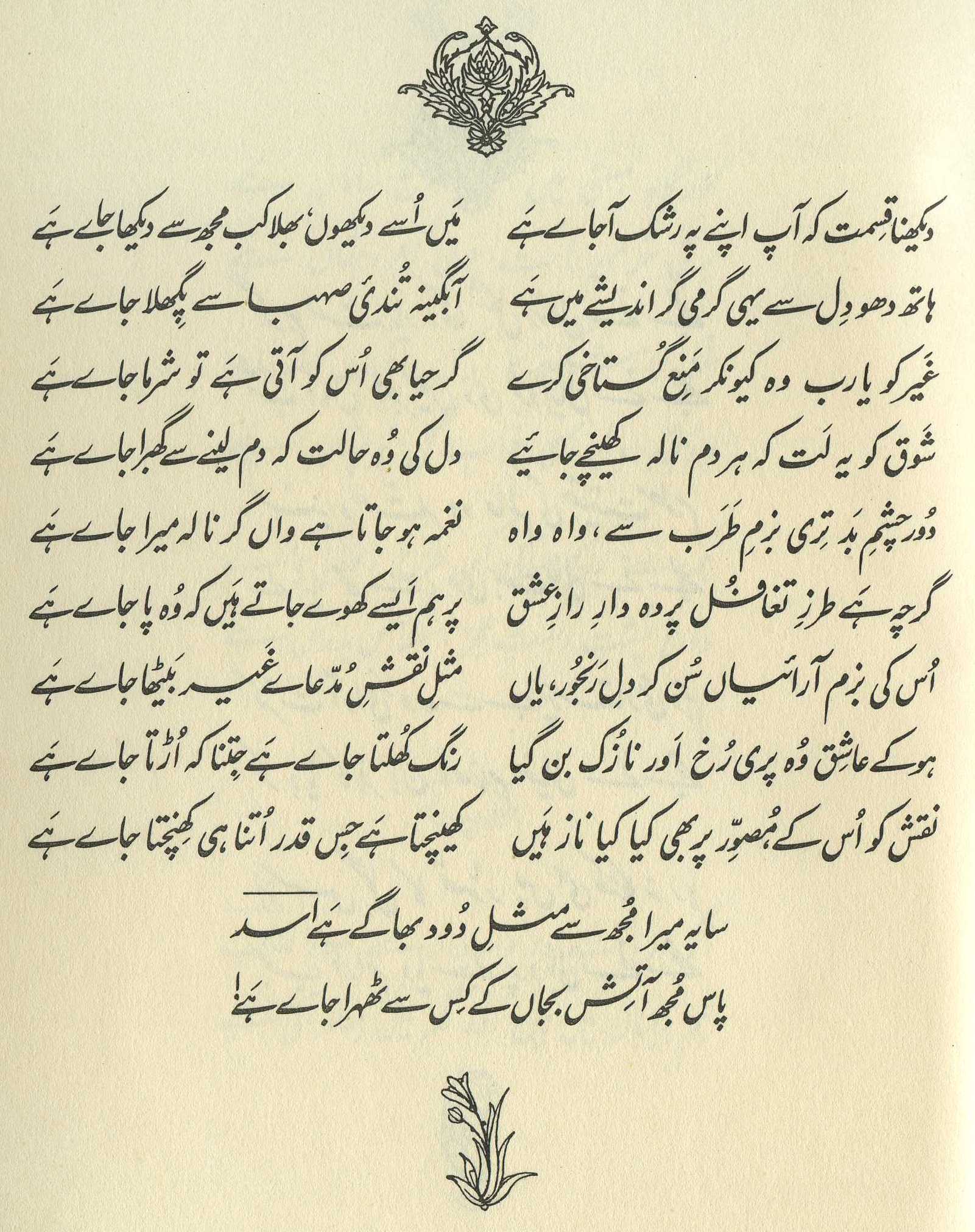
Having gone before her, we become lost in such a way-- that is, become transported out of ourselves-- that she finds us. That is, she understands that we are under a magic spell-- although she maintains the style of heedlessness, so that some concealment of the secret of my heart would remain. It should be remembered that with is for the meaning of self-obliviousness; if one would say then this meaning will not arise. (165)
== Nazm page 165

He says, although her averting of her eyes-- that is, inattention-- is a veil-keeper of the secret of love, before her we become senseless and outside ourselves in such a way that she becomes aware of the secret of passion. [sic] and -- he has used such idioms in this verse that sufficient praise is impossible. (221)
In this verse he has covertly [] expressed the idea that she is so beautiful that we want a hundred thousand times to keep hold of our senses, but we are not successful.
[The commentator] Shaukat says: 'Although the beloved's style of heedlessness is the veil-keeper of the secret of passion-- that is, the secret of passion is not revealed to anyone-- still, when she practices heedlessness before us, we don't remain in our senses, so that she guesses.' The Lord knows how he came up with this meaning!
[Or:] Because of the beloved's style of heedlessness, a curtain still covers the secret of my passion-- that is, the people of the gathering don't realize. Or she herself, in order to keep me restless or prevent me from being insolent, practices heedlessness. But I understand this much: that she certainly understands the state of my heart. (296-97)
Momin has expressed the theme like this:
[last night, in the gathering of the Other , when she averted her eyes
we became lost in such a way that the Others found out/us] (662)
Whose is the 'style of heedlessness', and whose is the 'secret of passion'? We can assume that the 'passion' belongs to the lover, but either the lover or the beloved may know the 'secret of passion'; and either the lover or the beloved may feign 'heedlessness' in order to maintain a proper public facade. Some of the resulting possible permutations are explored by the commentators. If we add in mystical interpretations, the possibilities multiply further.
Bekhud Dihlavi points to the witty, idiomatic use of expressions for 'losing' and 'finding'. Ghalib has done this kind of thing before: for examples, see 4,6 . In particular, can have the double sense either of 'finding the speaker' (since he's been lost, either by the finder or by some other agent); or of 'finding out' (information, such as the 'secret of passion'). For another example of this double use of , see 4,1 .
Note for grammar fans: Some confusion might arise in this case because can be either a transitive (taking ) or intransitive (not taking ) verb, with no change in its spelling. But the grammar is clear: it's the transitive form of the verb (in the passive present habitual), since only the transitive form can be made into a true passive. (Well, with a few rare exceptions, but not the kind we see here.) It's possible to confuse the true passive , made from the transitive, with the compound-verb form , made from the intransitive-- but not if you're a grammar fan. There's also, just conceivably, the reading -- we 'go around in a state of having been lost'-- with the colloquially omitted, but the ordinary passive reading is more plausible here.
graphics/veil.jpg