Verse 11821aapaayaa
G4
1
you say, 'we won't give back the heart, if we find it lying around'
2 a
do we even have the heart, that it would be lost?! --we found out your object!
2 b
where is the heart, that it would be lost? --we attained/'found' our object!
'Desire, wish; suit; meaning, object, view; scope, tenor, drift; -- object of search'.
is colloquially used in the first line to replace the subjunctive, ; GRAMMAR .
is an archaic form of the passive, ; GRAMMAR .
| References | |
|---|---|
| Arshi, Imtiyaz Ali | Ghazal# 5 |
| Raza, Kalidas Gupta | 319 |
| Nuskhah-e-Hamidiyah | 32-35 |
| Asi, Abdul Bari | 53-54 |
| Gyan Chand | 67-70 |
| Hamid Ali Khan | Open Image |
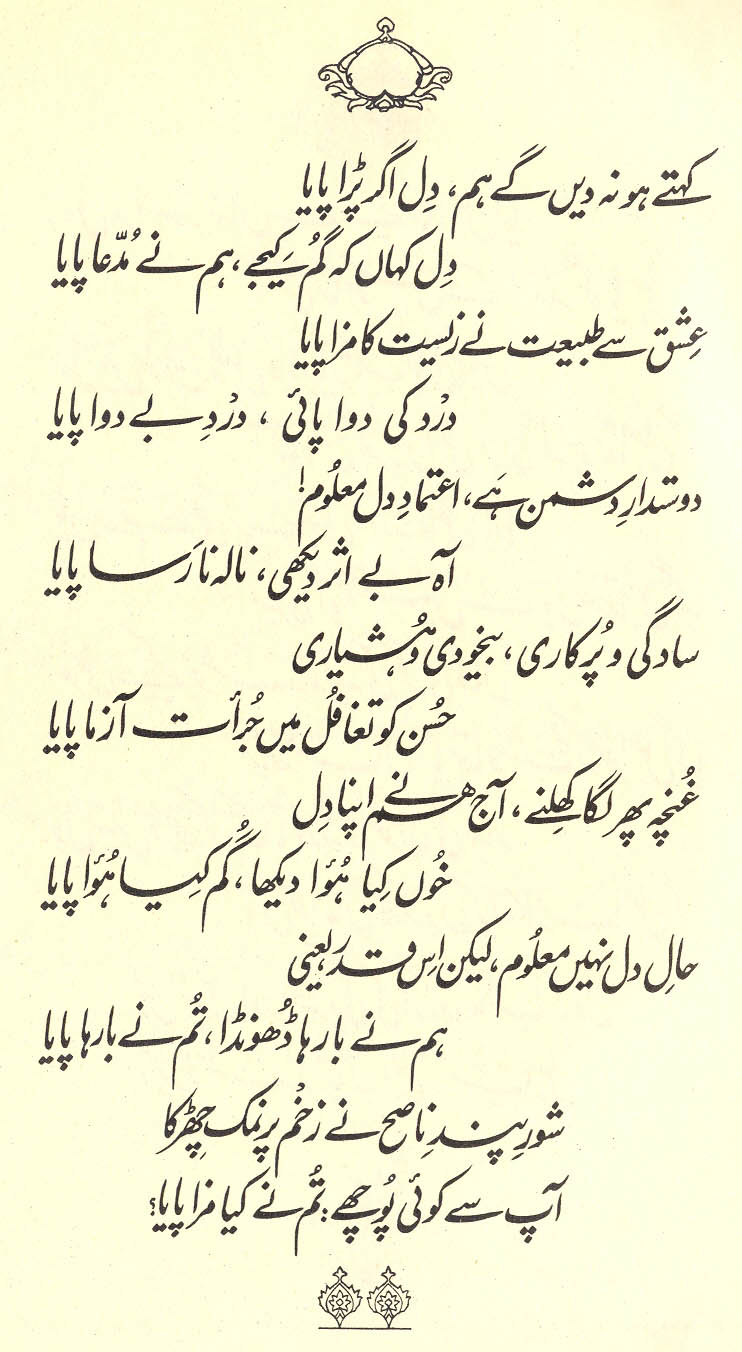
That is, your expression is saying: if we find your heart lying somewhere, then we won't give it back. Here, there's no heart at all that we might lose and that you might find lying somewhere. But from this attachment/intimacy we understood that the heart is in your custody alone. (4)
== Nazm page 4 ; Nazm page 5


Indeed, hearing this, I've understood your meaning: that is, you yourself have stolen my heart. (12)
Indeed, when you said that, I found the reward I had asked for: that you too pay attention to me, and value my heart. (7)
The two Bekhuds explicate (2a) and (2b) respectively. The Urdu is carefully ambiguous, and Ghalib surely intended both. For another such play on , see 153,6 .
In the second line, is a wonderful question. 'Where is the heart, that we might lose it?' is the obvious meaning, but the question also contains 'Where is the heart?'-- which of course is just what you'd say if you did lose your heart. Or you might say, 'Where is the heart?' and be eagerly looking for it, specifically because you wanted to lose it [].
There's also the strong rhetorical-question reading of -- 'Where? Why, nowhere, of course! Nowhere, never, no way! As if!'. In this case, 'As if I had a heart! How would I possibly have a heart?!' The question might be seen as almost insulting, as well as absurd, to think that a passionate lover would still retain his heart. And then of course by so utterly not having a heart that he can't even lose it, the lover claims to have found or attained his goal.
Justin Ben-Hain suggests (Feb. 2013) that the could be taken as a kind of emphatic pointer, so that the first line would read 'You say, don't you, "we'll give back the heart, if we find it lying around"?' The colloquial, teasing feel of this reading is enjoyable, and since the second line calls the beloved's credibility into question, in a sense it hardly matters whether she tells one kind of lie or another (since she already has the heart and thus can't possibly 'find it lying around' anyway). The weakness of this reading is that it makes less sense of 'We found out your object!', since her claim to be ready to give back the heart doesn't reveal her true object (to keep the heart) the way her claim not to be ready to give up the heart does. But the complexities of the second line invite complexities in the first one, and Justin's proposed reading has a pleasure of its own, so why should we not add it to the other pleasures of the verse?
For another ambiguous use of , see 4,15x .
On the use of the perfect verb form as a subjunctive, see 35,9 .
graphics/heart.jpg