Verse 21821aapaayaa
G4
1
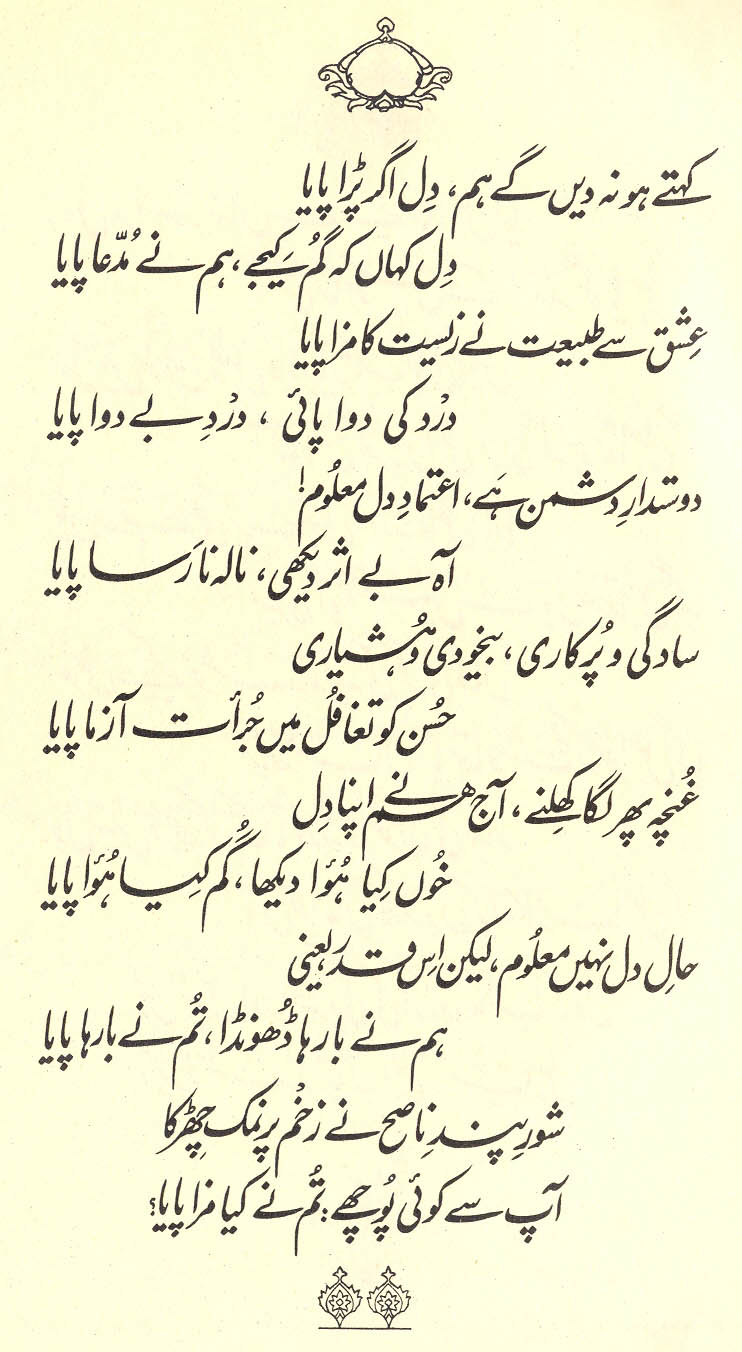
through passion, the temperament found the relish of life
2
it found a cure for pain; it found a pain without cure
'Taste savour, smack, relish; delight, pleasure, enjoyment; anything agreeable to the palate or to the mind, &c.; a delicacy, a tidbit; a bon-mot; jest, joke, fun, sport, amusement'.
| References | |
|---|---|
| Arshi, Imtiyaz Ali | Ghazal# 5 |
| Raza, Kalidas Gupta | 319 |
| Nuskhah-e-Hamidiyah | 32-35 |
| Asi, Abdul Bari | 53-54 |
| Gyan Chand | 67-70 |
| Hamid Ali Khan | Open Image |
That is, for me life was a single pain: passion became its cure, and it itself is an incurable pain. (4)
== Nazm page 4

The style of expression [in the second line]-- upon whom, except for Mirza Sahib, has such extreme excellence been bestowed? (13)
As if the pain without cure made our passionless life enjoyable, and this very pain without cure proved to be a cure for that former pain. (52)
This verse constitutes a second, supererogatory opening-verse for the ghazal. As a rule, this kind of display is just a flourish of virtuosity on the part of the poet. In this case, Ghalib grafted the opening-verse of one original ghazal onto the first half (including the opening-verse) of another original ghazal, to make the hybrid version he chose to publish in his divan .
The verse is a lovely achievement, wry and amused and relishing its game of paradox. It's also a perfect verse for mushairah performance-- the first line sets up a cheerful, optimistic assertion: passion provides the 'pleasure' or 'relish' of life. Then after (under mushairah performance conditions) a suitably suspenseful delay, the second line starts out by supporting the affirmative first line: passion is, or brings, a cure for (other, ordinary kinds of) pain. Only at the last possible minute do we get the final, balancing assertion: passion itself is, or brings, a pain without cure-- and the closural 'punch'-word, , which suddenly brings the whole verse together is withheld until the last possible moment, as the rhyme -word.
The in the second line is optional. With it, the reading is as in (2) above: there are two kinds of 'pain' involved, and one (curable) is removed and replaced by the other (incurable). Without it, the reading would be 'It found a (so-called) 'cure' for pain-- it found that the pain to be without cure'. That is, there is only one kind of pain involved, and it is first thought to be curable, but then discovered to be incurable. This reading is less piquant (and less apt) than the reading in (2), but the grammar certainly makes it available.
The second line is also so full of non-connectors that I used to use it to encourage students who were learning the script. In fact I used to put a beautifully calligraphed rendering of this verse on my famous Urdu tshirts. For a parallel to the second line, see 4,5 .
Note for meter fans: The spelling of as is to accommodate the rhyme . Such changes are permissible liberties that occur occasionally when it's convenient for the poet. In this ghazal, the same liberty, with the same word, is taken again in 4,7 .
graphics/balm.jpg
