Verse 51821aapaayaa
G4
1
the bud again/then began to bloom; today our heart we
2
saw [to have been] turned to blood, found [to have been] lost
| References | |
|---|---|
| Arshi, Imtiyaz Ali | Ghazal# 5 |
| Raza, Kalidas Gupta | 319 |
| Nuskhah-e-Hamidiyah | 32-35 |
| Asi, Abdul Bari | 53-54 |
| Gyan Chand | 67-70 |
| Hamid Ali Khan | Open Image |
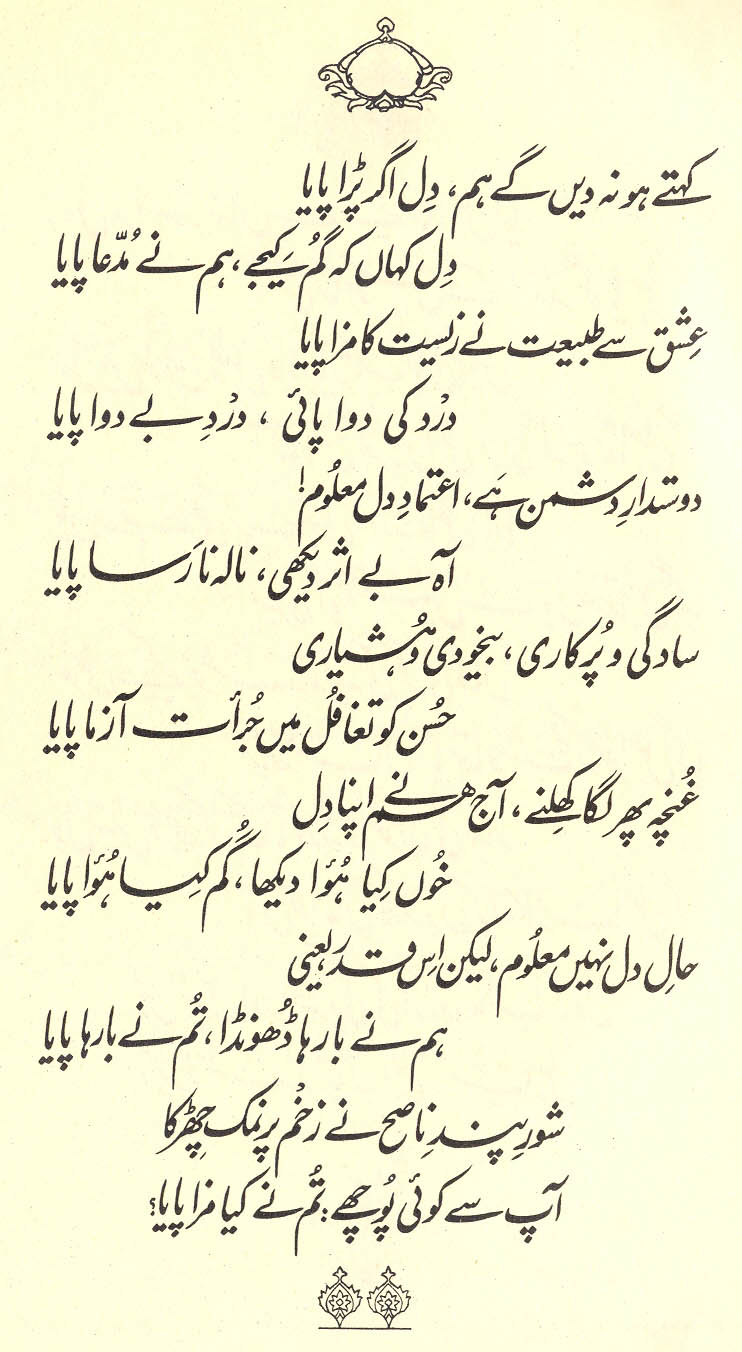
A lover without a heart expresses the suspicion about the bud, that this is my heart which had been lost for a long time. (4)
== Nazm page 4

Urdu text: Vajid 1902 {4}
The meaning is, our heart has turned to blood and dripped out on the ground by way of our eyes. It had gone, and nowhere around was there any trace of it. Today we saw that very heart, and found it again. That is, this rosebud, which in the spring season has bloomed a second time, is our heart itself, which in winter had turned to blood. For the heart the simile of 'bud' is often used. (13)
1) Today my heart is turning into blood; from this I know that spring has come.
2) A lover without a heart sees a bud and expresses his suspicion: This is my heart, that had been lost for a long time.
3) Because of the coming of the spring season, my tumult of madness became fresh.
4) God knows what happened to the heart in some springtime, that when that season comes its wounds become fresh. And when the glance falls on the bud, it freshens the memory of the turned-to-blood and vanished heart.
5) Spring came and my heart turned to blood and began to be as if lost. (8)
Compare to 164,2 . (160)
The second line here strongly evokes in its parallelisms the second line of 4,2 -- -- and will be echoed in turn in the second line of 4,6 -- . In all three cases the line is split at the midpoint (which in this meter makes possible a quasi-caesura) and parallel phrases are placed on each side, involving repetition, sound echoes, and the use of an arresting and paradoxical-seeming statement.
If anything, this one is the most intriguing of the three instances, because each half of the line is also paradoxical in itself. If a heart has already turned into blood and thus melted away, how can you 'see' it in this state? And works just as neatly in Urdu as 'I found it lost' does in English. For another study in lost/found subtleties, compare 153,6 .
This verse is unusual in that the various relationships that are usually negotiated between the first line and the second are here negotiated between the first half of the first line, and the second half of the first line combined with one or both of the two halves of the second line. Bekhud Mohani does an excellent job of suggesting some of the wide variety of ways in which those relationships can be arranged. (In fact, Bekhud Mohani does such a lovely, imaginative job that I want to salute him for it, and to thank him for opening my eyes to some of these possibilities. How I wish that he and the other commentators would do this kind of thing more often!)
For example, does 'the bud again/then began to bloom' refer to the speaker's heart's being turned to blood, or to the spring season? Is the losing of the heart the same as its being turned to blood, or are these two different situations? Is there a cause and effect relationship of any kind here between the bud blooming and the fate of the heart? If there is, which is the cause and which the effect? This verse is an inherently unresolvable one, with so many possibilities generated that no definitive interpretation is possible.
The convenient little adverb can readily be used to mean either 'again' or 'then', which makes it another excellent tool for creating multivalence.
graphics/rosebud.jpg