Verse 2after 1816aariihai
G8
In this meter the first long syllable may be replaced by a short; and the next-to-last long syllable may be replaced by two shorts.
1
again the fingernail has begun to dig into the liver
2
it's the coming of the season/harvest of tulip-making
'A season, time; reaping season, harvest; crop or crops'.
| References | |
|---|---|
| Arshi, Imtiyaz Ali | Ghazal# 188 |
| Raza, Kalidas Gupta | 300-01 |
| Nuskhah-e-Hamidiyah | 252-253 |
| Hamid Ali Khan | Open Image |
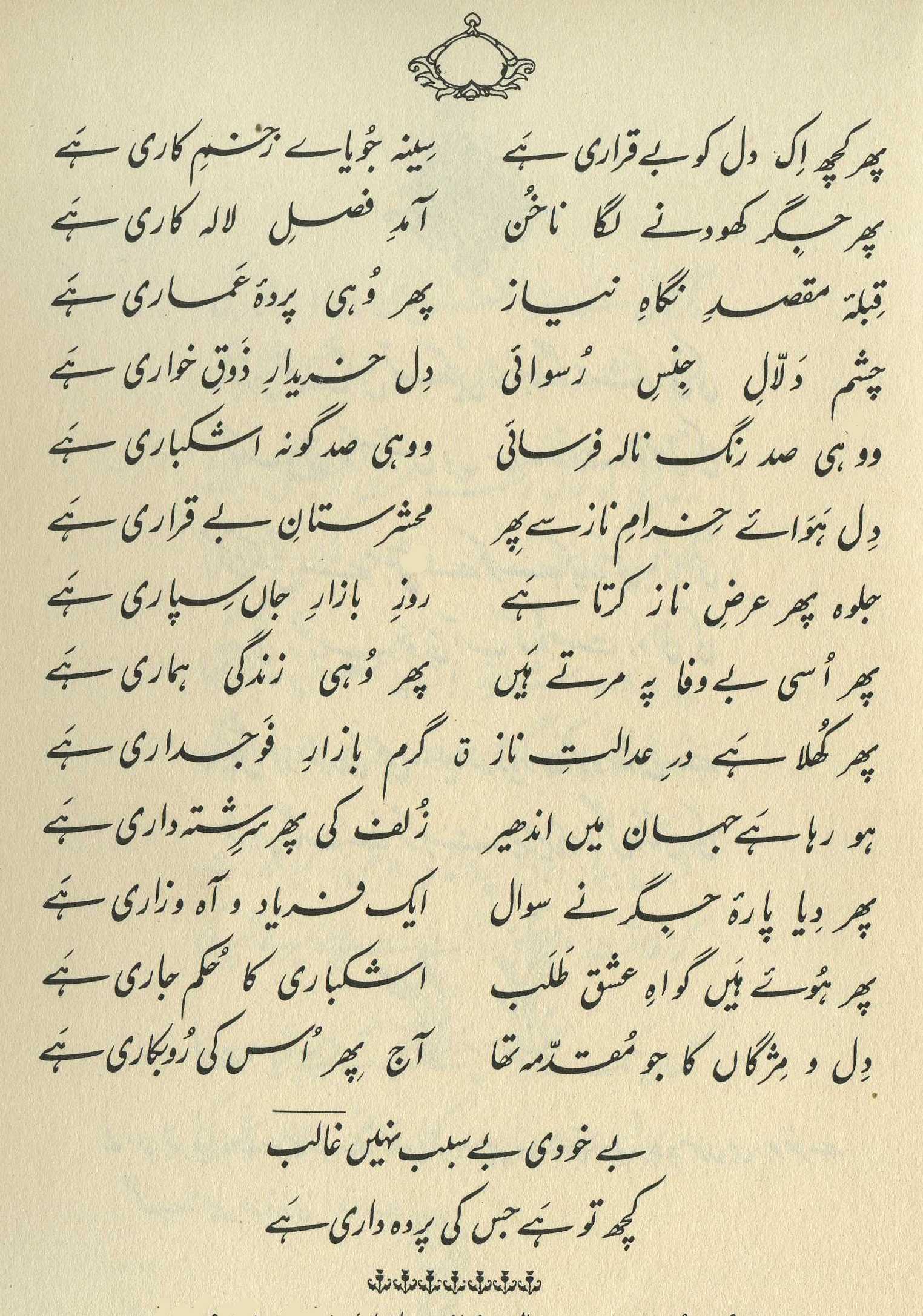
By fingernail is meant the fingernail of grief. But 'to scratch with a fingernail' [] is an idiom; 'to dig the liver with a fingernail' [] has fallen from the level of idiom. (177)
== Nazm page 177

He says, again the fingernail has begun to dig into the liver. It seems that the spring season has come near. In the garden the tulip and rose will bloom, and madness will again acquire force. The wounds of the people of passion will again become fresh. (237)
Again the fingernail of grief, or the fingernail of passion, digs into the heart. Again the time has come for the sowing of tulips. That is, the grief of passion has begun, and the heart seeks to become a tulip-garden through wounds.
[Rejecting Nazm's complaint:] This is not an idiom, it is a dictionary usage, and would have had no affinity with 'tulip-making'. (318)
Compare 4,5 . (160)
Here's a verse with two utterly simple but richly, even wildly, evocative lines, and no indication of how we are to connect them to each other. Because both lines are so 'pre-poeticized' within the ghazal tradition, the possibilities form a considerable network. Just to start with, here are some possible logical relationships between the lines:
=A and B as parallel accounts of the same situation: The lover has once again begun to dig into his liver, and it's once again the season of tulip-making.
=A as cause, B as result: Because the lover has once again begun to dig into his liver, the season of tulip-making will now arrive.
=B as cause, A as result: Because it's the season of tulip-making, the lover has once again begun to dig into his liver.
And of course, we have available complexly metaphorical resonances for both these activities.
=The coming of the spring season, the time of 'tulip-making', might have reawakened the lover's mad passion, so that he's begun to 'dig into his liver' in renewed self-torment.
=When the lover 'digs into his liver', he might be preparing a sort of flower-bed for the growth of beauty and love, as a gardener does in the early spring when he prepares to plant his flowers and engage in 'tulip-making'.
=Or the lover might be seeking supplies of fresh blood (since in the ghazal world the liver is the blood-making organ); the blood will emerge in the form of red drops, and will then fall and adorn the hem of his robe, turning it into a garden and thus performing 'tulip-making'. (For a similar case, see 233,6 .)
=Or the lover's beginning to 'dig into his liver' is perhaps to him entirely equivalent to the coming of the season of 'tulip-making', since in his wretchedness all he knows of spring is a fresh burst of self-torment.
=Or perhaps the lover's digging into his liver is all the spring there is in the world, perhaps his self-torment creates (the effect of) spring for everybody else; for a parallel case, see 62,8 .
For further permutations, we could also translate not as 'season' but as 'harvest', which would give an extra fillip to the gardening imagery.
And of course, for initial simplicity I've said that 'the lover' digs-- but it's really not 'the lover' at all, it's actually 'the fingernail' that digs. It could well be his own fingernail, but acting autonomously-- the fingernail might be digging without, or even against, his will. Or of course it could be somebody else's fingernail (the beloved's?), or the fingernail of a semi-personified abstraction ('the fingernail of grief', 'the fingernail of passion'), as Bekhud Mohani points out. (For that matter, it could even be somebody else's liver, though that possibility doesn't seem to take us anywhere.)
Even now the interpretations could go on; it's that kind of verse. In its luxuriance it reminds me of 4,5 . And of the superb, unforgettable 214,6 , which is also about gardening and the liver.
Note for grammar fans: Look how necessary it is, semantically and psychologically, to translate as 'has begun to dig', even though it literally appears to mean 'began to dig'. It's a powerful example of how what appear structurally to be parallel perfect forms between English and Urdu, in practice are often (or even usually) skewed one step further into the past in Urdu. For more on this, see 38,1 .
graphics/fingernails.jpg