Verse 6after 1816aariihai
G8
In this meter the first long syllable may be replaced by a short; and the next-to-last long syllable may be replaced by two shorts.
1
the heart, from the {desire for / breeze of} the gait of coquetry, again
2
is a {Doomsday/collection}-place of restlessness/instability
'A place of assembly or congregation; .... the day of the place of congregation, the day of judgment — , adj. (A woman) whose gait excites a commotion like that of the day of judgment.'.
'Restlessness, uneasiness, anxiety, discomposure, disquietude; instability, inconstancy, variableness, fluctuation'.
| References | |
|---|---|
| Arshi, Imtiyaz Ali | Ghazal# 188 |
| Raza, Kalidas Gupta | 300-01 |
| Nuskhah-e-Hamidiyah | 252-253 |
| Hamid Ali Khan | Open Image |
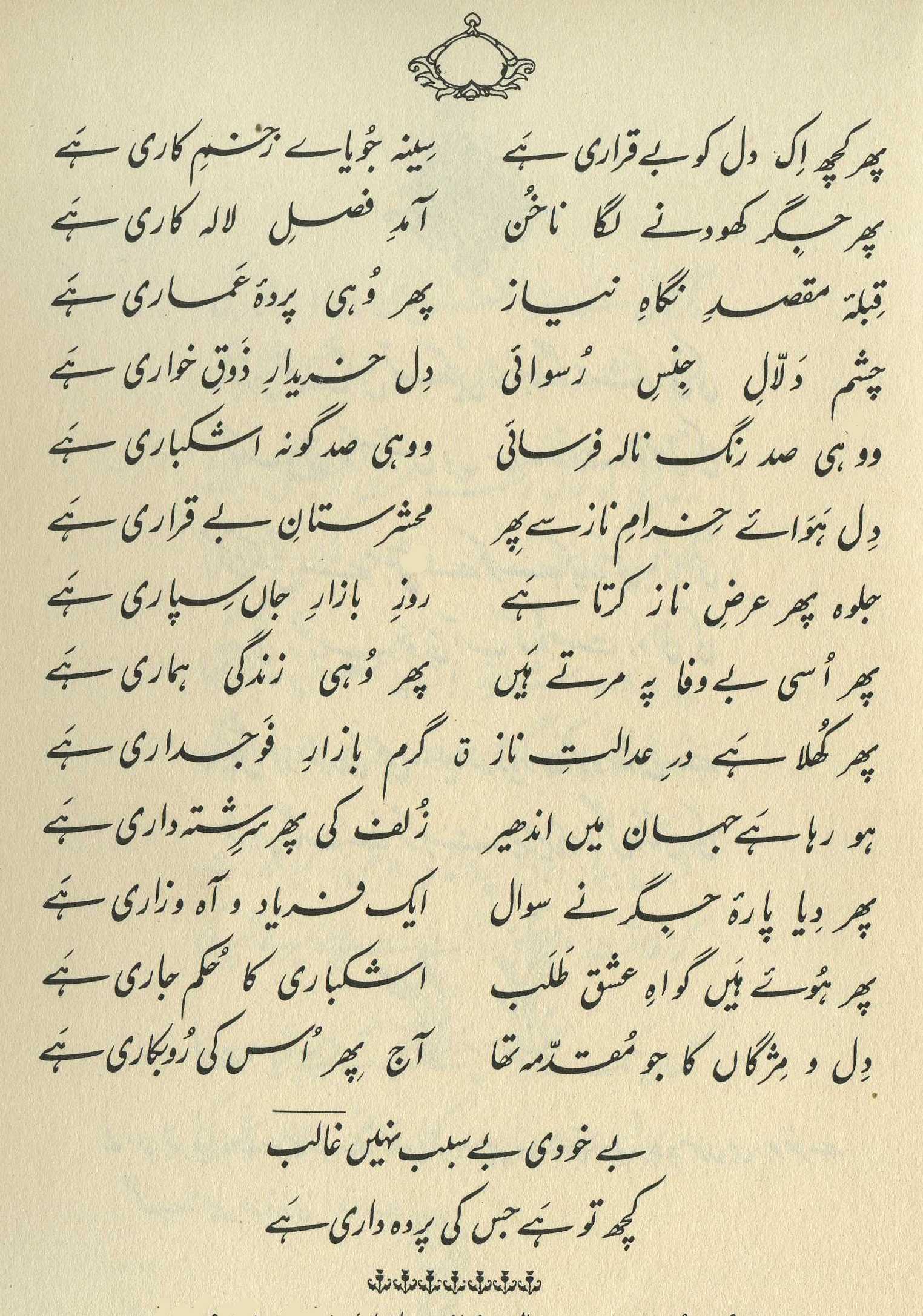

He says, in ardor for the beloved's gait of coquetry, again our heart has become, for restlessness, a field of Doomsday/collection. (237)
In the longing to see the beloved's gait of coquetry, again the heart has become a Doomsday/collection place. That is, in the heart are a crowd of restlessnesses. (They give as a simile for the gait of the beloved, the mischief of Doomsday.) (319)
This is a lovely verse of wordplay. The word can mean either 'desire' or 'breeze'; for a verse that plays (even more clearly) with this double sense, see 8,3 .
If we take to mean 'desire', then we have the heart longing to see the beloved's coquettish style of walking. This desire makes the heart a 'Doomsday' of restlessness. Although literally means 'gathering-place', it's often used, by extension, synonymously with , for the Day of Judgment, and thus metaphorically for any great, terrible, catastrophic situation-- and see the definition above, which includes the idiomatic . This 'Doomsday' scenario is doubly appropriate because it's so common in the ghazal world for everything the beloved is or does to be referred to as a 'Doomsday' in its power and effect: for many examples, see 10,11 . So the lover's heart is a final gathering-place, beyond the grave, of all the 'restlessness' in the world, all collected together in one ultimate, doomed, desire: not even to possess the beloved, but merely to behold her deadly, irresistible way of sauntering along.
If we take to mean 'breeze', then we have an actual physical effect: as the beloved walks along, the breeze of her passage (bearing, as it always does, traces of her intoxicating perfume) reaches the lover. And just as the same breeze disorders the wounded lovers in 8,3 , causing them to writhe, here too it inwardly disorders the lover, causing him to feel all the restlessness in the world: he is 'blown' into a state of 'instability' and 'fluctuation' that is itself very like the movement of the breeze.
Also enjoyable is the word- and meaning-play involving the two poles of being 'collected' or 'gathered', versus being 'restless' or 'unstable'. (For an intriguing parallel, see the use of in 111,8 .) The heart is a 'collection-place' for a state in which one can't 'collect' oneself.
Since already explicitly contains the idea of 'place', why do we need to call it a , a 'gathering-place-place'? I can't see any benefit to the verse from the redoubled 'place' information. Could it be that we're actually catching Ghalib in a small bit of ' padding '? On the question of padding in general, see 17,9 . And for a much more egregious case of adding , see 226,8x .
graphics/windblown.jpg