Verse 12after 1816aariihai
G8
In this meter the first long syllable may be replaced by a short; and the next-to-last long syllable may be replaced by two shorts.
1
again the witnesses of passion have been sought/'sent for'
2
the rule/order of tear-shedding is in force
'Judgment, judicial decision, sentence, decree, verdict, doom, award; judicial authority, jurisdiction, rule, dominion, government, control, direction, management'.
| References | |
|---|---|
| Arshi, Imtiyaz Ali | Ghazal# 188 |
| Raza, Kalidas Gupta | 300-01 |
| Nuskhah-e-Hamidiyah | 252-253 |
| Hamid Ali Khan | Open Image |
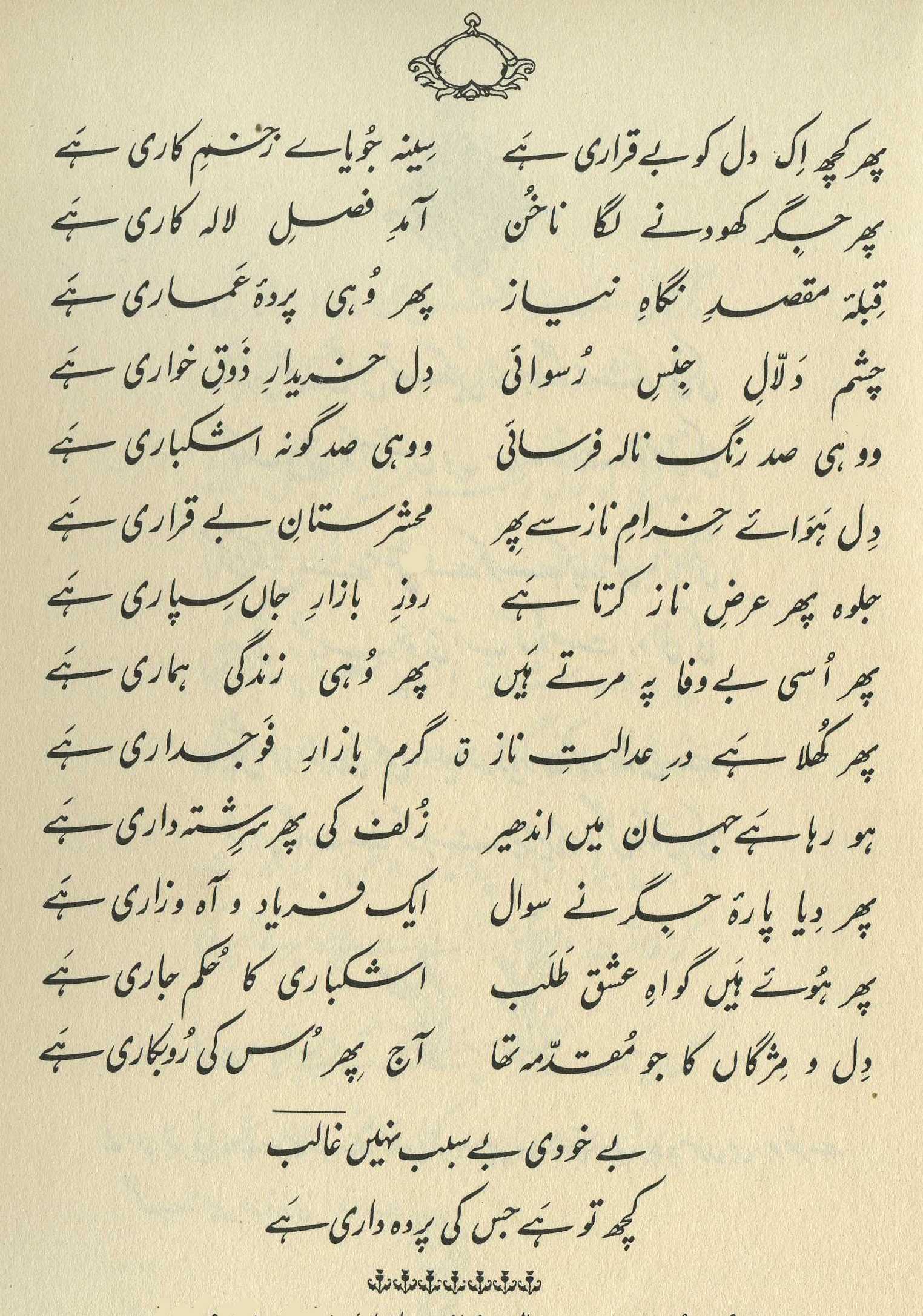


He says, 'Again before the court the witnesses of passion are appearing. The rule of tear-shedding is in force.' Along with tears, the blood of the heart is presenting a fragment of the liver as a testimony of passion. (238)
[See his comments about 164,9 .]
This is the fourth of five verses of a verse-set full of legal terminology; for further discussion of the whole set, see 164,9 .
The ambiguities of the come into play in this verse. In the first line, are those witnesses 'of' passion in the sense that they have observed it and will testify about it? Or are they witnesses 'of' Passion in the sense that they are made of semi-personified Passion and are identified with it (as in 'man of sorrows')? And in the second line, the rule of 'tear-shedding'-- is that a rule requiring that tears be shed, or does it refer to rule or governance by a semi-personified entity called 'Tear-shedding'?
These semi-personifications aren't at all implausible. In this verse-set, after all, the beloved's curls are court record-keepers, and a piece of the lover's liver is a plaintiff.
graphics/sprinklers.jpg