Verse 14after 1816aariihai
G8
In this meter the first long syllable may be replaced by a short; and the next-to-last long syllable may be replaced by two shorts.
1
self-lessness is not without cause, Ghalib
2 a
there is something, of which it is the concealment
2 b
something is there, of which concealing is done
'Concealing (a blemish), conniving at (a fault or offence); keeping one's secret; preserving confidence'.
| References | |
|---|---|
| Arshi, Imtiyaz Ali | Ghazal# 188 |
| Raza, Kalidas Gupta | 300-01 |
| Nuskhah-e-Hamidiyah | 252-253 |
| Hamid Ali Khan | Open Image |
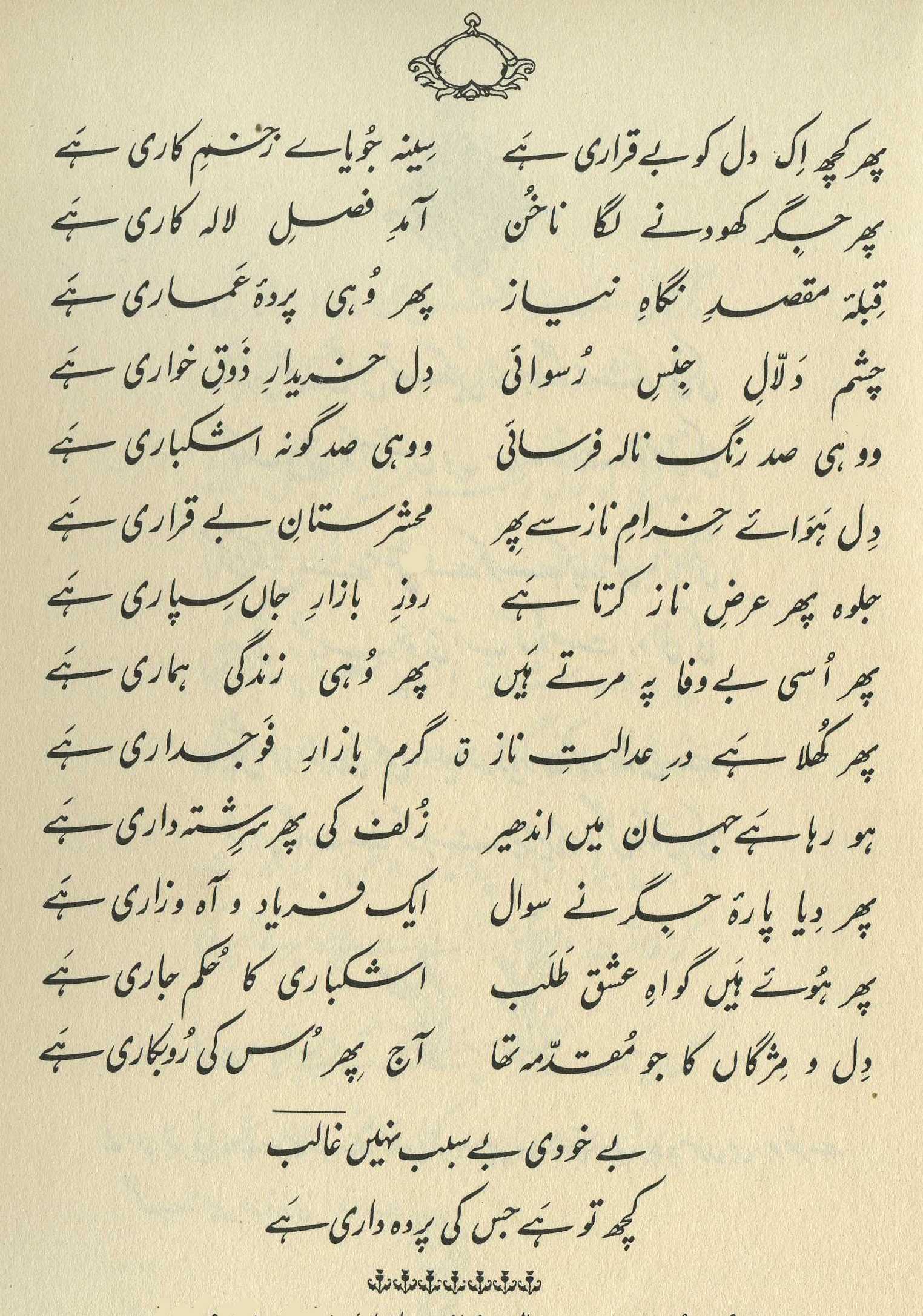
That is, this self-lessness is in order to hide the secret of passion. (179)
== Nazm page 179

He says, 'Oh Ghalib, this self-lessness is not without cause. There's certainly something or other going on, in order to hide which, this self-lessness prevails.' The meaning is that for the concealment of the secret of passion, the veil of self-lessness has come in between. (239)
The prevailing of self-lessness is not without a cause, for the veiling of which this aspect has been adopted. That is, the heart itself wants to preserve the secrecy of the beloved. Thus self-lessness continues to prevail, because after coming back to consciousness, restlessnesses will reveal the secret. (321)
As always, I use the spelling 'self-lessness' to distinguish this usefully literal translation from the normal English word 'selflessness' (meaning 'unselfishness').
Everybody likes (2a), and quite understandably-- it fits into the general frame of the lover's (half-conscious) trickiness. Is he tricking himself, or the beloved, and/or the bystanders? It hardly matters-- the lover's deep wish for privacy and concealment (preferably by wandering off into the desert) meshes perfectly with the beloved's yen for respectability and good repute. The lover's state of mystical rapture or trance-- a wandering in the spiritual desert-- satisfies both purposes at once; it is a kind of tactic, one that's adopted for good reason.
But I like (2b) even better, in its radical inscrutability. The veiled thing is so obscure that it can't even be named. Is it a real Divine presence? Is it a mere glimmer of something beyond this transitory physical world? Whatever it is, it's powerful-- it's somehow causing or forcing or producing the 'self-lessness'. It can only be dimly glimpsed or sensed, behind the veil-- but its undefinability, its dense mysteriousness, make it all the more powerful.
It reminds me of a verse of Zafar 's:
[when we erased our self, that veil-like thing did not remain any longer between
now that veiled one didn't remain within the veil, no one other than that one remained]
I've translated it with deliberate awkwardness, to show how multivalent the grammar really is: by the end of the second line, how many entities are left, and which ones exactly?
Our Urdu poetry group, people from different parts of India and Pakistan, unanimously maintained (Aug. 2022) that the whole second line, word for word, is a common expression of distrust and suspicion, like 'Something is rotten in Denmark' or 'There's no smoke without fire'. If we imagine that the expression was current in Ghalib's day as well, the verse acquires an extra dimension of darkly idiomatic relish.
graphics/curtain.jpg