Verse 13after 1816aariihai
G8
In this meter the first long syllable may be replaced by a short; and the next-to-last long syllable may be replaced by two shorts.
1
the lawsuit/preliminary that there was between heart and eyelashes
2
today again is its proceeding/warrant/order
'Prelude; introduction; premisses (of an argument); preliminary; --affair, matter, case, business... --law-suit, suit, cause, case, proceedings; prosecution'.
'Proceeding (of a cause [=case]), a record (in a cause); a warrant, an order; a communication (in Urdu or Persian) addressed by an official to an equal'.
'Orders or warrants to be issued for the trial of a case; to be tried or heard (a case)'.
| References | |
|---|---|
| Arshi, Imtiyaz Ali | Ghazal# 188 |
| Raza, Kalidas Gupta | 300-01 |
| Nuskhah-e-Hamidiyah | 252-253 |
| Hamid Ali Khan | Open Image |
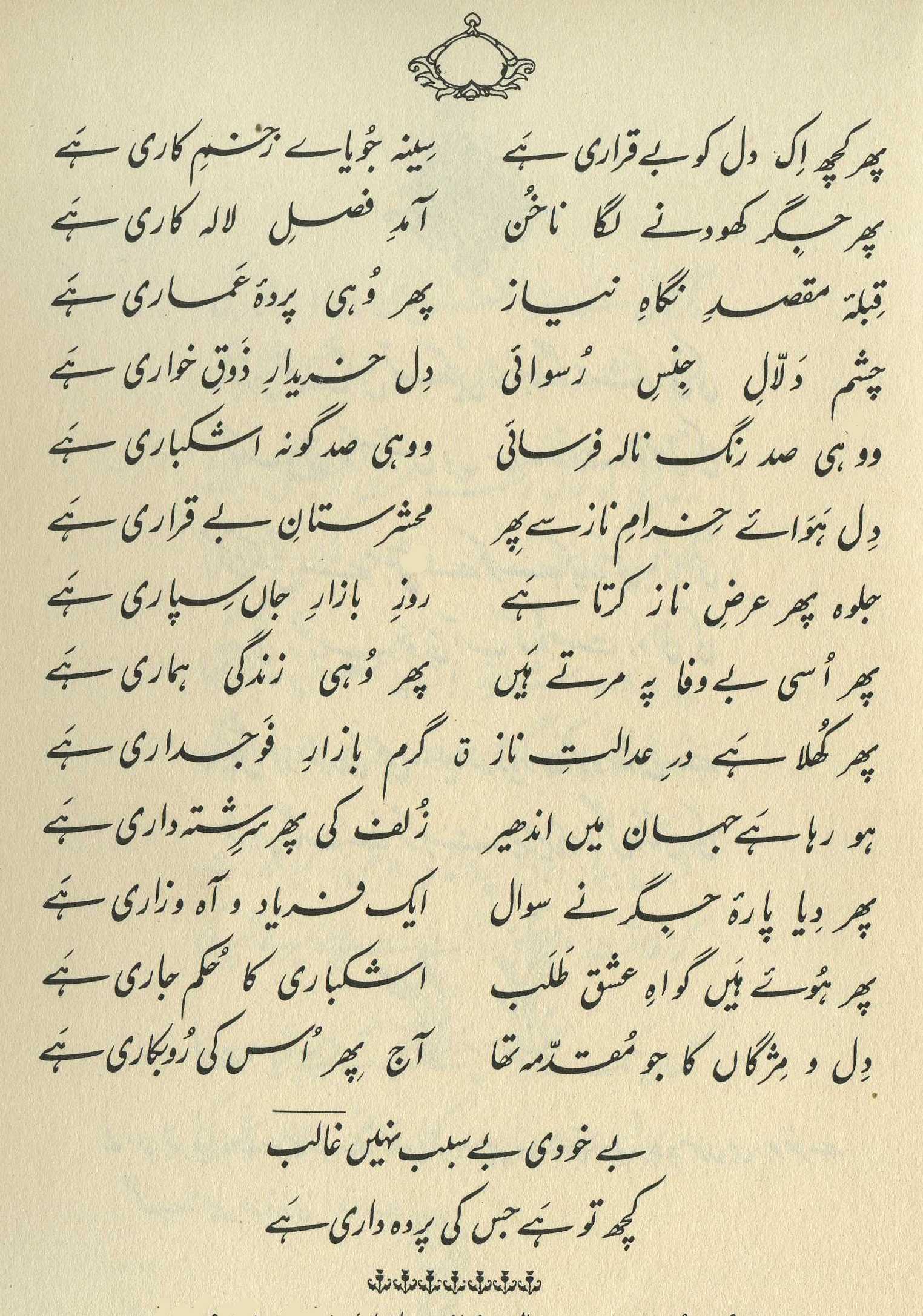


He says, the court case that there was between the beloved's eyelashes and the lover's heart, today has been called in the court of coquetry. That is, both parties are presenting their respective proofs and evidence, and rebuttals. Mirza Sahib's inventive temperament couldn't bear not to keep creating new constructions in his verses. Thus this verse-set too is an extreme example of the height of expression. (238)
The court case of the heart and the eyelashes, in which the heart is the plaintiff and the eyelashes the accused, is today called again.
Compare 228,4 . (280)
This is the last of five verses of a verse-set full of legal terminology; for further discussion of the whole set, see 164,9 .
In addition to the obvious legal wordplay, there's one more nice touch: the literal meaning of is setting one's 'face toward action', which is of course perfect for describing a part of the face (the eyelashes) and their cruel or criminal behavior (in lacerating the lover's heart).
Arshi is right to suggest a comparison with 228,4 : it concerns a similar court case, and it culminates in a rhyme -word of .
graphics/courtpapers.jpg