Verse 4[1816 and] 1821aarhai
G3
1
the heart became a plaintiff; and the sight/eye, an object-of-suit accordingly
2
the lawsuit/preamble of the gaze/view is again proceeding
'A claimant, suitor; plaintiff (in a law-suit), complainant, prosecutor, accuser'.
'Asserted as a claim, claimed, sued for; alleged; pretended; meant;--what is claimed, or alleged, or pretended, or meant; desire, wish; suit; meaning, object, view; scope, tenor, drift; --object of search, stolen property'.
[A varant spelling of ] 'On, upon, above; according to, &c. ... it occurs only in Arabic phrases.
'The first part; preamble (to a speech); preface (to a book); prelude; introduction; premisses (of an argument); preliminary; --affair, matter, case, business, subject, topic, thesis; --law-suit, suit, cause, case, proceedings; prosecution'.
'Face to business,' ready for business, intent (upon); approaching, in hand, on foot, about to be, in agitation; agitated, proceeded on (as a suit at law); --a proceeding (of a cause); an order'.
| References | |
|---|---|
| Arshi, Imtiyaz Ali | Ghazal# 176 |
| Raza, Kalidas Gupta | 262-263,344-345 |
| Nuskhah-e-Hamidiyah | 266-269 |
| Asi, Abdul Bari | 267-268,269 |
| Gyan Chand | 391-392,392-394 |
| Hamid Ali Khan | Open Image |
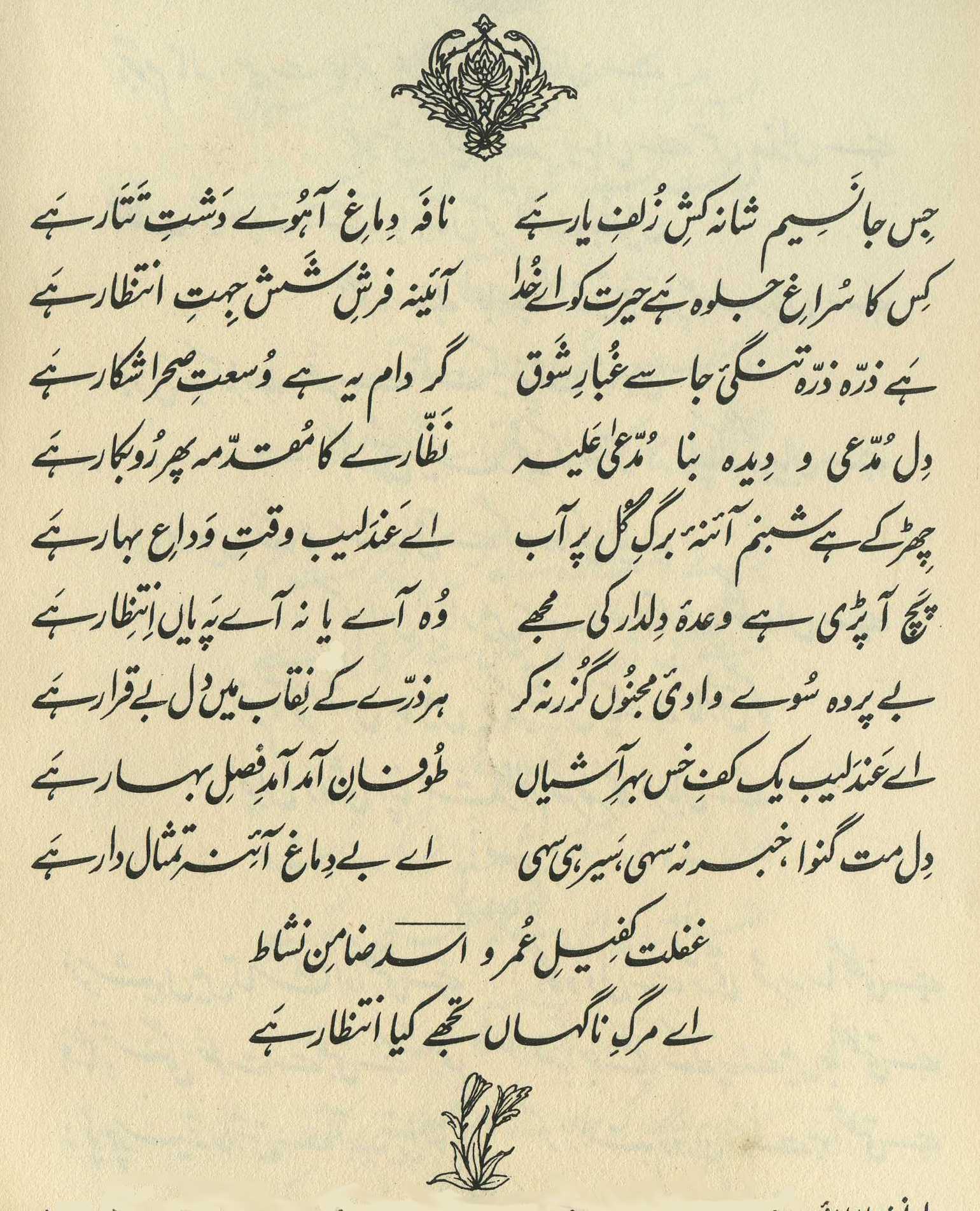
The heart has made a complaint against the eye, that neither does it gaze, nor am I murdered. He calls the eye [] the 'sight' [], but to use in every place 'sight' instead of 'eye' is a bad thing, because in Urdu idiom they call a bold and shameless eye a , and the word has become peculiar to women's language. [Some examples.] In this verse by saying 'sight' instead of 'eye' he has loosened the shape; even a blind person would notice such ruination. But the theme of the verse is very lofty.
The second flaw in this verse is that.... in reality the structure is , and he has brought in between two Hindi sentences a Persian connector. The poets of Lucknow avoid this, and so they should. (256)
== Nazm page 256

He says that the heart has opened a case against the eyes, that 'Because of the impropriety of their ogling glances, I have become immersed in sorrow and disaster. It's necessary and required that I should receive justice from the porch of the ruler of passion.' (313)
The heart has made the complaint that 'Neither do the the eyes look at the face of the beloved, nor am I destroyed'. And today again there will be a hearing of this case, in which a charge has been made against the gaze. [He goes on to argue at length against Nazm's objections, with evidence from other poets.] (463)
Compare 164,13 . (280)
Here's one of the relatively few verses in which the charm comes from wordplay related to bureaucratic terminology. In this case, it's that of the law court. The heart became a plaintiff, and the eye something like the 'thing being sued for'. The commentators take the eye as the defendant, but that doesn't seem to suit the sense of .
The commentators also seem sure that they know the content of the complaint; but as can be seen from their interpretations above, they don't agree about what it is. This isn't surprising; we've seen so many verses in which Ghalib sets up a framework and requires us to supply the details from our own imaginations. Does the heart complain about the lover's own eyes, because it wants to have a 'sight' of the beloved, and they don't provide one? Or could the heart even be suing the beloved, for withholding herself from the lover's eyes? Or does the heart complain because it has had all too deadly a 'sight' already (as Bekhud Dihlavi maintains)?
No matter how we decide such questions, the real pleasure of the verse is obviously in its wordplay. Not only is there the clever use of ponderous (but multivalent) legal terminology-- there are also the body parts. We have a 'heart', the 'sight' or 'eye', the 'gaze' (which surely unites heart and eye). And best of all, we have a word that unites the legal with the physical: the cleverly chosen , a legal term that literally means 'face [] toward action'.
Arshi is right to suggest for comparison 164,13 , which also concerns a lawsuit, and which gets its punch from another clever use of . By no coincidence, in both verses these words occupy the strategic, last-possible-moment rhyme position.
graphics/courtroom.jpg