Verse 8[1816 and] 1821aarhai
G3
1
oh Nightingale , one handful of grass/straw for a nest?!
2
it's the typhoon of the announcement/arrival of the season of springtime
'A fragrant grass, Andropogon muricatum ... ; any useless herb or stick, rubbish of sticks or thorns'.
'On account of, for the sake of, for'.
'Sea, gulf,... flow, rhythm'.
tuufaan>> : 'A violent storm of wind and rain, a tempest, typhoon; a flood, deluge, inundation; the universal deluge; a flood or torrent (of obloquy, &c.);--a commotion, noise, riot'.
'The announcement of an arrival'.
| References | |
|---|---|
| Arshi, Imtiyaz Ali | Ghazal# 176 |
| Raza, Kalidas Gupta | 262-263,344-345 |
| Nuskhah-e-Hamidiyah | 266-269 |
| Asi, Abdul Bari | 267-268,269 |
| Gyan Chand | 391-392,392-394 |
| Hamid Ali Khan | Open Image |
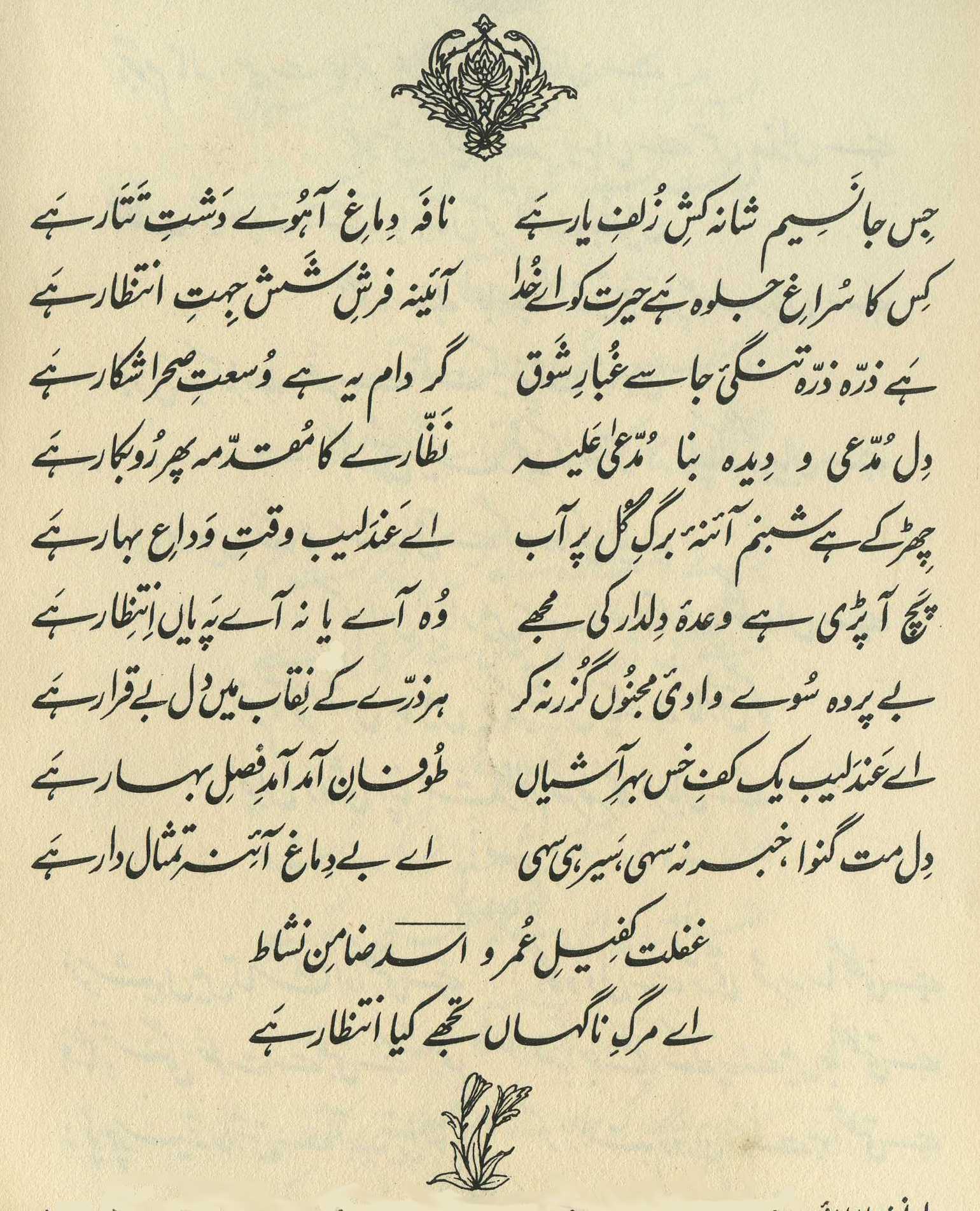
That is, oh Nightingale, if you want to enjoy the pleasure of spring, then bring a fistful of grass and make a nest. Otherwise, in this typhoon, even if you search you won't find even a single dried straw, because the season of spring will make all the grass and straw green and verdant. (257)
== Nazm page 257

He says, oh Nightingale, if in the rose you want to enjoy the pleasure of spring, hidden from the gaze of the gardener, then go right now and gather a few straws and make a nest. Otherwise, in the enthusiasm and turmoil of the spring, you'll long in vain for dried straws. The spring will come and make the whole garden into verdure. (313)
The pleasure of this interpretation can be fully enjoyed by those gentlemen who would have seen for themselves the scene of the rose and nightingale in Iran, or who at least would have seen the picture captured by the pen of Maulvi Muhammad Husain Azad in 'Poets of Persia' []-- where he writes about the unique sacrifice of the Nightingale: that it calls out and calls out, until it ceases, and the gardeners find many dead Nightingales. (468)
The Nightingale is more commonly a ; for discussion of the few cases where he's an , see 228,5 .
The commentators are sure that the first line is meant to be read as a warning, to tell the Nightingale to hurry and make a nest. But really there's no verb at all: it's just an exclamation. 'A handful of grass for a nest!' is, grammatically, like 'My kingdom for a horse!'. In both cases, only the context can enable us to narrow the interpretive range. Here are some other tones in which the exclamation can be read:
=indignant: Aren't you even willing to collect a handful of straw for a nest?
=reproachful: Is that puny little handful of straw the best you can do for a nest?
=admiring: How elegantly you make a whole nest out of just one handful of straw!
=inquiring: Is that handful of straw enough for a nest, or isn't it?
=helpful: Here, take this handful of straw, I know you can use it for your nest.
=pleading: Please give me just a handful of straw to make my own nest! (The lover sometimes speaks as a bird; see 126,5 for examples.)
As so often, the second line works differently, but equally enjoyably, with all these various readings.
There's also one more pleasure of this verse-- one that would work well in mushairah performance, or any oral recitation. More common than the word , 'for the sake of', is the word , 'sea'. The two sound exactly the same. Listeners hearing the first line might well hear 'one handful of dust, an ocean of a nest'. This sounds strange, but no stranger than many other Ghalibian lines. Only when we hear the second line are we able to realize for sure which of these two homonyms is intended.
Once we hear the second line we also realize that although 'for' [] is the correct reading, the aural presence of the 'sea' has a fine affinity with 'typhoon', which can mean 'flood, deluge'. And with 'typhoon' the wave-like swell of works excellently too. Moreover, there's the partial aural echo of and in too).
Compare 234,6 , another verse about nest-building.
graphics/straw.jpg