Verse 1[1816 and] 1821aarhai
G3
1
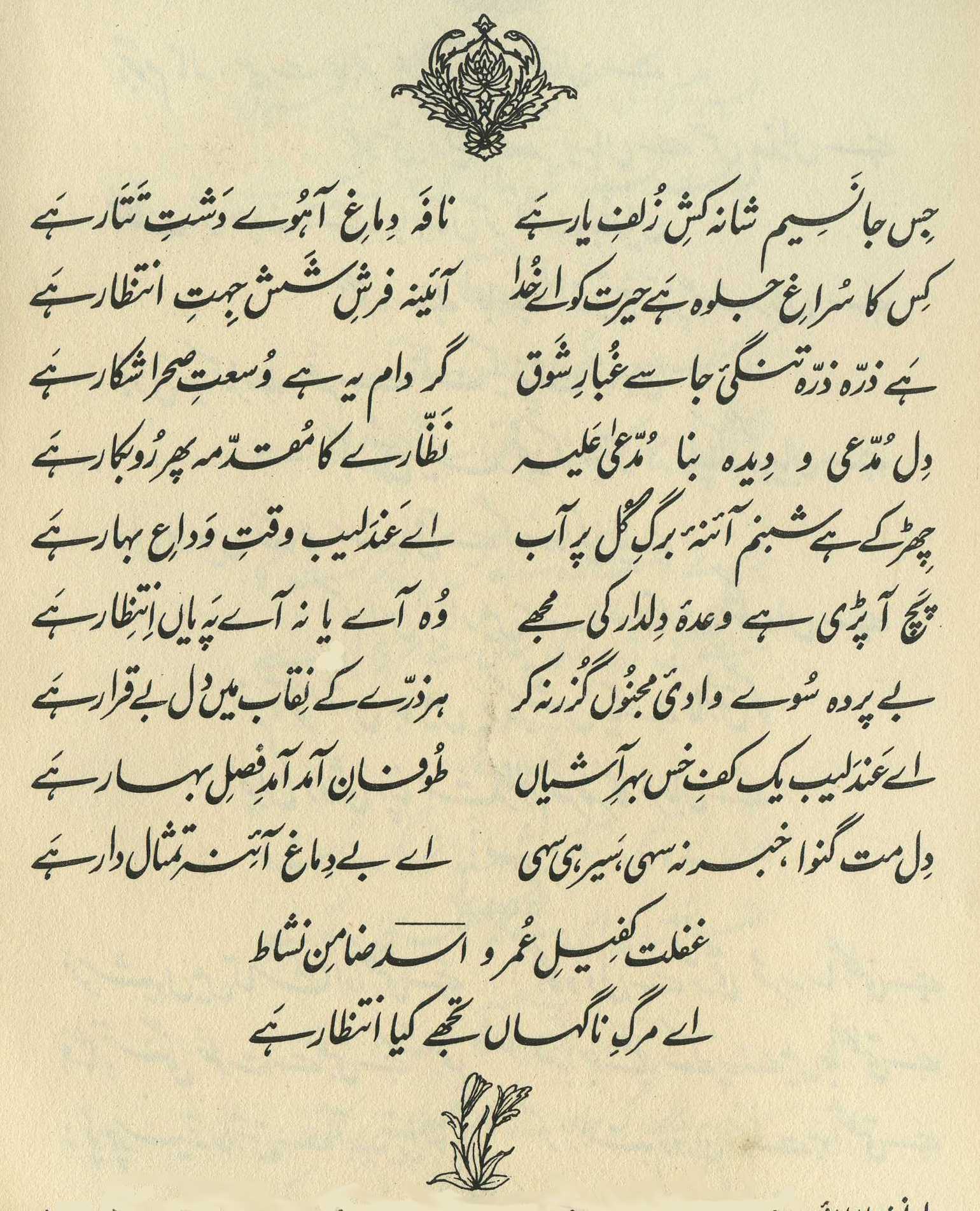
in the place where the spring breeze is comb-pulling through the beloved's curls
2
a musk-pouch is the conceit/mind/nose of the deer of the desert of Tartary
'A comb;... the shoulder-blade'.
'A bag or bladder of musk, musk-bag (i.q. )'.
'The brain; head, mind, intellect; spirit; fancy, desire; airs, conceit; pride, haughtiness, arrogance; intoxication; high spirits (produced by stimulants, esp. by drinking , &c.); --the organ of smell'.
| References | |
|---|---|
| Arshi, Imtiyaz Ali | Ghazal# 176 |
| Raza, Kalidas Gupta | 262-263,344-345 |
| Nuskhah-e-Hamidiyah | 266-269 |
| Asi, Abdul Bari | 267-268,269 |
| Gyan Chand | 391-392,392-394 |
| Hamid Ali Khan | Open Image |
That is, where the spring breeze would be blowing the perfume of the curls, there even the mind/nose of the deer of Tartary wouldn't go. In the second line, the author's intention was that the mind/conceit of the deer is a musk-pouch of the musk of Tartary-- that is, he wished to make the connection of Tartary with musk. But the waywardness of his pen was such that he made the connection of Tartary with the deer. (255)
== Nazm page 255

He says, on whichever territory the spring breeze spreads the perfume of the beloved's curls, there the mind/conceit of the deer of the desert of Tartary too becomes a musk-pouch. (312)
Where the spring breeze is blowing the perfume of the beloved's curls, there the mind/conceit of the deer too becomes a pouch of the musk of Tartary. That is, her curls have such a perfume that the mind/conceit of the door of Tartary too becomes perfumed. (462)
On musk-deer imagery, see 141,5 .
Central to the verse is the enjoyable wordplay about the body: means 'shoulder-blade' as well as 'comb'; the beloved's 'curls' appear; contains the word , 'navel'; and of course means 'brain' and 'nose'. If this isn't a verse of wordplay, what else could it be? Certainly its literal prose meaning seems labored, unpersuasive, and flat.
With the benefit of wordplay-- and that of in particular-- the second line acquires three separate readings:
=The 'conceit' or 'arrogance' of the deer becomes a musk-pouch-- smelling the scent of the beloved's perfume, the deer thinks it comes from his own musk-pouch, and he prides himself on that.
=The 'mind' or 'brain' of the deer becomes a musk-pouch-- the deer is unable to think of anything else except that fragrance.
=The 'nose' or 'sense of smell' of the deer becomes a musk-pouch-- the deer is unable to smell anything else except that fragrance.
All these readings assume that the perfume of the beloved's curls, even at a vast distance and greatly attenuated, is both more powerful and more desirable than the famously valuable scent-oil produced by the musk-deer-- and that this superiority is sensed even by the musk-deer himself. We have to take 'deer of the desert of Tartary' as describing a kind of deer, not the place where he lives, since the action of the verse is set in the place (wherever it may be) where the wind combs through the beloved's curls.
This verse is thus a little riff on the multivalence of , and is no better than one-dimensional at best. But without proper attention to the wordplay, it becomes a zero-dimensional verse. For more examples of this kind of wordplay on , see 11,2 .
graphics/curlcomb.jpg