Verse 21821ammeraa
G2
1
I loved the garden-- but now, there is this [much] irritation--
2
that from/with a wave of rose-scent, {I am harassed / 'the breath comes into my nose'}
The idiomatic use of conveys a sense of emphasis ( GRAMMAR ).
'Bad-temper, irritability, impatience'.
'The brain; head, mind, intellect; spirit; fancy, desire; airs, conceit; pride, haughtiness, arrogance... ; --the organ of smell'.
'To be greatly worried or harassed'.
| References | |
|---|---|
| Arshi, Imtiyaz Ali | Ghazal# 10 |
| Raza, Kalidas Gupta | 322-323 |
| Nuskhah-e-Hamidiyah | 27-28 |
| Asi, Abdul Bari | 60-61 |
| Gyan Chand | 84-87 |
| Hamid Ali Khan | Open Image |
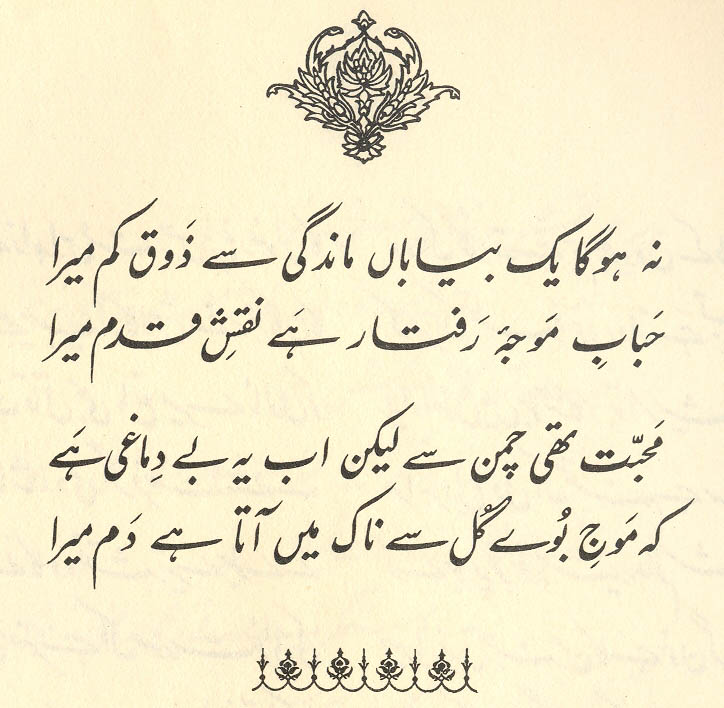
Since the scent of a rose comes into the nose when a breath is drawn, it's not inappropriate to say that with the scent of a rose the breath comes into the nose. And 'for the breath to come into the nose' means to be [displeased, vexed, disgusted]. Here, the second sense is intended, and he has made an toward the first sense. (13)
== Nazm page 13

Urdu text: Vajid 1902 {11}
The meaning is, formerly I loved the garden. Now such hatred has been born in me that the rose-scent, which formerly used to evoke joy and happiness-- now 'my breath is in my nose' from it. From the revolving of the times, love has taken on the form of hatred. (26)
I had an ardor for strolling in the garden, but now, enduring so many difficulties and remaining so unsuccessful, my heart has become so disaffected from the garden that the scent of the flowers has begun to make my mind disturbed and my breath choked. (24)
Compare 27,4 . (166)
ABOUT : A tertiary meaning of the word , which normally means 'brain, head, mind,' as well as 'pride, conceit', is of course 'nose' (see the definition above). In the present verse, this adds a further fillip to the wordplay involving . For other examples of such 'mind/nose' wordplay see 3,13x ; 21,7 *; 27,4 (perhaps); 53,8 ; 228,1 (in which all three meanings are operative). And for as 'nose-hair', see 42,8x . Just to show that Ghalib doesn't always 'activate' the potential wordplay, see the straightforward use of in 42,11x . For Mir ian examples, see M 386,1 .
Perhaps in this verse the lover is irritated because of the failure of love (the garden reminds him of the unavailable beloved), perhaps because of its limits even when most successful (the garden reminds him of the briefness of life). Or does the garden vex him by its seductiveness (when he wants to lead a life of undistracted austerity), or by its sheer physicality (when he wants to move into the realm of spirit)?
In any case, Nazm has pointed to the chief source of enjoyment in the verse: its irresistibly clever exploitation of the idiom (see the definition above). If we take the expression idiomatically, a wave of rose-scent (normally a wonderful pleasure) harasses and upsets the speaker. If we take the expression literally, the speaker says that 'the breath comes into my nose with/from/like a wave of rose-scent'; this might be taken to mean that he is so obsessed with his anti-garden hostility that it's as if he's compelled to breathe in rose-scent every time he inhales. But this literal sense is really a rather tortured reading and has no clear ' connection ' with the first line. Thus the literal meaning is perhaps best taken as excellently framed wordplay.
Compare Mir 's treatment of a similar kind of disaffection: M 693,1 .
graphics/rosegarden_ooty.jpg