Verse 8x1821aaaashnaa
G1
1
it's a disagreeable/'nose-hair' fire of/to ardor, your heat/zeal
2
otherwise, of whom {are we / would we be}, oh wound of longing, a friend?
'Hateful, disagreeable'. (Steingass p.1350)
'The brain; head, mind, intellect; spirit; fancy, desire; airs, conceit; pride, haughtiness, arrogance; intoxication; ... —the organ of smell'.
'Warmth, ardour, fervour, zeal; the anguish of love; solicitude of friendship; love, affection, friendship; apparent cordiality; —affliction, distress, uneasiness, disquietude; consternation'.
'Acquaintance; friend; associate; intimate friend, familiar; lover, sweetheart; paramour; mistress, concubine; --adj. Acquainted (with, - ), knowing, known; attached (to), fond (of)'.
| References | |
|---|---|
| Arshi, Imtiyaz Ali | Ghazal# 21 |
| Raza, Kalidas Gupta | 324 |
| Nuskhah-e-Hamidiyah | 66-67 |
| Asi, Abdul Bari | 68 |
| Gyan Chand | 103-105 |
| Hamid Ali Khan | Open Image |
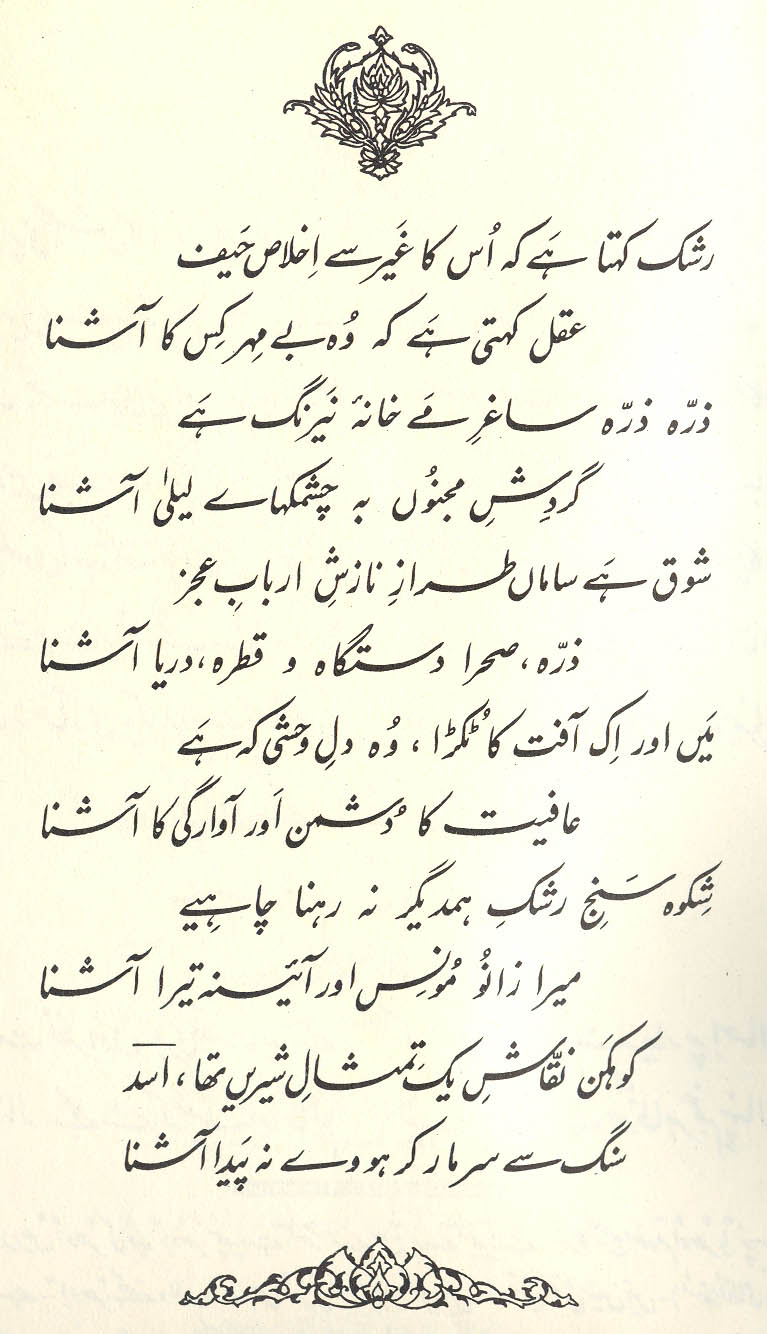
To the wound of longing he says, 'We don't meet and mix with anyone but you-- becaise the 'heat' that you increased was only so that the hair that had grown in the nose of ardor and had kept on causing pain, would be burnt up, and exactly this is your specialty'. The point of speaking to the wound of longing is that we long only to somehow suppress unsuccessful ardor. If it would not be suppressed, then like a hair in the nose it will keep on pricking.
== Zamin, p. 65
A is someone who would be rejected and excluded from company. And is passion. The is that which terminates pursuits and activities that take one away from passion. Since the enemy of an enemy is a friend, the fire that burns displeasing hairs will be pleasing.
The is the wound of longing, that obviously befell after failure in love. Whether in love there's success or failure, union or separation, it definitely makes one indifferent to the affairs of the world. We were not friends with anyone; but, oh wound of longing, in the path of ardor you burned up all the obstacles that were hindering us. Thus we've been pleased with your heat/exuberance.
== Gyan Chand, p. 104
For background see S. R. Faruqi's choices . For more on Ghalib's unpublished verses, see the discussion in 4,8x .
Here's a really classic case of grotesquerie! It makes me wish for more commentators, to see what they would have made of it. Both Gyan Chand and Steingass discreetly define only in general terms, as someone or something unpleasant or distasteful. But it seems to be an idiomatic use of a Persian phrase with the clear literal meaning of 'nose-hair'. (If you're surprised at as 'nose', see 11,2 for discussion.) Apparently an ingrown nose hair can be painful and vexatious.
Asi omits this verse alone from his commentary, perhaps in order avoid the vulgarity of 'nose-hair'. Zamin, perhaps because he's not familiar with the Persian idiom, goes to the other extreme and discusses only the literal meaning: he imagines that a nose-hair might irritate the nose, and thus annoy the owner of the nose.
To paraphrase Gyan Chand, it seems that the burning heat of the wound of longing is a fire that destroys the 'nose-hair' of ardor-- that is, it burns up whatever is annoying and bothersome and distasteful to, or in, ardor. Thus the speaker says: 'Oh wound of longing, if I'm not your friend, then whose friend am I (or, would I be)?'.
In the previous verse, 42,7x , the lover's one friend was 'friendlessness'; here, with much less piquancy, it's a hot and burning wound. I can't see much real connection between the two lines, other than the vague idea of heat and fire. Disappointingly, it doesn't even do anything special with . Perhaps for the original audience, the enjoyable shock of encountering that particular idiom in a formal poetic context was enough to energize the whole verse. It's certainly a ' fresh word '; it appears nowhere else in the published divan .
For other 'nose-hair' verses, see 117,5x ; and 360x,2 (in which apparently the expression is reversed, and seemingly refers to something cherished).
graphics/nosehair.jpg