Verse 51821aaaashnaa
G1
1
we ought not to remain complaint-reciters of mutual jealousy/envy
2
my knee(s)-- a companion; and the mirror-- your friend
'Solacing, consoling, cheering; --s.m. A sociable companion; an intimate friend; a solacer, consoler'.
'Acquaintance; friend; associate; intimate friend, familiar; lover, sweetheart; paramour; mistress, concubine; --adj. Acquainted (with, - ), knowing, known; attached (to), fond (of)'.
| References | |
|---|---|
| Arshi, Imtiyaz Ali | Ghazal# 21 |
| Raza, Kalidas Gupta | 324 |
| Nuskhah-e-Hamidiyah | 66-67 |
| Asi, Abdul Bari | 68 |
| Gyan Chand | 103-105 |
| Hamid Ali Khan | Open Image |
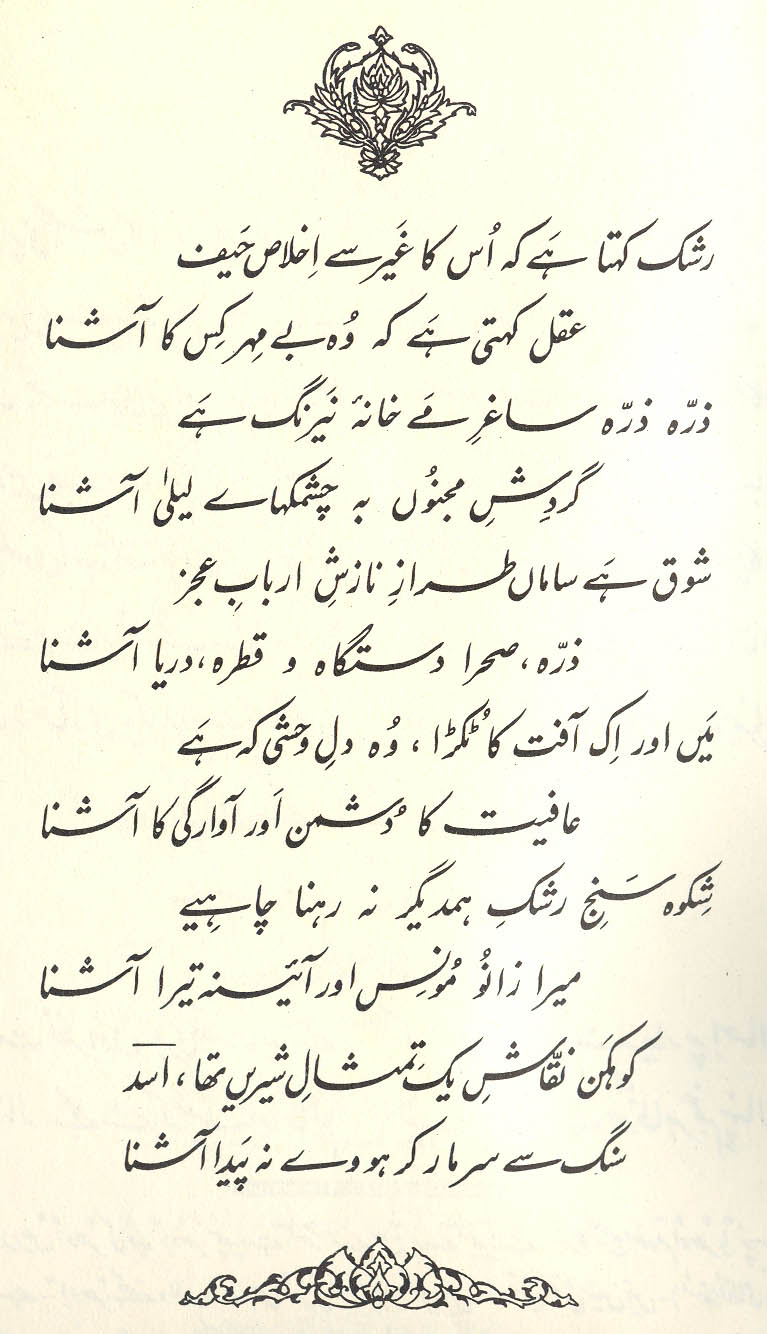
That is, you constantly remain absorbed in the mirror, and I don't complain; and if I constantly sit with my head on my knees, then don't you take it amiss. Poets always use the mirror as a simile for the knees. (40)
== Nazm page 40

He says, jealousy and suspicion are both creators of displeasure. We two ought to ignore both those disasters. Because the knees are my friend, I always have my head on my knees. And the mirror is your friend, you're always absorbed in it. You ought not to complain, nor ought I to take it amiss. (78-79)
Janab Shaukat [makes the objection that] the beloved absolutely never feels jealousy of the way Ghalib's head rests on his knees; thus, some other word should be used.
[I reply that] although the beloved's jealousy is not as famous and well-established as the lover's, the world is not devoid of such examples.... [A]lthough the beloved herself is not kind, she finds no rest from the suspicion-- 'After all, love for whom has made him into a picture of grief, and about whom is he always thinking?' (97-98)
[See his discussion of 71,2 .]
Here an unusual degree of symmetry is set up between the lover and the beloved-- at least, at first glance. For one thing, they are envisioned as mutually jealous of each other. This does sound strange, in ghazal terms, but I think Bekhud Mohani has explained it well. The beloved too can be-- at least sometimes, and at least in her own way-- exceptionally possessive about the lover's attention, and suspicious of his possible attentions to others.
The interest here lies, as it does so often, in the relationship between the two lines. Does the second line describe the cause of the jealousy, or merely a symptom of it?
On the 'cause' reading, which the commentators generally adopt, the beloved is jealous of the lover's knees, since he always sits hunched over, with his head down, and his eyes lowered so that his melancholy gaze is directed toward his knees. For more on the possible attitude of the knee(s) [], see 32,2 . Similarly, the lover is jealous of the beloved's mirror, since her eyes are always obsessively focused on it. Each resents the other's absorption in another object of attention, even though it's not a human Rival. The lover is urging an end to this jealousy-- they shouldn't think of these objects of attention as rivals, but merely as each other's comforting friends.
On the 'symptom' reading, the lover and beloved have been jealously quarreling, each accusing the other of spending time with other beloveds or lovers. Now they are both sulking, both pointedly ignoring each other: he stares at his knees, she fixes her gaze on the mirror. The line thus describes a symptom of mutual jealousy, not a cause. This reading has a modern, solipsistic edge to it. Which is more irritating-- a flirtatious lover, or a self-absorbed, sulky one? And ultimately, isn't a self-absorbed lover really flirting with himself/herself? (For more on the complexities of , see 53,4 .)
There might even be a kind of 'cure' reading as well. Perhaps the lover is urging an end to their jealous quarrels-- they should realize that in fact neither of them spends any time with Rivals at all. The lover offers proof: apart from each other, they spend their time alone. He spends his time staring at his knees, she spends her time gazing into the mirror. They should both realize that his knees are in fact his only 'companion', her mirror is in fact her only 'friend'.
Note for Arabic usage fans: In principle, the word is not . Rather, the is a chair for a , as in the case of . (See the spelling used in Platts.) In this case, however, the scansion is not affected either way. I've modernized the spelling just to make the screen display easier.
Compare this verse with its unpublished cousins, 42,7x and 42,11x .
graphics/mirror.jpg