Verse 41821aakaa
G9
In this meter the next-to-last long syllable may be replaced by two shorts.
1
in the grief of separation, don't give me the trouble of [taking] a stroll in the garden
2
I have no mind/desire for inappropriate smiles
'The brain; head, mind, intellect; spirit; fancy, desire; airs, conceit; pride, haughtiness, arrogance... ; --the organ of smell'.
| References | |
|---|---|
| Arshi, Imtiyaz Ali | Ghazal# 14 |
| Raza, Kalidas Gupta | 326 |
| Nuskhah-e-Hamidiyah | 57-58 |
| Gyan Chand | 91-92 |
| Hamid Ali Khan | Open Image |
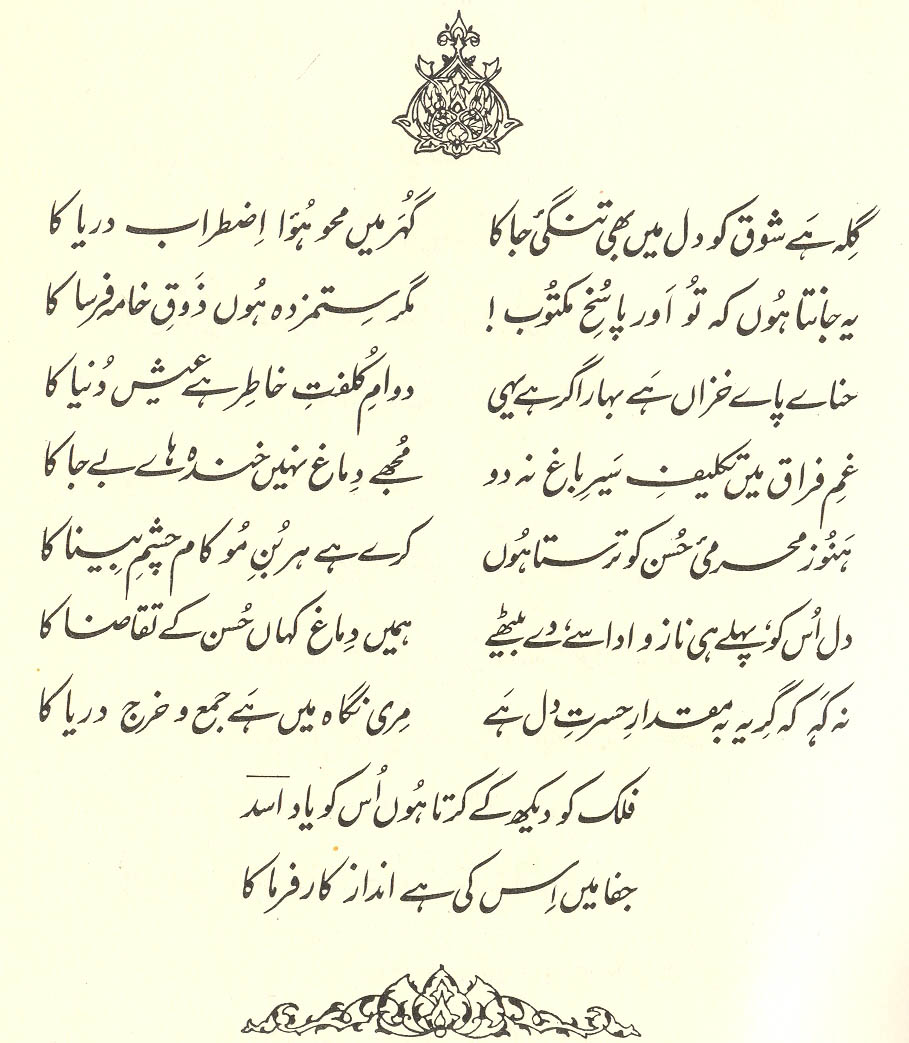
He has called the smile of the rose an inappropriate smile since it does not smile at some thought, or because it is surprised, so it's as if its smile is out of place.
==Urdu text: Yadgar-e Ghalib , pp. 140-41
That is, I can't stand to look at the smile of the rose. (28)
== Nazm page 28

Urdu text: Vajid 1902 {27}
When one is grieved or sorrowful, inappropriate smiles are generally displeasing to one's temperament. There's no question about the verse's excellence. (57)
He has not called the smile of the rose inappropriate because it is devoid of understanding. Rather, he has said this because when we are in this state, then what occasion is there for laughter? (71)
Compare 11,2 . (166)
[Compare his comments on Mir's M 386,1 .]
In the ghazal world the tightly closed bud, 'narrow' and like an oppressed heart, smiles or laughs as it opens into a rose, since its widening petals look like a mouth smiling in enjoyment. And of course, its smiles betoken its imminent death, which works very well for poetic purposes.
This verse also plays on the , which means 'mind, desire' (see the definition above); for more examples of this kind of wordplay on , see 11,2 . It also has a tertiary meaning of 'nose' or 'sense of smell', though this is not so clearly invoked in the present verse. For the rose's 'smile' coincides with its diffusion of rich perfume, as well as its brilliant color and imminent death. Any or all of these might distress the morbidly sensitive lover; as usual, Ghalib leaves all possibilities open.
Why are the rose's smiles 'inappropriate' or 'out of place'? Hali says it is because the rose smiles at random, for no good cause. The two Bekhuds say it's because the lover is in no mood for joviality and cheer. Both reasons make sense, but I think the latter is closer to the heart of the matter. This is a great verse for expressing the lover's irritable, disaffected mood. Can't you just hear the stiff and cranky tone in which he rebuffs the well-meaning friend who is trying to cheer him up?
Compare Mir 's treatment of the theme, as he cuts dead the friendly overtures of the roses: M 693,1 . Elsewhere, he perhaps tries to avoid going to the garden in the first place, by taking refuge in postponement: M 1502,2 .
graphics/smileyflowers.jpg