Verse 31821aakaa
G9
In this meter the next-to-last long syllable may be replaced by two shorts.
1
spring is henna on the foot of autumn; if it is only/emphatically this
2 a
the pleasure/luxury of the world is a perpetual vexation of the temperament
2 b
perpetually, the pleasure/luxury of the world is a vexation of the temperament
2 c
the pleasure/luxury of the world is the perpetuity of vexation of the temperament
''Life; animal life'; a life of pleasure and enjoyment, pleasure, delight, luxury; gratification of the appetites, sensuality; carnal intercourse'.
'Continuing, lasting; persevering; continuance; perpetuity; duration;--adv. Continually, always, perpetually, eternally'.
'Trouble, vexation, distress, inconvenience'.
tir>> : ''Whatever occurs to or passes in the mind,' cogitation, thought, suggestion; memory, remembrance; --mind, soul, heart; inclination, propensity; affection, regard, favour; pleasure, satisfaction; will, choice'.
| References | |
|---|---|
| Arshi, Imtiyaz Ali | Ghazal# 14 |
| Raza, Kalidas Gupta | 326 |
| Nuskhah-e-Hamidiyah | 57-58 |
| Gyan Chand | 91-92 |
| Hamid Ali Khan | Open Image |
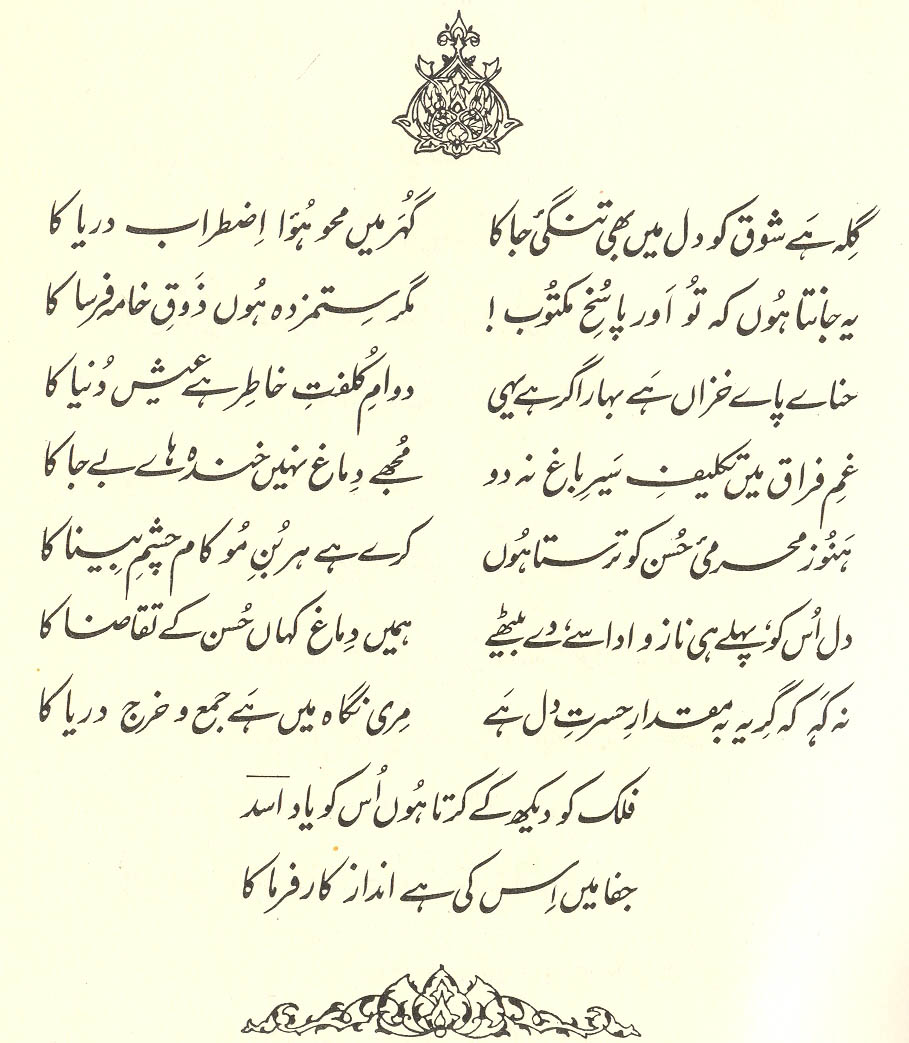
That is, even if it's spring, so what? It's the red color of henna; in a few days it will fade away-- and then only the foot of autumn will make itself felt. (28)
== Nazm page 28

He says, if spring is so transitory and fleeting, then what is spring anyway? That is, the spring season is the henna on the foot of autumn, which will vanish very quickly; and it can be compared to enjoyment of the world. The period of enjoyment is extremely short, and inner pain remains established for a lifetime. (56)
He has used spring as a simile for enjoyment of the world, and fall for inner suffering. To call spring 'henna on the foot of autumn' is the limit of the flight of thought. What further meaning-creation can there be than this? (92)
Metrically speaking, an after is permissible but not required. Arshi doesn't have an there, so I take his as the preferred reading. But I also like (2c), the reading with the (as Hamid does too).
'Spring is henna on the foot of autumn'-- as Josh says, what could be more complexly meaningful, and also more beautiful? Even in English some of its loveliness comes through. Henna is brightly colored, changing from a kind of greenish shade when first applied to hands and feet, to a vivid reddish color when fully dry. (For more on henna, see 18,4 .) Henna is usually applied in ornate, lacy designs that exult in their own delicacy and extravagance, and of course it is a supremely festive symbol used for celebrations, especially weddings. It is also all too temporary-- within a week or two it has begun to fade, within another couple of weeks it is gone.
Obviously, these qualities resonate with those of springtime. The henna is gorgeous but vulnerable, just a thin little layer-- and as Nazm says, when it's gone 'only the foot of autumn will make itself felt'. The henna of springtime is a brief, deceptive veneer of color and enjoyment. It's false advertising, a bait-and-switch, inducing us to buy into a world full of bleakness and suffering-- an autumnal world. One small benefit might be that if henna is applied to the feet of autumn, it may also prevent autumn from moving until the henna has dried, and thus buy us a bit more time.
But there's no escape-- the assertion in line one, if accepted ('if this is so'), directly implies line two. The force of the second line comes from the heavy weight of , which can be any of three distinct parts of speech. It can be an adjective ('perpetual, permanent') as in (2a), or an adverb ('perpetually, permanently') as in (2b), or a noun ('perpetuity, permanence') as in (2c); in this latter case, we would read with an after it.
In all of these senses, applies to the heavy burden of 'trouble, vexation' (see the definition of above) that is the opposite of the frail, thin, delicate layer of henna. The henna of spring, with its vivid and complexly radiant design that's soon to be worn away, survives only briefly-- only long enough to seduce us into embracing (to our sorrow) a world that 'perpetually, permanently' crushes us under its no-longer-hennaed foot.
graphics/hennafoot.jpg