Verse 81821aakaa
G9
In this meter the next-to-last long syllable may be replaced by two shorts.
1
having looked at heaven/sky/fate, I remember her/Him, Asad
2
in anger she/He has the manner of a ruler/commander
'The celestial sphere, the vault of heaven, the firmament; heaven; sky; sphere; fortune, fate'.
'An emperor; a minister; a commander; a superintendent; anyone vested with power'.
| References | |
|---|---|
| Arshi, Imtiyaz Ali | Ghazal# 14 |
| Raza, Kalidas Gupta | 326 |
| Nuskhah-e-Hamidiyah | 57-58 |
| Gyan Chand | 91-92 |
| Hamid Ali Khan | Open Image |
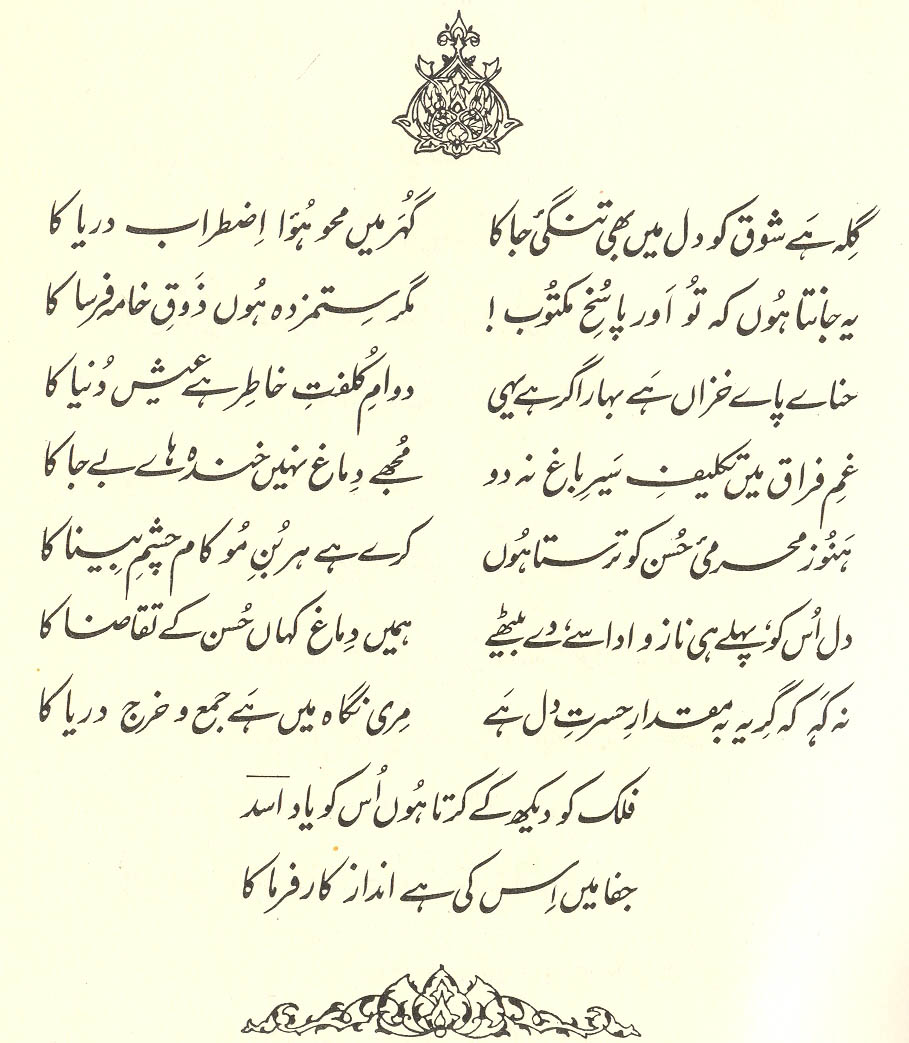
That is to say, when I have looked at the sky, the Lord comes to mind, because the oppression that falls from the sky is due to His command.
==Urdu text: Yadgar-e Ghalib , p. 141
That is, when does the sky have this talent for behaving like an idol? There's some Beloved behind the curtain of the mirror's backing. (28)
== Nazm page 29

The verse is very clear, and the thought very pure. (58)
[According to Asi:] When I, in a state of oppression, look at the sky, then my beloved comes to mind. Because the cruelty of the heavens looks to me like a glimpse of my beloved's commandingness. From this the result emerges that the beloved alone is the origin of tyranny and cruelty, and she alone has given the heavens the order for cruelty. (99)
Hali provides the obvious pious reading; Asi, as quoted by Baqir, lays out the worldly-love one. Naturally, both are possible. The first line sets up the ambiguity-- the pious suggestion of looking up at the heavens, from whence descend disasters [], and then of reflecting on the power of God. The second line is such a truism when applied to God-- namely, that when God gets angry he can do powerful (bad) things-- that it's hard to avoid moving beyond it, to the alternative reading in which the thought is of the human beloved.
The really striking thing is the omission of from the second line. If that word were there then we could read, in anger she too has commanding power; thus her power would be seen in the light of God's celestial power, and as an echo of it. But Ghalib's refusal to put in the means that only one powerful ruler is thought of in both lines: if the verse is about God, then it is a cliched commonplace; if it's about the beloved, then she entirely displaces God from the lover's horizon. When the speaker looks at the heavens, the proper domain of God alone, he doesn't think of God at all, it's she whom he thinks of-- for she has masterful power when she's angry. God, in short, is nowhere, since not even looking at the heavens serves to evoke him, and the very quality he is famous for-- being powerful and dangerous when angered-- is blithely transferred to the beloved. Her status as an idol has rarely been so unselfconsciously confirmed.
For another meditation on the sky, the beloved, and memory, see 136,1 . There are also intriguing similarities with 200,3 .
Mir plays his own tricks with this kind of ambiguity in M 139,6 .
graphics/sky.jpg