Verse 11821aakaa
G9
In this meter the next-to-last long syllable may be replaced by two shorts.
1
ardor has a complaint, even/also in the heart, of narrowness of place
2
in a pearl became absorbed/annihilated the restlessness of the sea
is , in a variant spelling to accommodate the scansion.
'Erased, effaced, obliterated; forgotten; abolished; annihilated; --overpowered (by), struck or astonished, thunder-struck; fascinated, charmed, captivated; mad (from love), distracted (with terror or grief); --engrossed, absorbed, wrapt (in)'.
| References | |
|---|---|
| Arshi, Imtiyaz Ali | Ghazal# 14 |
| Raza, Kalidas Gupta | 326 |
| Nuskhah-e-Hamidiyah | 57-58 |
| Gyan Chand | 91-92 |
| Hamid Ali Khan | Open Image |
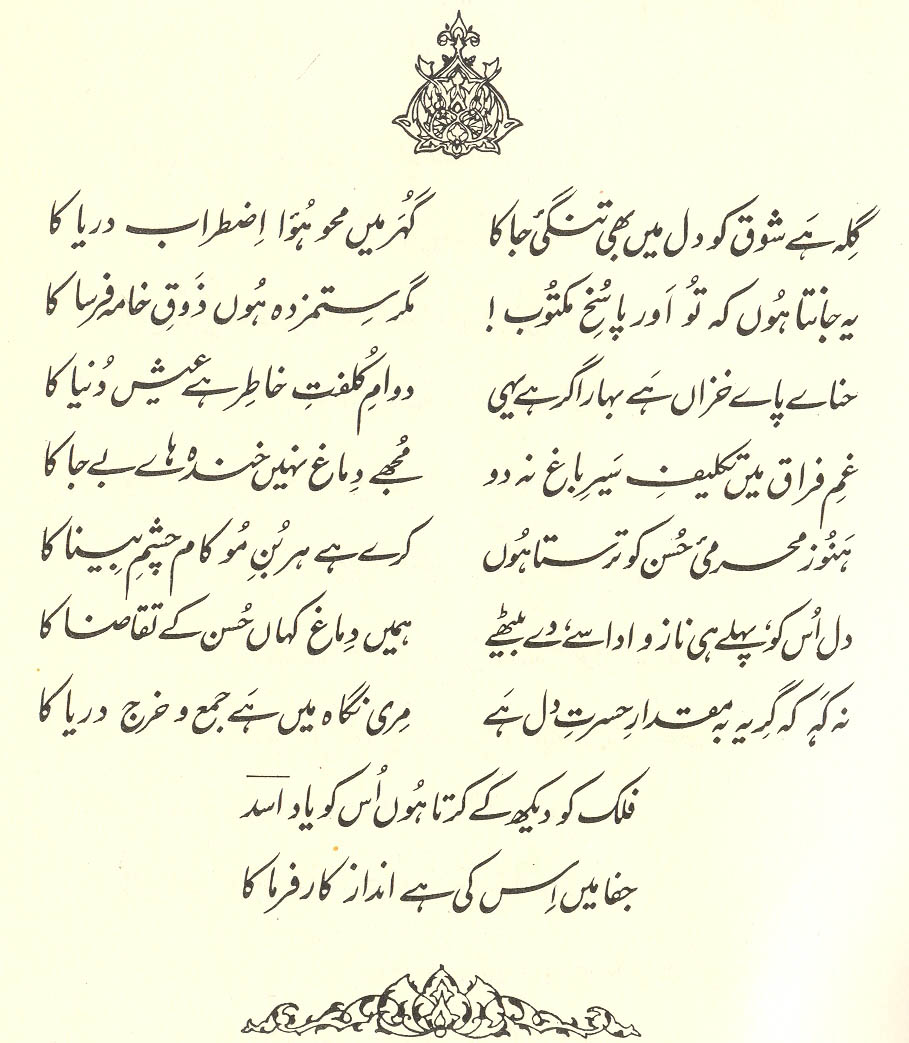
That is, Ardor, having been contained within the heart, can't show its turmoil and turbulence because of the narrowness of the space, as if the sea became contained within a pearl, so that it had no more buffetings left. (28)
== Nazm page 28

Urdu text: Vajid 1902 {27}
Mirza Sahib says in a tone of surprise, that Ardor complains of narrowness of space even in the heart! The word 'even' tells us that the heart is such a broad thing that both worlds are contained in it, and it still remains empty. Despite this breadth, Ardor complains of the narrowness of space. It seems that the breadth of Ardor too is not in any way less than the breadth of the heart.
Now let's consider the proof [] of the narrowness of space. He says that the flow of the sea became absorbed in a pearl, that is, the sea became contained in a pot. But because of the compressedness, the motion of the waves came to a stop. He's used the simile of the pearl for the heart, and the sea for Ardor, which is an entirely new simile. The truth is that in this opening-verse he has confined the sea within a pot. Then, the pleasure is that no diminution has been allowed to occur in the trimness of construction, the proportionateness of words, the style of expression. Both lines seem to have been shaped in the same mold. (56)
In a very beautiful ornamentation, Mirza has juxtaposed the restlessness of Ardor and the restlessness of the sea. He says, what comparison is there between the restlessness of the sea and the restlessness of Ardor? The extent of the restlessness of the sea is merely such that a drop of water enters an oyster and assumes the form of a pearl. Its restlessness is a feature of its nature that has vanished-- although how much scope is there in a pearl? In comparison to it, look at the extent of the restlessness of Ardor-- such that even in a broad place like the heart it complains of narrowness of space. (70)
Compare this verse with 29,4 . (74)
Compare 62,6 . (205)
The meter in which this ghazal has been composed is the least popular among the meters used in Urdu. In our time it is being used even less. [Discussion of its various forms.] ....
If the second line would be taken as a negative rhetorical question, then the meaning at once becomes plain. Now the meaning will be that although the heart is broad, Ardor is broader. Thus Ardor complains of narrowness of space even in the heart. The illustration [] of this is that water/luster [] is in a pearl, and water is in the sea too. But how could it ever be possible for the ocean's restlessness (that is, its waves) to be contained in a pearl! A pearl no doubt contains a thousand waters/lusters, but it is less than the water of the sea. The water/luster of the pearl is likened to stilled water.
== (1989: 45-46) 2006: 53-56
[See also his comments on Mir's M 1506,5 .]
Here is a marvelous and mysterious verse, a classic 'A,B' example of that Ghalibian strategy of giving us two separate statements and leaving it up to us to decide about their mutual relationship. (This is the verse that first made me realize that 'A,B' structure existed. Imagine that-- such a powerful device, and no recognition of it in Persian/Urdu poetics!)
=Do the two lines describe the same situation, the first literally and the second metaphorically? If so, the confinement of which Ardor complains within the heart, can be understood or illustrated by imagining the confinement that the whole restless ocean would feel inside a pearl.
=Or do the two lines describe different but similar situations? Ardor complains of narrowness within the heart; similarly, the restlessness of the sea is 'abolished' or 'annihilated' (see the definition above) by confinement within a pearl. Thus Ardor is unhappy in its own compressed space of the heart, and the sea too is unhappy when its restlessness is confined within a pearl. Both are essentially uncontainable.
=Or do the two lines describe different, contrasting situations, the first line one of unsuccessful 'absorption', and the second line one of successful 'absorption'? This reading would suggest that while the sea is containable, Ardor is not. The sea is containable in a pearl, while Ardor is not containable 'even' in the heart. The little 'even'-- such a touch of brilliance!-- implies either that the heart must be a more powerful container and absorber than a pearl, or else that the heart is more spacious than any other imaginable container; it also suggests that Ardor might be a wilder force than the sea.
Faruqi reads the second line as a negative rhetorical question ('Could the restlessness of the sea ever become absorbed in a pearl?'); it could also be an exclamation of scorn ('As if the restlessness of the sea could ever become absorbed in a pearl!'). In other words, we should hardly be surprised that Ardor complains-- it was a foregone conclusion that it would complain, since the very idea that it could be contained, even within the heart, was so absurd. As absurd, in fact, as the idea that the restlessness of the sea could be absorbed within a pearl.
The logical possibilities are all there, and all kept fully open. But in addition, how beautiful the lines are! Even in my deliberately clunky English they haven't lost quite all their power and mystery, and of course in Urdu they sound gorgeous. For an even more complex verse along similar lines, see 27,7 . For another meditation on 'narrowness of place', see 228,3 .
Compare Mir 's equally extravagant use of the sea: M 100,6 .
graphics/pearl.jpg