Verse 6after 1826uurnahii;N
G5
In this meter the first long syllable may be replaced by a short; and the next-to-last long syllable may be replaced by two shorts.
1
when I say, 'We will take you on Doomsday!'
2
with what haughtiness she says, 'We are not a Houri .'
| References | |
|---|---|
| Arshi, Imtiyaz Ali | Ghazal# 103 |
| Raza, Kalidas Gupta | 371 |
| Gyan Chand | 492 |
| Hamid Ali Khan | Open Image |
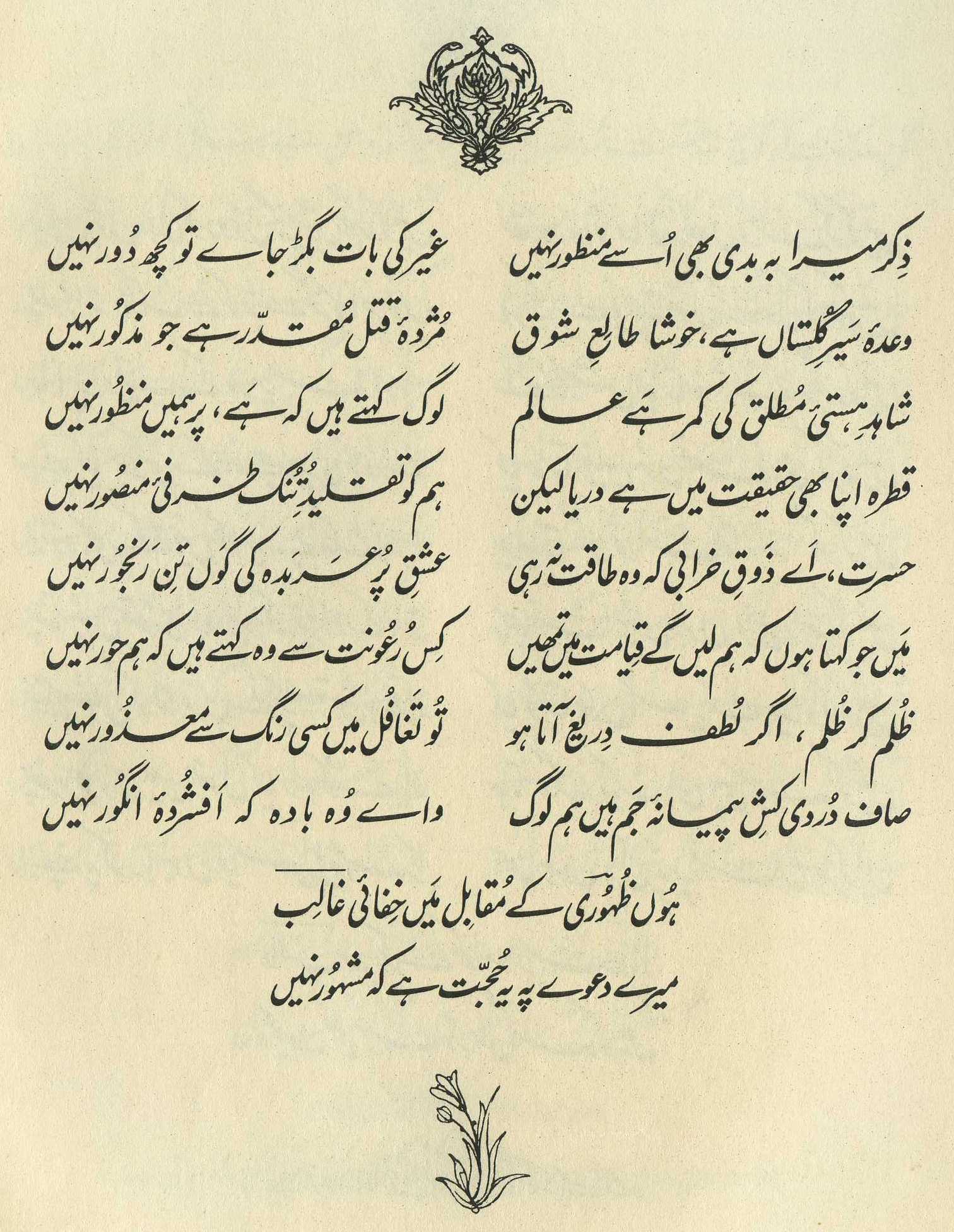
This too is a major theme of the ghazal, that the beloved's repartee should be mentioned; and often such verses become the high point of the ghazal . (105)
== Nazm page 105

In this verse the beloved's repartee creates an extraordinary pleasure. He says, when I said to her, 'Here you hate us and remain very far from us; on Doomsday we will ask for you from God'-- hearing this, with extreme pride that mischievous one said to us, 'We are not a Houri, that we would be given to you'. (157)
In one [other] place, in the guise of longing too, he has said just the same kind of thing: 111,7 . (205)
Compare 111,7 . (229)
Playfulness, so typical of a large number of Ghalib's couplets. Also hints at the poet-lover's belief that the beloved is actually far more beautiful than the most beautiful Houri.
== Naim 1972, p. 9
Repartee [] is indeed the great charm of this verse. It's a pleasure to hear how thoroughly the beloved deflates the lover's wistful or playful threat. While an ordinary woman would be flattered to be called a Houri [] or a Pari -like one [], the beloved is not only not flattered, she is actually insulted: can she possibly be likened to a mere celestial maiden of Paradise? She speaks with hauteur, even disdain. She's not one to get worked up over such trivial insults, things so impossible to take seriously for even a moment. Thus the effect of her repartee is doubled by her indifference.
This one is also an almost perfect mushairah verse. The punch-word, , the single word that makes the whole verse comprehensible and also renders the whole joke amusing, is withheld until the last possible moment. It's hard to imagine that the original audience wouldn't have burst out laughing when they heard it.
The comparison with 111,7 proposed by Bekhud Mohani and Arshi is also, in thematic terms, very apt. But without the element of deadpan dialogue, that one is less amusing than the present verse.
This verse is of course a member in good standing of the 'snide remarks about Paradise' set; for more of these, see 35,9 . It is also a verse in which the beloved seems not to be God; for others, see 20,3 .
Compare 413x,4 , a clever variation on the same general idea.
graphics/hur.jpg