Verse 2after 1826uurnahii;N
G5
In this meter the first long syllable may be replaced by a short; and the next-to-last long syllable may be replaced by two shorts.
1
there is a promise of a stroll in the garden-- bravo, (auspicious) fortune of ardor!
2
the good news of murder is destined/implied, which is not mentioned
taala((>>: 'Rising, appearing (as the sun), arising; --s.m. Star, destiny, fate, lot, fortune; prosperity'.
'Decreed (by God), appointed, ordained, destined, predestined, predetermined; --understood, implied'.
| References | |
|---|---|
| Arshi, Imtiyaz Ali | Ghazal# 103 |
| Raza, Kalidas Gupta | 371 |
| Gyan Chand | 492 |
| Hamid Ali Khan | Open Image |
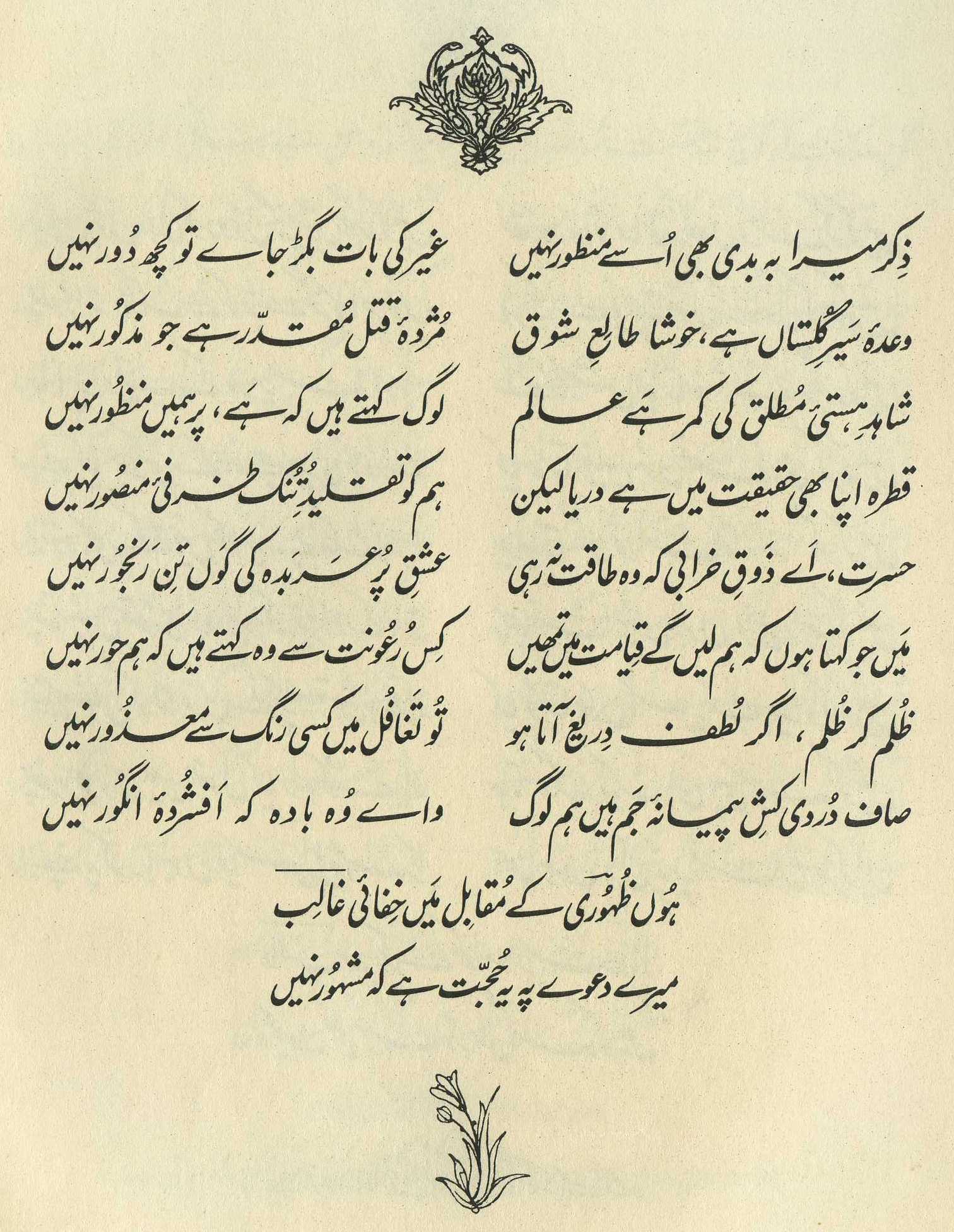
That is, she promised to enjoy the spectacle of tulip and rose. From that I realized that she will slay me. How could it be vouchsafed to me that truly she would, in my presence, take a stroll through the garden? It's not strange that instead of the good news of slaying, she would have said the good news of union. (105)
== Nazm page 105

The meaning of the verse is that she will look at the flowers with an admiring gaze, and I, considering them Rivals, will be slain by envy. (156)
By 'a stroll in the garden' she doesn't mean a real walk in the garden. Rather, she's so bloodthirsty and cruel that she considers the sight of wounded ones writhing in blood to be a stroll through roses. Thus from her promise of 'a stroll in the garden' it ought to be understood that she gives me the good news of my being slain. He has said just such a thing in two other places, 8,3 and 136,4 . (204)
is that [implied] word that comes before some utterance and would not be mentioned [].... Some judge that in place of 'good news of slaying' there should be 'good news of union', but this opinion doesn't seem to be correct. The reason is that from saying 'good news of union' the verse becomes superficial, and Mirza's special style of speech and tone of poetry is erased. (197)
[Ghalib once quoted a somewhat altered form of the second line in a letter:] 'the longing for union is implied, which is not mentioned' []. (229)
What makes this a verse of 'double activation' is that both meanings of are independently and conspicuously brought into the verse:
=Its meaning of (auspicious) fortune or destiny is strongly linked to in the first line (see the definition above).
=Its meaning of 'implied, understood' makes it an exact opposite of 'mentioned' [] in the second line.
=It is actually defined in the second line: what else is something 'implied', but something 'that is not mentioned' []?
=It joins with 'mentioned' to form a pair that occupies the whole verse, which could well be called a verse of implication . After all, what does happen in the verse? The lover hears one thing that is 'mentioned' (a stroll in the garden), and instantly, confidently deduces another thing that is not mentioned but is 'implied' (his murder).
Clear evidence of all this impliedness and non-explicitness is how differently the commentators themselves interpret the 'implications' of the verse. For Nazm, the beloved is, by promising the lover a favor so huge it's unimaginable that she would grant it, implying that she will kill him instead; for Bekhud Dihlavi, it's her admiration for the flowers that will kill the lover with jealousy; for Bekhud Mohani, the beloved is announcing her plans to stage a spectacle of red blood and swaying, writhing forms by killing him, since that's what she means by a stroll in the garden (as in 8,3 ).
I like Bekhud Mohani's reading best, and he also supports it with two very apposite verses. But what I really like is the cleverness with which and deftly, unobtrusively, shape not only the affinity patterns in the verse, but even its semantic content, with the latter embedded in a definition of the former. In such a small space, Ghalib gives us several quite different forms of patterning to enjoy. What can you say of such a poet, except !
graphics/bloodyflower.jpg