Verse 3after 1826uurnahii;N
G5
In this meter the first long syllable may be replaced by a short; and the next-to-last long syllable may be replaced by two shorts.
1
it is the waist of the Beloved of absolute/unconfined existence, the world--
2 a
people say that [this] is [so], but [the claim] is not accepted by us
2 b
people say that it exists/'is', but it is not 'seen' by us
tlaq>>: 'Freed, free, unrestricted, unconfined; unconditional; indefinite; unrestrained, uncontrolled; not shackled; independent, absolute, entire, universal; principal, supreme'.
zuur>>: 'Seen, looked at; visible; admired; --chosen; approved of, admitted, accepted; sanctioned, granted; --agreeable, acceptable, admissible'
| References | |
|---|---|
| Arshi, Imtiyaz Ali | Ghazal# 103 |
| Raza, Kalidas Gupta | 371 |
| Gyan Chand | 492 |
| Hamid Ali Khan | Open Image |
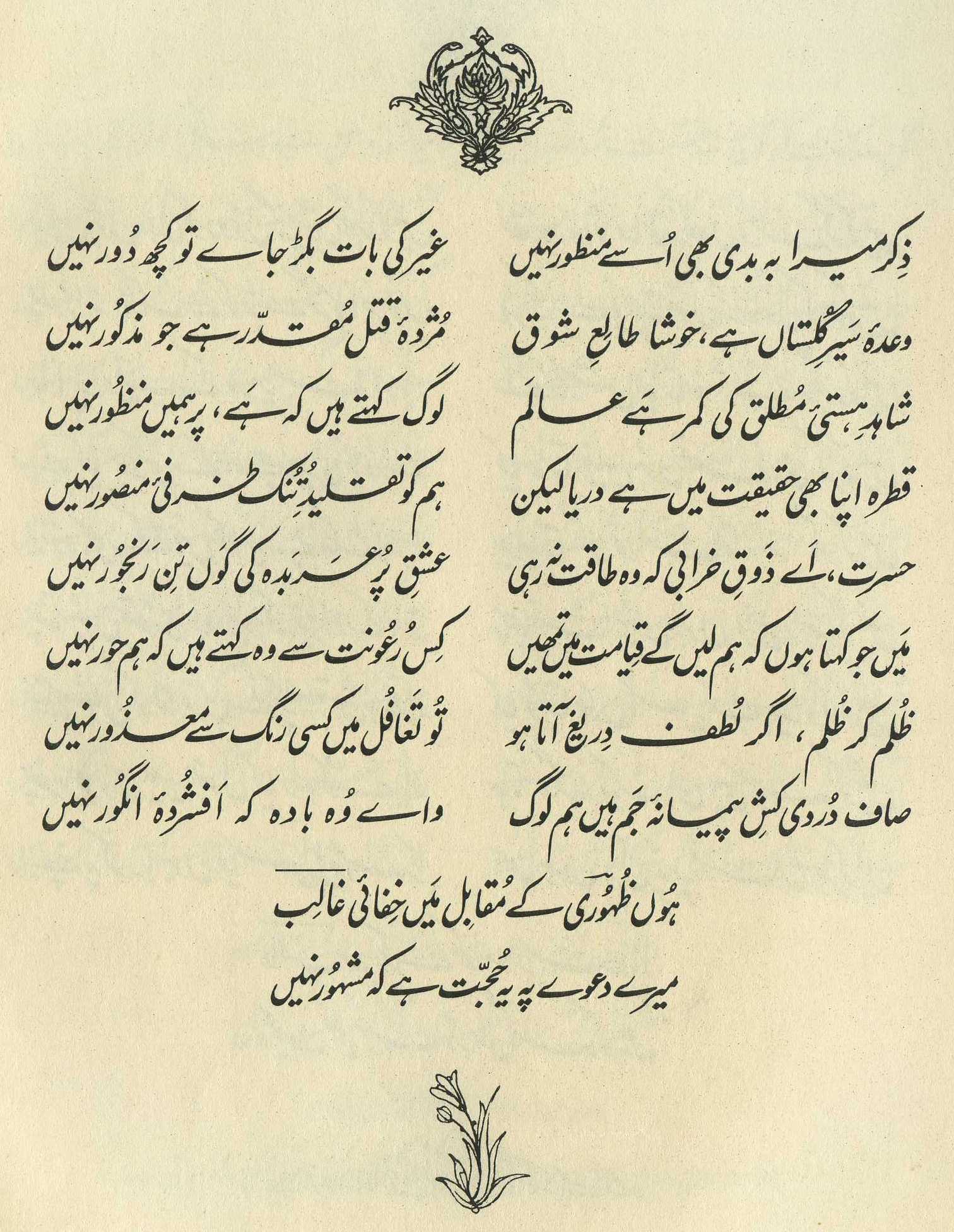
That is, the world has just such a relationship with being, as the waist does with the beloved-- we hear only its name, and it's not visible. The author has here used the word in its meaning of 'seen', not in its idiomatic sense of 'favored'. (105)
== Nazm page 105

People say that the world is the waist of the True Beloved, but let them go on saying it-- we don't agree. That is, they say that the existence of the world is postulated, and to be accepted. But we say that when something is not, then what's the point of saying 'it is' about it? The gist is that we don't believe in even the postulated existence of the world.
[Nazm is wrong to restrict the meaning of as he does.] When the meaning of as 'we don't agree' is present, then what's the need to take the meaning of 'it is not seen by us'? Indeed, from the word the verbal device of has certainly been created. What's the connection of this with idiom? (104)
Bekhud's commentary and understanding are both very fine. But the truth is that in there's not only an ....
It's clear that the beloved's waist (because of its delicacy and narrowness) is assumed to be nonexistent. The beloved's waist of course exists, but the lover doesn't accept its existence. Now consider that Absolute Existence (that is, God Most High) is the Beloved. If he is the Beloved, then he will have a waist as well. But this waist, for the lover, will be nonexistent. What is this world? It's the waist of the beloved of Absolute Existence. Ordinary people say that the world exists (the way ordinary people say that the beloved has a waist), but we don't believe it (the way in the lover's eyes, the beloved's waist is nonexistent)....
Now three further points emerge. (1) We are lovers of the True Beloved. This fact is not explicit in the verse, but is conveyed through implication . (If we were not considered to be lovers of the True Beloved, then the question of the existence or nonexistence of the waist wouldn't even arise.) (2) The fact of the True Beloved's having no waist is proved by His being Absolute/unconfined Existence. A thing is unconfined when it would be beyond all possible things (for example, time, space, organs, limbs, etc.). (3) Both the waist's existence and its nonexistence are indications of the existence of the True Beloved. Ordinary people believe the present world to be a proof of the Lord's existence, and we consider the world nonexistent, so that the Lord is present.
Thus this verse gives more support to the True Existence than to the multiplicity of contingent existence. There's fine meaning-creation .
== (1989: 144-45) 2006: 166-67
There's a marked disagreement over , with Nazm insisting it has only its more literal meaning (2b), and Bekhud Mohani (with his usual desire to contradict Nazm) insisting it has only its more commonly used meaning (2a). The controvery itself reveals the centrality of the word; its doubly activated meanings are one of the verse's chief pleasures, since the grammar of the second line is carefully arranged to elicit, and use, both meanings.
Faruqi does a good job of explicating the pro-waist view (held by 'ordinary people') and the anti-waist view (held by the true lover). (For more on the beloved's classic lack of a waist, see 99,4 .) As he points out, both views are consistent with the existence of God.
Other word choices in the verse also work well with its mystical inclinations. The word used for 'beloved' is the philosophically fertile term (for a reminder of its resonances, see 98,6 ). And the word has both the sense of absoluteness proper to God, and the meaning of 'free, unconfined'-- which at once calls into question the idea that such a God could ever have a 'waist', even (or especially?) one like the world.
This is a verse in which there is clearly a divine, not a human, beloved; for other such verses, see 20,10 .
In the first line, God is credited with absolute 'existence'. Then in the second line, people say the cleverly unqualified , meaning 'it is'-- or, of course, 'it exists' (or even 'He exists'), so that we are reminded of the first line. But then, what is the (unstated) 'it'? I see three possibilities: (1) the proposition expressed in the first line (which the 'people' are affirming); (2) the idea that the waist exists; and (3) as a corollary, the idea that the world exists.
The three verses that Arshi suggests for comparison are well chosen, and show the lines along which Ghalib's poetic thought processes move when he's in these abstract domains. Needless to say, they don't resolve any questions. But surely we don't expect them to. A ghazal verse is not, after all, a philosophical disquisition. The idea that the world is God's tiny, almost invisible waist is so strange and fascinating (and amusing) that two piquant little lines seem hardly enough to pose and also complexly explore it. Yet here they are, and pose and explore it they do.
Compare Mir 's similarly deft and enjoyable use of heavy-duty Sufistic concepts for the beloved's body: M 1421,2 .
graphics/corset.jpg