Verse 71821aalhai
G3
1
don't {be taken in by / 'come into'} the deceit/beguilement of existence/life, Asad
2
the whole world is a link/circle of the net of thought
'Being, existence; entity; world; life; --wealth, riches; --worth, merit.
'To be deceived or deluded (by), be taken in (by), be duped, be gulled, be cheated (by), be misled (by)'.
'Deception, deceit, fraud, trick, duplicity, treachery, imposture, delusion, fallacy; allurement, beguilement, &c.'
is the third-person future imperative of ( GRAMMAR )
| References | |
|---|---|
| Arshi, Imtiyaz Ali | Ghazal# 138 |
| Raza, Kalidas Gupta | 343-44 |
| Nuskhah-e-Hamidiyah | 189 |
| Asi, Abdul Bari | 219 |
| Gyan Chand | 335 |
| Hamid Ali Khan | Open Image |
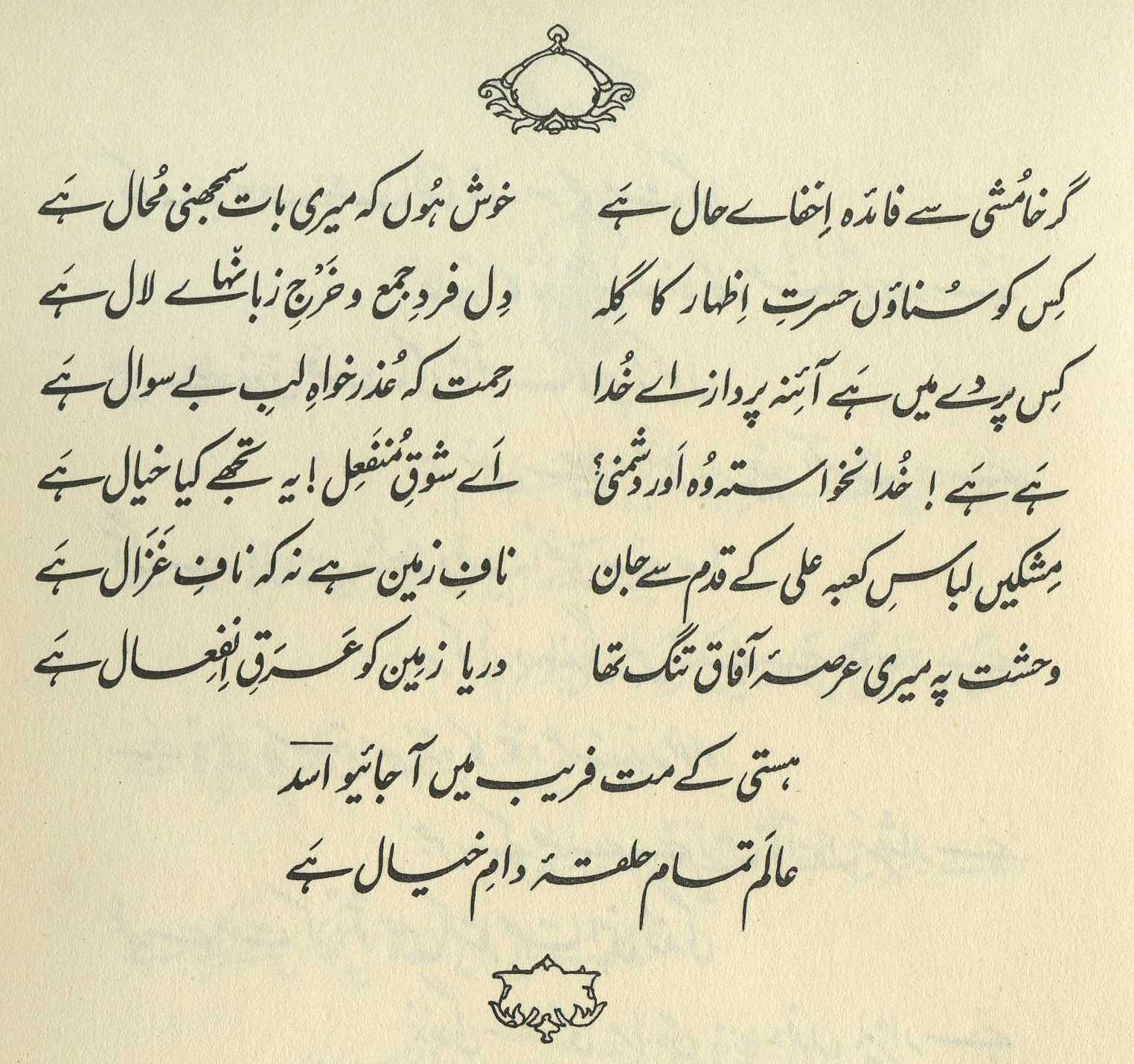
That is, the whole world is only imagined and suppositional []. One ought not to consider his existence to be 'existence'. He has constructed the sphere of the world as a link in the net of thought. (152)
== Nazm page 152

He says, 'Oh Asad, this whole world is only imaginary, and has a suppositional existence. Don't by any means consider your presence here to be your 'existence'. This whole world has no more reality than a link in the net of thought.' (209)
Oh Asad, don't consider the world to be present. There's nothing in the world. Its existence is hypothetical and suppositional. As many spheres as might be considered to exist, they are nothing but imagination.... The Sufis too have this view: that in the world there's only the Lord, and nothing else at all. (278)
This verse apparently replaced an earlier closing-verse , 141,8x .
What does it mean to 'come into', to be taken in by, to be lured into or suckered into, the trick/deceit of existence []? Well, that depends on what the trick 'of' existence is. It can mean at least three things: 1) the trick that itself is existence; 2) the trick that is played by existence on somebody; 3) the trick that somehow belongs or pertains to existence. In short, all the possibilities Ghalib so often smuggles in with the , he here provides with . (In 196,4 , he uses itself.) On the complexities of , see 71,3 .
Uncertain among those three possibilities, we wait (under mushairah performance conditions) for the second line, expecting clarification. And what do we get? More ambiguity and multivalence, of course. (Are we really surprised?) This is an 'A,B' verse, in which it's unclear how the two lines are to be connected; and because of the level of abstraction, the range of possible connections is particularly wide.
For it's impossible to tell what kind of entity 'thought' might be. Is it an autonomous agent named 'Thought', like a personification? Is it something in the mind of God, that shapes us willy-nilly? Is it something in our own minds, that we can play with as we like? Is it something in our own minds that compels us, and over which we have no power?
Putting it all together, here are just a few of the possible interpretations of the first line:
=Don't foolishly think that you 'exist'.
=Don't naively play the games that 'existence' wants you to play.
=Even though you're forced to 'exist', don't be blind to the real truth.
To be paired at will with any of these interpretations of the second line:
=The whole world is imaginary/imagined.
='Thought' is a notorious trickster.
=Use your 'thought' to perceive the tricks of 'existence'.
=Your own 'thought' is what ensnares and deceives you.
The imagery of being ensnared 'in' a trick/deceit [] works suggestively with the 'net' in the second line-- the kind of net in which birds are commonly trapped. (See for example 167,2 .) What kind of a net would it be, in which the whole world would constitute only one link? Vast and awesome, no doubt, but would it also encompass other worlds, other universes (and might they be accessible to us somehow, within the net)? Could we somehow avoid it (the way clever birds don't fly into a net)? Could we escape from it (the way a trapped bird might find a small hole in the net)? To imagine that the net has been placed by God is relatively comforting; what if we ourselves have created the net? Or, most frighteningly, what if there's no one at all behind the net?
Truly this verse is spectacular. An especially enjoyable one for comparison: 196,4 .
graphics/net.jpg
graphics/manhole.jpg
From a privately printed collection by Kamil Hyderabadi, with thanks to Mansoor Khan