Verse 31853aamire aage
G13
1
except as a name, the aspect of the world is not accepted/'seen' by me
2
except as an illusion/idea, there's no existence of things, 'before me'
zuur>> : 'Seen, looked at; visible; admired; --chosen; approved of, admitted, accepted; sanctioned, granted; --agreeable; acceptable; admissible; --designed, intended'.
'Thinking, imagining, conceiving (esp. a false idea); —opinion, conjecture; imagination, idea, fancy'.
'A thing, object; a matter, an affair; an article, &c.'.
| References | |
|---|---|
| Arshi, Imtiyaz Ali | Ghazal# 229 |
| Raza, Kalidas Gupta | 442-43 |
| Hamid Ali Khan | Open Image |
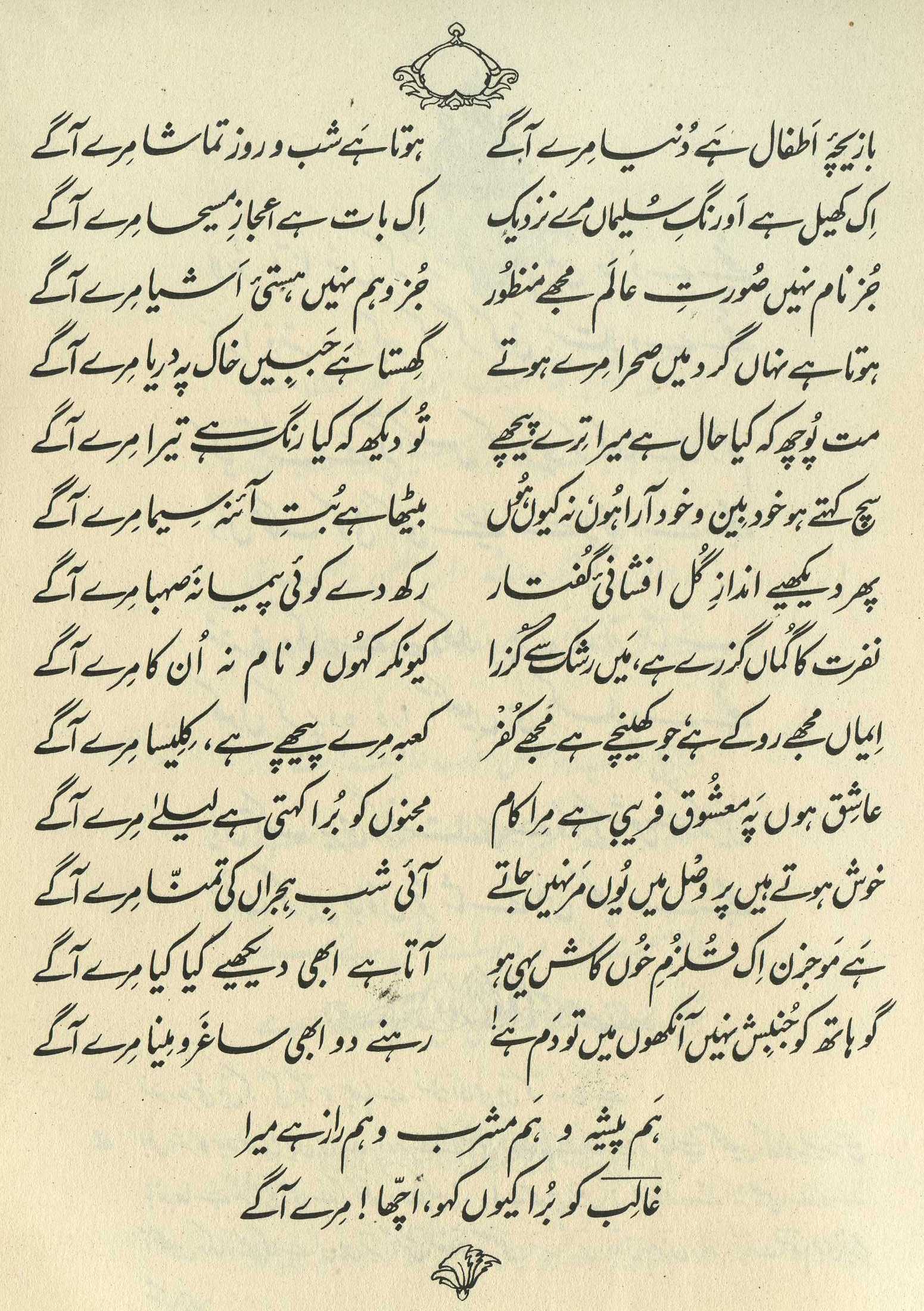
That is, the world is nothing but a name; its aspect is not perceptible []. This is an extraordinary problem of philosophy and Sufism. [He provides a long explication.] The meaning in which the late author has used the word , is not used in Arabic. We've already seen a verse in the refrain : 100,3 . Here too he has taken in the meaning of 'perceptible', but the idiom doesn't justify it. (234-35)
== Nazm page 234 ; Nazm page 235


In this verse an extraordinary problem of philosophy and Sufism has been expressed. He says, the world is nothing but a name, its aspect to the gaze is nothing at all. The existence of things, in my opinion [], is nothing at all except an illusion. The meaning is that except for God Most High Himself, he doesn't consider any substance to be present. (292)
Here Mirza has not taken the meaning of to be 'perceptible', nor was there any necessity for him to take it so. Its meaning is according to the Urdu idiom: 'we don't accept it' []. Indeed in the word there is certainly an . (416)
This verse is the third of a set of four that feel like an informal kind of a verse-set ; for discussion, see 208,1 .
One pleasure of this verse is the word-and-meaning play of the oscillation of between its literal meaning, 'seen', and one or more of its metaphorical meanings (see the definition above); and similarly the enjoyably parallel oscillation of between its literal meaning, 'before me' (so that it would refer to actually things in the universe that I might or might not see), and its abstract, metaphorical meaning of 'in my opinion'. Even as the commentators argue about the exact nuances of , they're really reacting to this kind of oscillation.
But for the most part, the commentators-- not just the ones I cite here but most others as well-- are busy slicing and dicing the philosophical content of what they take to be straight, heavy-duty abstract statements. I strongly disagree. I maintain that the chief enjoyableness of this verse is as part of a set of four humorous, tongue-in-cheek, mock-pompous assertions that become more and more self-evidently ridiculous until the fourth verse clinches the case.
There's a literary anecdote that reminds me of the tone of this verse. A soulful transcendentalist named Margaret Fuller is said to have exclaimed, 'I accept the Universe!'. To which Thomas Carlyle is said to have replied, 'Gad, you'd better!'.
In this verse, in short, Ghalib is presenting a tongue-in-cheek rendering of such a grandiose, pompous, absurdly self-important stance (except of course that the transcendentalist accepts the universe, while the speaker in this verse rejects it). In both lines there's that 'it's all about me' quality-- 'I am the arbiter of the universe, and I now pronounce my judgment'. The speaker has no sense of how amusingly disproportionate such a solemn proclamation might sound to a listener.
As more straws in the wind, let's take Arshi's three suggested verses for comparison. Verse 100,3 centers on the amusingly bizarre conceit of the world as 'the waist of the Beloved of absolute/unconfined existence', and goes on to describe the argument of whether that waist exists or not-- which reminds us enjoyably of the beloved's own waist, which is small to the point of nonexistence. Then in 141,7 we get 'the whole world is a link of the net of thought'-- a strikingly beautiful, powerful, and ambiguous assertion. And finally, in 196,4 we encounter the cleverly playful and remarkably multivalent , in which it's not at all clear who's saying what about what. Not one of these 'parallel' verses has the same deadpan quality of surface flatness as the present verse. These other verses are all obviously doing poetry, so to speak, rather than philosophy or Sufism. Which is, after all, what Ghalib himself is doing too-- so that we would be well advised to take a second (and third, and fourth) look at anything too suspiciously 'prosy' or apparently simplistic in his poetry.
And to make sure we see through what he's doing by creating this pompous speaker-persona, Ghalib has provided the irresistible culmination of the four-verse group: 208,4 .
graphics/nataraja.jpg
