Verse 41853aamire aage
G13
1
the desert/wilderness is [habitually] hidden in the dust in my presence
2
the sea/river rubs its forehead on the dust/earth, before me
| References | |
|---|---|
| Arshi, Imtiyaz Ali | Ghazal# 229 |
| Raza, Kalidas Gupta | 442-43 |
| Hamid Ali Khan | Open Image |
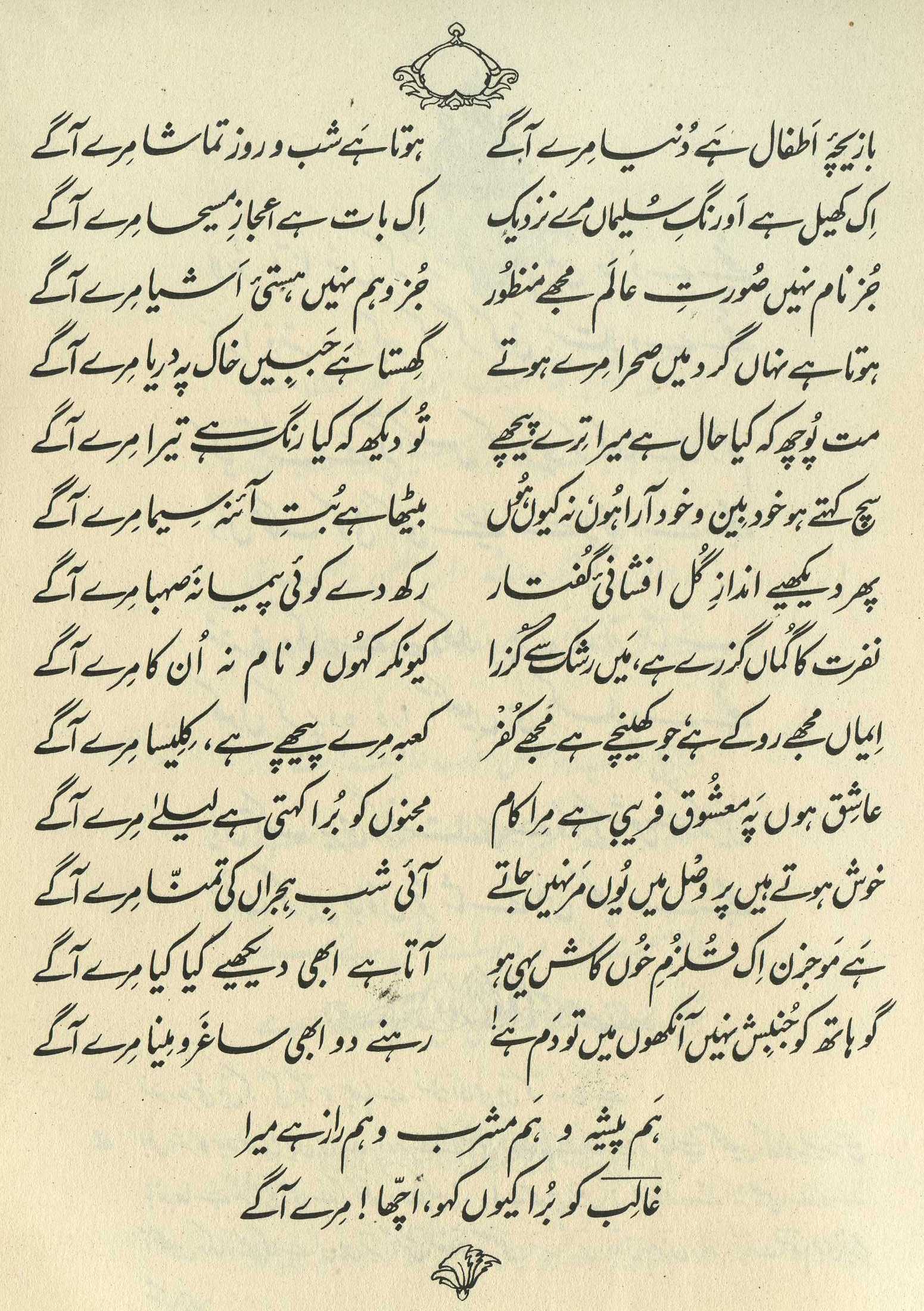
That is, I kick up dust to such an extent that the desert is hidden in the dust. And the river, before me, slips along the dust, that is, the river emerges from the earth. Or else that the flood of tears from the eyes reaches to the earth. (235)
== Nazm page 235

He says, 'In the state of madness I kick up so much dust that the wilderness becomes hidden in dust. And from my eyes I shed tears to such an extent that a river flows before me.' He has constructed the force of the water as 'rubbing of the forehead'. (292)
Whirlwinds always pick up dust; the sea always collides with the shore. But the poet sees these situations and says that the reason for the desert's being hidden in dust is that it itself considers itself nothing before me, thus it hides its face in a veil. And the sea, through its weakness and helplessness, always touches its forehead to the ground before me. Thus I am supreme among the creatures. (208)
This verse is the fourth and last of a set of four that feel like an informal kind of a verse-set ; for discussion, see 208,1 .
All right, here's the verse that's the crest-jewel of my argument. The previous three verses have been building up a persona-- the voice of a speaker who's terminally pompous and pretentious and self-important. Now we see that very pretentiousness reasserted-- and in the same process most elegantly and wittily rendered ludicrous. In case we might miss the point, this process happens not once but twice, in cleverly parallel ways.
In the first line, the (tongue-in-cheek) pompous speaker boasts, 'I am so lofty that the desert humbly and fearfully hides in the dust when I'm around'. And we realize with glee that since the desert consists of nothing but dust anyway, that proposition is at once irrefutable and quintessentially silly.
In the second line, the (tongue-in-cheek) pompous speaker boasts, 'I am so lofty that the sea rubs its forehead on the dust, abasing itself before me'. And we realize with even more relish that anybody who walks along the shore, where the small waves are constantly lapping on the bank, will have exactly the same experience. So here's another proposition that's at once irrefutable and quintessentially silly.
Both these claims are almost examples of ' elegance in assigning a cause ', except that the cause operates in this case only when the speaker is around. But of course, the speaker is so solipsistic that perhaps in his view the whole universe operates only when he's around.
Now if we think back to the voice of the speaker in the previous three verses, isn't it clear that it's the same voice? No other reading 'works' so well poetically. Only instead of being left (apparently) unchallenged, that voice now gets its comeuppance. And the best part is, the voice doesn't even know it. The voice itself gives us, in the very fabric and phrasing of its boastfulness, the full measure of its folly. Could anybody fail to relish such a wickedly witty verse? (Yes, alas-- the commentators could; Bekhud Mohani almost gets there, but not quite.)
graphics/shoreline.jpg