Verse 111853aamire aage
G13
1
[people/we] are happy, but [people/we] don't die gratuitously/'like this', in union!
2
the longing of the night of separation came upon/'before' me
'Thus, in this wise, in this manner; --just so, for no particular reason; without just ground, vainly, idly, causelessly, gratuitously'.
| References | |
|---|---|
| Arshi, Imtiyaz Ali | Ghazal# 229 |
| Raza, Kalidas Gupta | 442-43 |
| Hamid Ali Khan | Open Image |
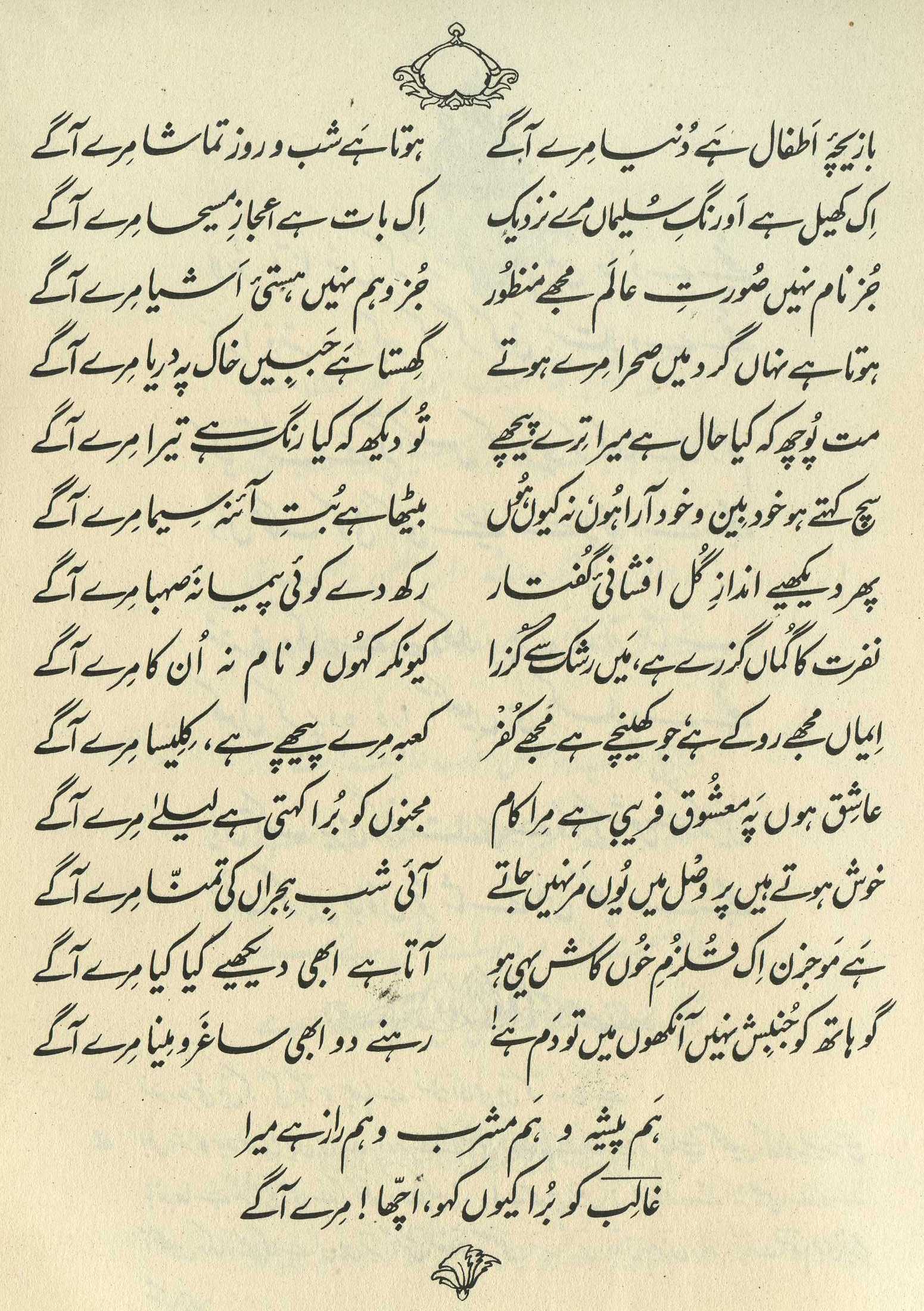
This verse is, in this ground , the ' high point of the ghazal '. The meaning is that the longing to die that I had felt in the night of separation-- today it has come before me, in that I have died in the happiness of union. Other people too have used the idea of dying in the happiness of union, but this idea is something else. And the wonders of idiom and language, which have made the theme of dying come alive. This verse too ought to be counted among the wonders of the thought of Ghalib. (236)
== Nazm page 236

He says, all lovers are always happy in union, but they don't 'die of happiness' []! It seems that the longing and desire for death that I felt in the night of separation has come before me in union. This verse is one 'lancet' [=sharp and pointed, thus excellent, verse] among Mirza's lancets. (294)
The beloved has come, and the lover is feeling such joy that he's about to 'die of happiness'....
The first line makes clear that the kind of happiness he's had in union, other lovers don't have. And it also makes clear that the degree of difficulty there was in meeting the beloved, is not there in meeting other beloveds. And it also makes clear that the way he loved, others don't love; and the kind of despair he felt over the chance of obtaining union, other lovers don't feel....
From looking over the verse it can be seen that the first line is showing the limits of happiness, and the second line is holding up a mirror of his longing. The late Mirza Dagh too has composed this theme , and has composed it well:
[alas, at what a time were both longings fulfilled!
when the beloved came to my beside, then death too came] (419-20)
When we hear (under mushairah performance conditions) the first line, the great question is, who? Somebody masculine plural, or somebody masculine singular but receiving an honorific, is the (colloquially omitted) subject. The speaker could also be speaking of himself, and referring to himself colloquially as 'we'. For the content is so abstract that we listeners really can get no idea where the verse is going.
After the usual delay, when we begin to hear the second line, we still have no idea what's going on, or who's involved, for now we have a feminine singular verb and the vague 'night of separation', and no means to put it all together. Only at the last possible moment are we given the punch-word, , followed by the (in this case) equally necessary . Suddenly, all at once, we (sort of) 'get' it; and in true mushairah-verse style, once it's given us its burst of pleasure, we see that there's nothine else there, and we're ready to move on.
But still, there remains an ambiguity in the first line that's annoying because it's poetically unrewarding. If the colloquially omitted subject is 'they' or 'people', then the effect is to contrast the normal, sensible good fortune of other lovers with the uniquely bad fortune of the speaker, as described in the second line. (Those others are able to be happy, they don't just suddenly collapse and die when they have attained 'union' with the beloved.) But in that case, we have to supply the subject entirely on our own, because nothing else in the verse gives us any clue to it; the subject could also be 'you' in the third person plural, or 'he' as used for an honored person. This kind of ambiguity is really pushing the liberty of colloquial subject omission almost to the breaking point, so it feels awkward and unpleasantly lax.
Alternatively, we could imagine that the colloquially omitted subject is 'we', used by the speaker about himself. (He's scolding himself for his own undesirable, uncharacteristic behavior, before trying to explain it in the second line.) But in that case, we have to let him call himself 'we' in the first line and 'I' in the second line (because of ). This kind of shift in self-reference within a single verse almost never happens and sounds extremely awkward. Whichever choice we make, the result doesn't feel really satisfactory.
The clever use of keeps several interpretive possibilities open. If we take to mean 'gratuitously, causelessly', then it compares the normal lovers' behavior (they are happy, but they live to tell about it) to that of the speaker, who simply collapses and dies once he has attained union with the beloved. Or perhaps he too doesn't normally show such behavior, and it's just his own wretched fortune (his making the wrong wish during the night of separation) that has suddenly condemned him to such a miserable, inexplicable fate.
And if we take to mean 'like this', then it refers to the particular kind of death that the speaker experiences: rather than treating that death as gratuitous or causeless, the verse seeks to explain it. In the second line, the speaker provides what seems to be a causal explanation: his own despairing death-wish, uttered during the 'night of separation', has now actually taken effect on him, at the most awful, unacceptable time. The death-wish is thus potent, though uncontrollable in its timing.
Or the speaker could mean his observation in the second line simply as an ironic meditation or commentary on the perversity of life: during the night of separation he longed for death in vain, and now that it's fantastically unwanted and inopportune, sure enough here it is before him. Death comes ineluctably in its own time; as we're reminded in 191,7 . (For more on , see 30,1 .)
Another possible interpretation is that of the commentators: that the lover is specifically 'dying of happiness', for which Urdu has the excellent idiom . That sounds like a plausible extrapolation, but there's no particular warrant for it in the verse. As Bekhud Mohani observes, on this interpretation the contrast with normal lovers serves to highlight the unique power of the true lover's passion: his extreme despair in separation, and his extreme bliss in union, two unendurable intensities that seem to cause him to drop dead from the contrast between them, or from the sheer intensity of his joy. Which is all very well, but it's not what interests the speaker when he gives us his own reflections on the subject.
For another verse in which 'normal' behavior is contrasted with that of one particular lover, see 111,5 .
graphics/lovebirds.jpg