Verse 81853aamire aage
G13
1
the suspicion/surmise of aversion/disgust 'passes'; I 'passed' through/over envy/jealousy
2
how/why would I say, 'Don't mention her name before me'?
'Abomination, detestation, horror, abhorrence, aversion, disgust'.
'Doubt, distrust, suspicion; surmise, conjecture'.
is a variant spelling of .
is an archaic form of ( GRAMMAR )
'To pass, go, elapse; to come to pass, to happen, to befall; to pass (by or over, ); to pass (through, , or ); to pass (before, or under, or in review, ), to be put or laid (before, ), be presented; to pass (over, ), to overlook, to omit; to abstain (from), desist (from); to decline; --to pass (beyond), to surpass; to pass away, to die'.
'By what means? in what way? how? in what manner? why?'.
| References | |
|---|---|
| Arshi, Imtiyaz Ali | Ghazal# 229 |
| Raza, Kalidas Gupta | 442-43 |
| Hamid Ali Khan | Open Image |
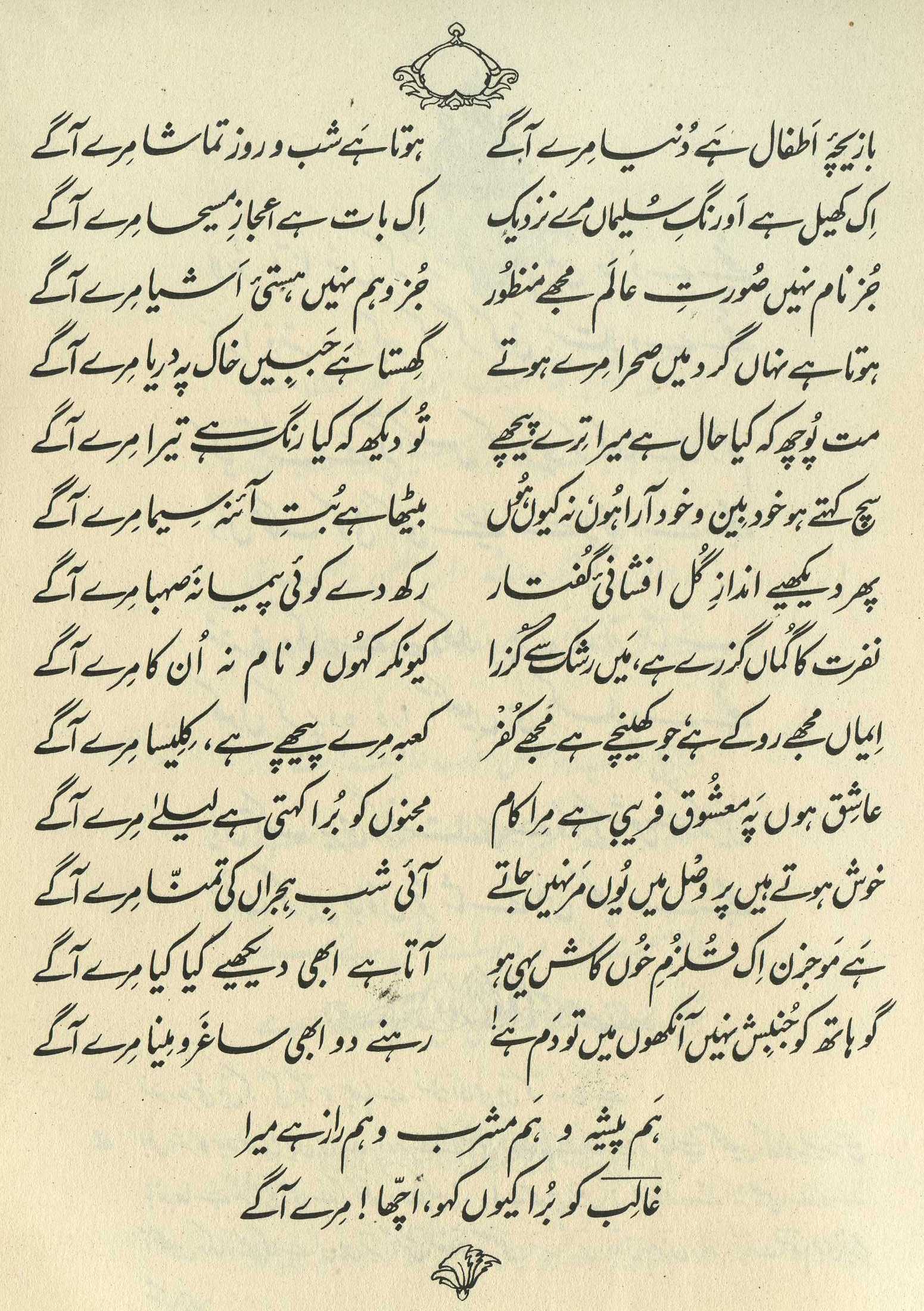
The meaning is that having heard someone mentioning the name of the beloved, through envy/jealousy it doesn't please me; and it's also not possible for me to forbid it-- for if I would say 'Don't mention her name before me', then the suspicion of aversion/disgust will occur [] to people. (236)
== Nazm page 236

He says, 'If someone mentions the beloved's name before me, then because of envy/jealousy I become displeased. People suspect that it's a sign of aversion/disgust. Rather than this, I should leave off feeling envy/jealousy. I can't say to anyone, 'don't mention her name before me'.' (293)
The lover, replying to himself, or to his heart, is saying, 'Although envy/jealousy isn't pleased if someone else would mention the beloved's name, what can I do? For I also can't forbid it, because people will suspect that I feel aversion/disgust for the beloved, and this doesn't please me.'
Janab Momin too has said something of just this kind, and the truth is that he's said it well:
[I won't heed the advice, but how could I not listen to it?
for in every single utterance the Advisor used to mention your name] (418)
When (an archaic form of ) can mean either 'comes to pass' or 'passes away' (see the definition above), whatever subject it applies to can obviously be either on the way in, or on the way out. Nor is it clear what the subject itself is, for the suspicion 'of' aversion/disgust can mean the same range of things as an construction would: a suspicion that is generated by aversion; a suspicion that consists of aversion; a suspicion that aversion might exist; or a suspicion pertaining to aversion in some other, unspecified way. Nor does the grammar make clear who might be beginning to feel, or no longer feeling, the 'suspicion of aversion'. Is it the speaker's emotion, or that of others, that's being evoked? Here are some of the manifold possibilities:
=The lover begins to feel a suspicion related to aversion/disgust, at the mention of her name.
=The lover ceases to feel the suspicion related to aversion/disgust, that he used to feel at the mention of her name.
=The lover begins to have the suspicion that people mention her name out of aversion/spite toward him.
=The lover ceases to have the suspicion that people mention her name out of aversion/spite toward him.
=People begin to have the suspicion that the lover might feel an aversion/disgust toward her.
=People cease to have the suspicion that he might feel an aversion/disgust toward her.
Then, similarly, what does it mean to say ? There are at least these three main possibilities for what the lover did with regard to envy/jealousy:
=(1) to pass over, overlook, omit, abstain from
=(2) to pass through, pass under, be presented to
=(3) to pass beyond, surpass
For further discussion of the intricacies of , see 152,7 . For more on the complexities of , see 53,4 . On the ambiguities of , see 125,1 .
Then, needless to say, all these mix-and-match complexities of both phrases, in whatever combinations, work cleverly with the second line. For the second line offers us the colloquial complexities of , which can mean 'why would I say?'-- but can even more easily mean 'how would I say?' The former sense would suggest that I have no reason to say, and therefore probably don't want to say; the latter sense would suggest that I might be thinking of how to manage to say, and therefore perhaps do want to say. (Moreover, either such question might or might not be taken as rhetorical.) Now the mix-and-match items are three: two sets from the first line, and one set from the second line-- and we are hopelessly without guidance as to how to fit the puzzle pieces together.
The result, as so often, is that we're both permitted and required to make our own meaning for the verse-- and to do this task afresh, every time we read it. One fringe benefit of all this ambiguity and mental work is that we have a kind of action-picture of 'the end of the affair'-- the rejected lover's turmoil of envy, jealousy, anger, resentment, disgust, all feeding on suspicion and uncertainty, and all swirling around together, barely concealed by his efforts to transcend or at least control them. Don't we all recognize this witches' brew of unresolvable emotions?
But still, the effort is not so rewarding; there are too many possibilities, too loosely linked together. After all the necessary dissecting work, there's really not enough 'there' there.
graphics/jealousy.jpg