Verse 11853oto kyuu;Nkar ho
G9
In this meter the next-to-last long syllable may be replaced by two shorts.
1
that idea/saying is gone, that if there would be conversation, then how would [it] occur/be?
2 a
from saying [it], nothing happened; if you say [it] again, then how would [it] occur/be?!
2 b
from saying [it], nothing happened; so then/again say-- then how would [it] occur/be?!
'Speech, language, word, saying, conversation, talk, gossip, report, discourse, news, tale, story, account; thing, affair, matter, business, concern, fact, case, circumstance, occurrence, object, particular, article, proposal, aim, cause, question, subject'.
'By what means? In what way? how? in what manner? why?'.
| References | |
|---|---|
| Arshi, Imtiyaz Ali | Ghazal# 125 |
| Raza, Kalidas Gupta | 438 |
| Hamid Ali Khan | Open Image |
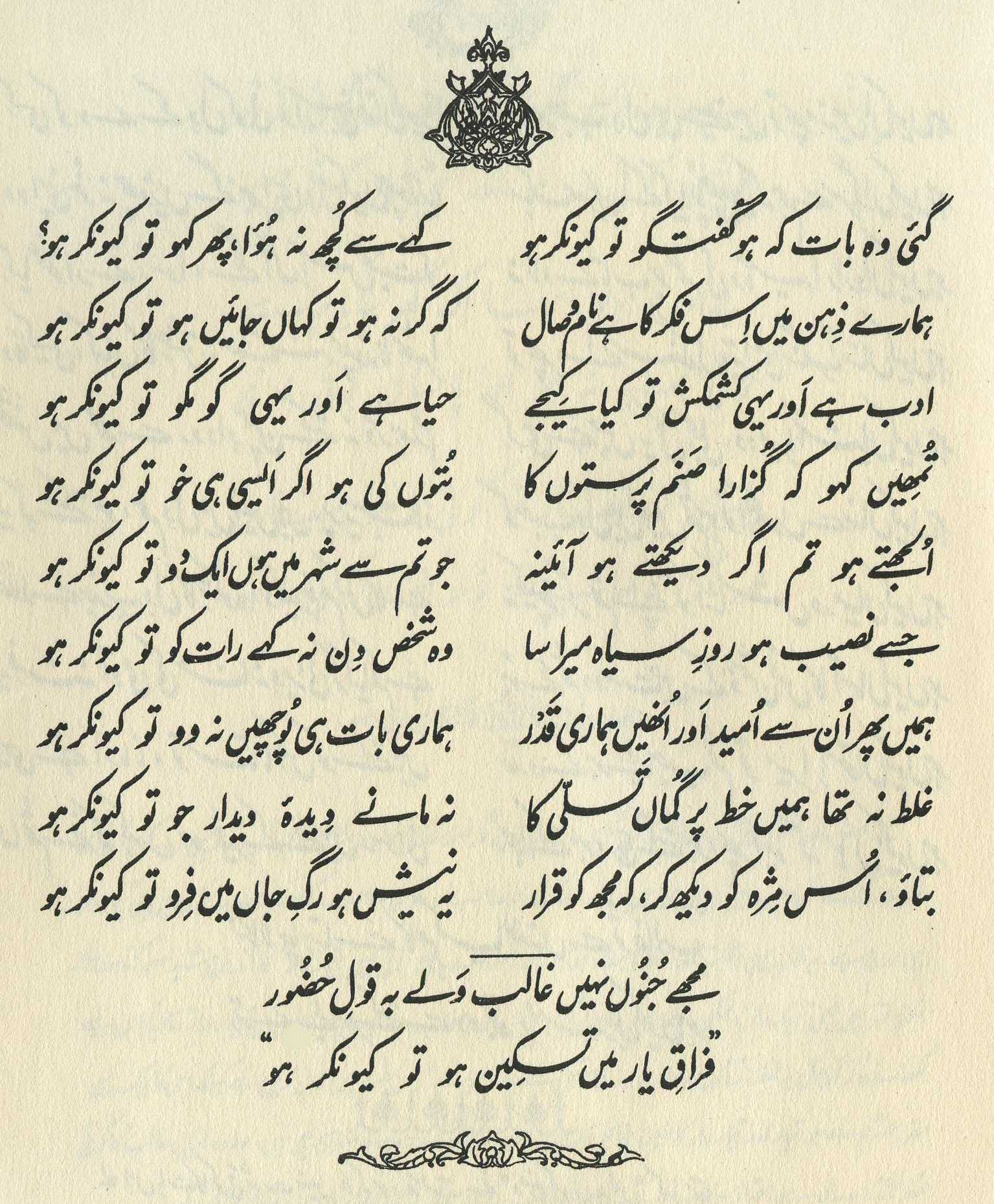
In this ghazal, in a number of verses is different from the idiom of Lucknow. Here, the author has, in the style of the people of Delhi, said instead of . That is, now those days no longer remain when we used to say, 'let's see if there would be conversation with her, then what would be []. We've already spoken and heard, and nothing happened. Now if we speak again, then what would be []. Another aspect too is that when from saying nothing happened, then tell us, now what would happen, and now what would we do? (133-34)
== Nazm page 134

He says, that time has passed when we used to wonder how we should begin to express our longing to her. Through good fortune, we were given such an occasion, when after much thought, we gave a long, thorough speech along lines we had devised, and she listened to it all. But no result at all came from it. Now how can our project be accomplished? The meaning is that we said everything but there was no effect at all on her, and no result at all came from our speaking. Now what would we do? We're helpless. (188)
In the present circumstances, the situation is that we have already explained our purpose to her. Even after hearing everything, she showed no kindness. Now you yourself say: what would we do, and how would we speak to her, and for how long we would humiliate ourselves by again and again submitting our request-- and what result does it even have? (252)
In the 'Dihli Urdu Akhbar' 15,10 (6 March 1853), under the title of 'Ghazals from the Mushairah of the [Red] Fort', this ghazal was printed, along with a number of other ghazals. (248)
This ghazal proves that Ghalib's complexity [] was not only on the basis of Persianness; rather, his mind itself was such that he could present numerous aspects of every idea even in those verses in which he used very little Persian. In the verse under discussion, only one word is Persian, and that too an extremely common one: . And then, the words themselves are every one of them two or three [Urdu] letters long. Despite this, a number of layers of meaning are present in the verse....
has two interpretations. (1) That time has gone. (2) The thoughts that he used to wander around discussing with himself-- those are now finished. When he couldn't open the lip of expression before the beloved, then he used to say to himself, 'We'll say this, we'll say that'. Or imagining himself to be the beloved, or imagining the beloved to be present, he used to practice speaking directly. Now all those thoughts no longer remain.
In the first line, has three interpretations. (1) In what tone of voice, in what aspect, would the idea be expressed? (2) What path can be devised, through which conversation would take place? (3) What the hell-- how is it possible at all! If it would take place, then how? That is-- as if it could take place!
In the second line, has two interpretations. (1) No effect occurred. (2) An expression of failure. That is, we certainly spoke, but not properly, not completely.... Another interpretation is that to speak is one thing, to converse is another. We spoke, but conversation didn't take place. In the first line is a mention of conversation [], and in the second of saying [].... Another meaning is that we said everything, but felt that we were able to say nothing. Now if we're even able to say it a second time, there's no telling whether even this time there will be any sense of something happening or being done.
The truth is that in such a difficult ground , with such easy language, to compose a verse in such fresh and complex language was within the reach only of Ghalib (or Mir as well). And if we consider it from the point of view of ' description of an affair ', then even Momin is checkmated.
== (1989: 233-34) 2006: 255-56
ABOUT : As Faruqi observes, (see the definition above) here has a wonderfully effective three-fold multivalence; it's related to the use Ghalib so often makes of . In the refrain of this ghazal, the final can mean, 'How would this particular thing that we've been discussing come about?'-- that is, would it come about, or not? But it can equally well mean, 'In what manner would this thing come about?'-- that is, what would this thing be like, if it did come about?. Or of course it can be a negative exclamation: 'How would this thing come about!'-- that is, it would never come about. Other such complex examples, besides those in this ghazal: 70,1 ; 153,3 ; 206,2 ; 208,8 .
Throughout this ghazal, rhyme -words have occasionally been skewed in their pronunciation (just as in other cases they're occasionally altered in their spelling) to fit nicely into the rhyme. The final vowels of and don't rhyme, and there's no reason to believe that Ghalib thought they did; he's just taking a permissible liberty. Another example: pronounced as in 125,4 ; and in 125,7 , quite conspicuously (and irritatingly), is even spelled as . In 125,8 is turned into .
Faruqi has explicated the semantic possibilities, and has pointed out both the brilliance and complexity of the wordplay, and the verse's remarkably simple vocabulary and grammar. The speaker is talking to himself (in the second person familiar, it seems, as ), and pondering his options in this new and dire crisis: the perils of success (?) appear even greater than those of failure, because there's less left to hope for in the future. It's all pretty confusing.
graphics/words.jpg