Verse 3after 1821aajaa))e hai
G1
2
if even/also shyness/modesty comes to her, then she's ashamed
'By what means? In what way? how? in what manner? why?'.
'Shame, sense of shame, modesty; pudency; shyness, bashfulness'.
| References | |
|---|---|
| Arshi, Imtiyaz Ali | Ghazal# 184 |
| Raza, Kalidas Gupta | 360-61 |
| Hamid Ali Khan | Open Image |
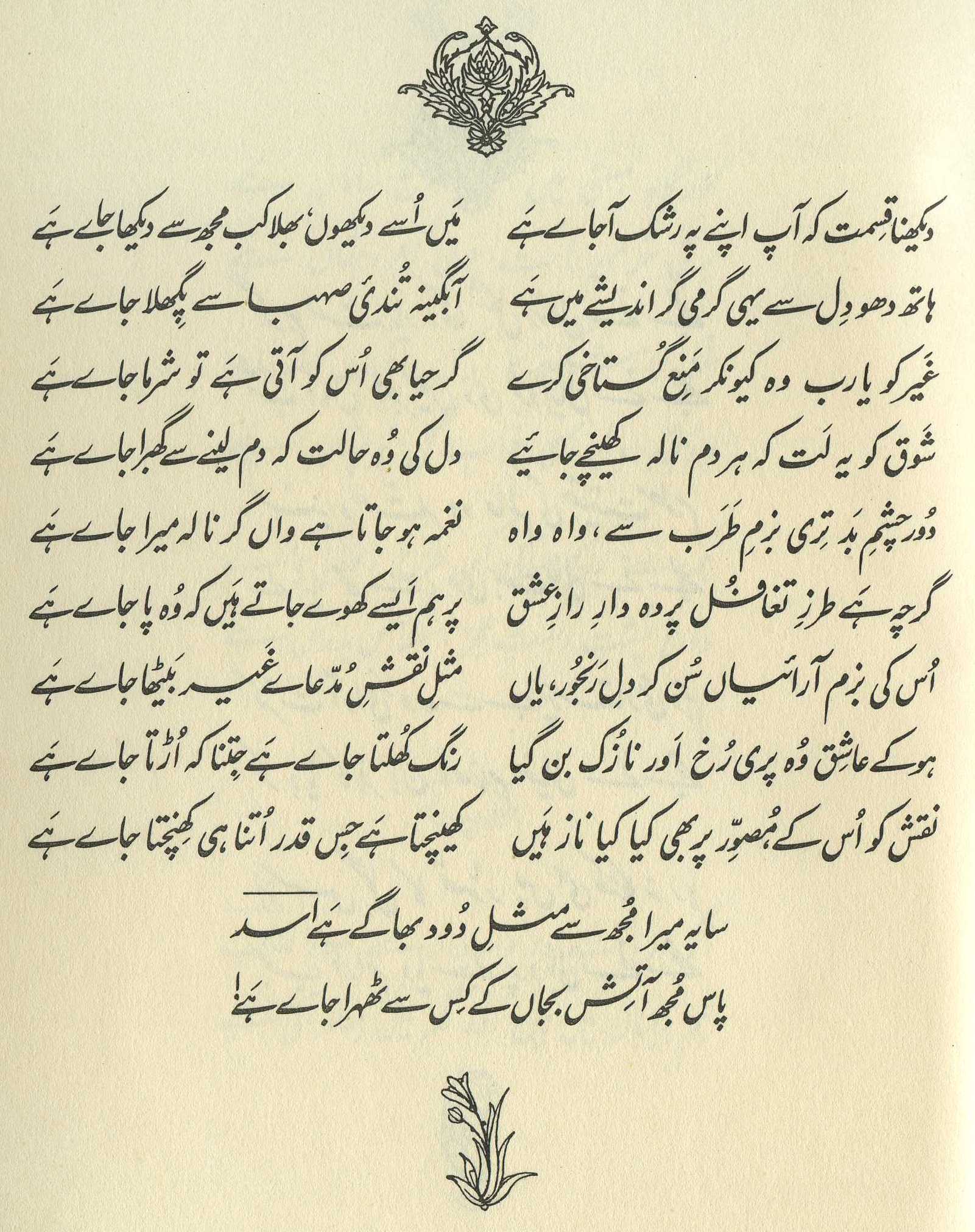
This is a verse of the affair s that usually take place between seeker and sought, and poetic refinement is found in the second line. It's clear that to be shy, and to be ashamed, in reality is one single thing; so what does it mean, that even if she feels shy, then she's ashamed? The idea is in that situation the cause of shyness is one thing, and the cause of shame is another. If she even feels shy-- that is, at the Other's insolence and inappropriate desire-- then she is ashamed-- that is, of the Stranger or of repeating [his words].
==Urdu text: Yadgar-e Ghalib , p. 156
'Shyness/modesty' [] has been taken to be something animate, from the coming of which the beloved feels shame. That is, when from the Other's teasing/pestering shyness comes to her, then from that too she feels shyness. The meaning is she feels so much shame that she doesn't forbid the Rival to show insolence. (164)
== Nazm page 164

The beloved is shy, and as yet the air of the world has not touched her. If at some time the Rival's insolence causes her shyness, she remains struck by embarrassment. And the lover, seeing this situation, is vexed, and also understands the beloved's inability to forbid him.
[The commentator Shaukat says:] How would the shameless beloved forbid the Other's insolence (seeking to touch or pinch or squeeze her), when if shame even comes to her, she's embarrassed? That is, she would consider shyness worthy of shame. (295-96)
Perhaps, as most of the commentators assert, the beloved is so shy that she's too embarrassed to rebuke the Other for his insolent behavior. There's a good basis for this reading in the verse, though none of them cite it: the verb . A shy, modest young woman would be duly embarrassed by anyone's approaching her; when 'even' shyness approaches or 'comes to' her, the embarrassment is paralyzing. Thus the beloved is quite unable to confront and rebuke the bold Other.
Or else, on Shaukat's reading, the beloved is so shameless she considers shyness itself a cause of embarrassment. If shyness 'too' comes to her, along with all her other feelings, she is ashamed of herself. So it goes without saying that she won't rebuke the shameless behavior of the Other. Naturally I enjoy this contrarian reading, though I admit that the presence and position of the are not ideal for establishing it.
Either way, the beloved shows the same extravagant, hyperbolic behavior as does the lover in 153,1 . He's the limit-case lover: he can't permit even himself to even look at her. And she's the limit-case beloved. Whether she's totally shame-filled or totally shameless, the result is the same: the Other can take liberties with her, while the lover himself can only stand by, gnashing his teeth, lamenting his lot, and plaintively trying to understand her.
On the ambiguities of , see 125,1 .
graphics/shyness.jpg