Verse 8after 1821aajaa))e hai
G1
1
having become a lover, that Pari -faced one became more delicate/sensitive
2
[her] color goes on showing/'opening out', as much as it goes on fading/'flying away'
'Thin, slender, slim, delicate, tender, fragile; fine; light; brittle; nice; neat; elegant; genteel; subtle; —facetious; gracious; keen; sensitive, touchy, testy'.
'To be uncovered, be unfolded, be exposed, be laid bare;... -- to be expanded, be widened or enlarged; to be developed;... to be made known, be disclosed, be divulged, be revealed;... to be let loose, be set free;... to be dissipated or lost;... -- to acquire fullness, clearness, brightness, or depth (a colour); to stand out well or conspicuously, to appear to advantage'.
'To open, expand (as a flower), to blow, bloom, flower; to open, crack, burst, swell'.
is an archaic form of ( GRAMMAR )
| References | |
|---|---|
| Arshi, Imtiyaz Ali | Ghazal# 184 |
| Raza, Kalidas Gupta | 360-61 |
| Hamid Ali Khan | Open Image |
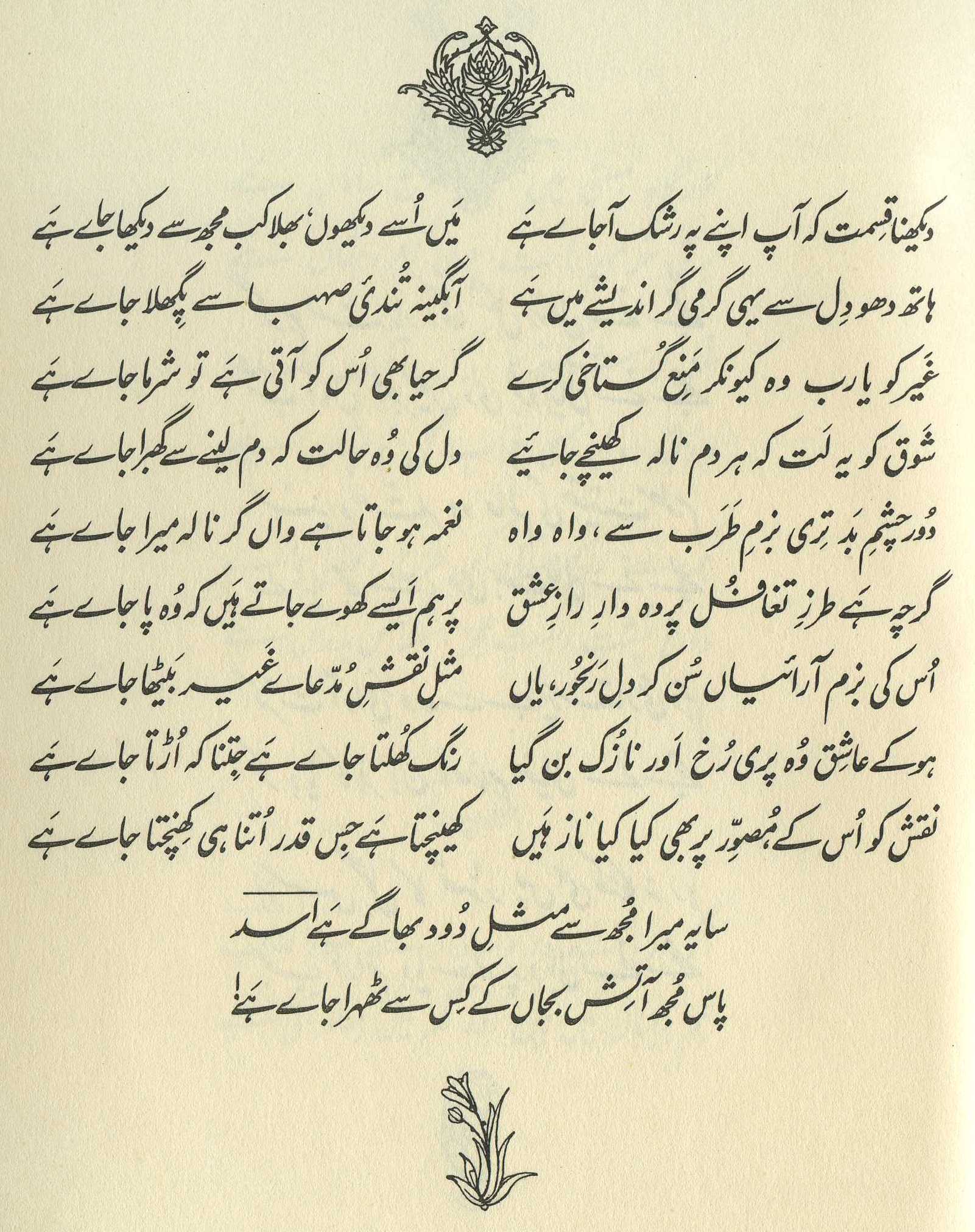
In passion, the color's becoming white he has constructed as the color's 'opening'. (165)
== Nazm page 165

He says, that Pari-faced one, having fallen in love with the Other , became even more delicate. From the shock of love, to the extent that her color fades, to that very extent it keeps becoming clearer. That is, it becomes more pleasing. (221)
He says, from falling in love the beloved's delicacy has increased somewhat more. As her color kept fading, she kept becoming more of a Pari. That is, now two things increased: the first is that she became more delicate than formerly; and the second is that her color keeps becoming clearer.
[Or:] It's possible that he might say this to tease the beloved, or that he might be taunting the Rival 's passion. (297)
[Compare 13,2 . (37)]
Faruqi rightly mentions 13,2 as an excellent verse for comparison, and I'd add 7,2 as another (and lesser, though enjoyable) example of Ghalib's face-color wordplay.
Above all, this verse is powered by the cleverly exploited multivalence of -- or else it can be khilnaa , if we prefer (see the partially overlapping definitions above). Here are some of the possible readings that the second line can generate:
=By some effect of her delicacy, her color actually becomes more visible and evident as the roses slowly fade from her cheeks. Perhaps because her skin is becoming more pale and delicate, since she's not eating or sleeping properly? Or perhaps because it now has a more inward and mystical glow?
=Her color becomes even more radiant and attractive as it fades, since she's so beautiful that her beauty can't be dimmed by passion; her new ethereal glow appears to advantage, making her even lovelier than before. A Pari is, after all, a creature of special radiance, made from fire rather than (like us mortals) from mere earth.
=Her 'color' or 'mood, state, condition' (since is so multivalent) is revealed to the world all the more clearly, the more her cheeks become pale; the secret of her new status as a lover is exposed for all to see, so that everybody can gossip about it.
This latter reading is the most piquant, since it requires the meaning of to change horses in midstream-- to begin the line as metaphor ical, and end it as literal, without the usual luxury of a repetition. But why not? Obviously it can do this, because it does do it-- in our minds, as we read the line. The sudden 'flip' is unsettling, but also enjoyable. (From a flip-- a fillip?)
Note for script fans: it's true that can also be read as , 'to bloom'. In order to squelch this possibility, Arshi carefully provides a . It's also clear that offers a much less interesting reading, since there's no other 'flower' imagery in the verse. For more on this pair, see 94,1 .
For more on the rare event of the beloved's falling in love, see 13,2 .
graphics/colors.jpg