Verse 11816aar-echaman
G1
1
it's the rainy-season of the lover’s weeping-- it ought to be seen!
2
[it] has bloomed/opened like a rose in a hundred places-- the wall of the garden
'To open, expand (as a flower), to blow, bloom, flower; to open, crack, burst, swell (as a wall, or plaster, or parched grain, &c.; cf. ); to break out, show itself or its effects (as intoxicating liquor, &c.); --to be set off (by), to show to advantage (on, - ), to look well or becoming (as a dress or a person, or one colour upon another); --to expand or swell (with pleasure), to be exhilarated, be delighted; to rejoice, laugh'.
'To open, come open or undone; to open, expand, blow (as a flower; com. ); to open out, unravel; to be opened (as a knot, or a road for traffic, &c.); to be disentangled, be unravelled; to be untied or unfastened; to be uncovered, be unfolded, be exposed, be laid bare; to be laid or cut open, be dissected, be analyzed;--to be expanded, be widened or enlarged; to be developed'.
| References | |
|---|---|
| Arshi, Imtiyaz Ali | Ghazal# 93 |
| Raza, Kalidas Gupta | 216 |
| Nuskhah-e-Hamidiyah | 164-165 |
| Asi, Abdul Bari | 167-168 |
| Gyan Chand | 270-271 |
| Hamid Ali Khan | Open Image |
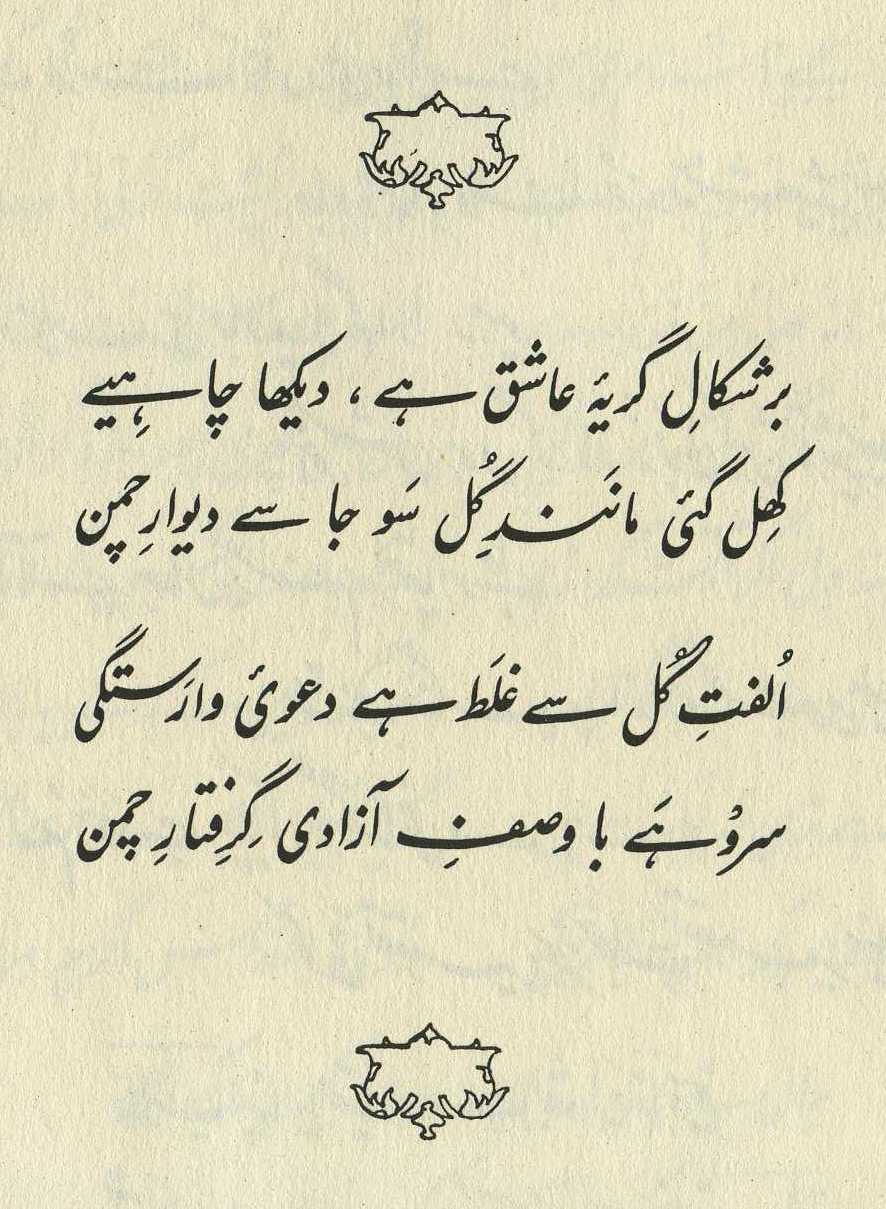
In place of , perhaps there was . The calligrapher made an error. (96)
== Nazm page 96

He says, the rainy season of the lover's eye is worth seeing. Like a flower, the wall of the garden bloomed/opened (broke open). When the wall of the garden has bloomed/opened like the flowers, then because of the lover's weeping the abundance of flower-buds is worth seeing-- what a height it has reached. (145)
It's the rainy season of the lover's weeping. The wall of the garden, like a rose, has bloomed/opened in a hundred places. It's worth seeing-- what else will happen now?
[Or:] The wall of the garden has itself become a garden. From the flood of the lover's tears, or from the effect of his weeping.
[If replaced as Nazm suggests,] then the meaning of surprise would emerge. Otherwise, the meaning of will be, 'let's see what else happens now'. (189-90)
The first line is merely exclamatory-- the 'rainy season of the lover's weeping' is worth seeing, but why? What's going on with it now? There's no way we can tell. Under mushairah performance conditions, we have to wait in suspense for the second line. And even then, in classic mushairah-verse style the punch-word, 'wall', is withheld until the last possible moment. Only then does the verse become fully and suddenly interpretably and enjoyable. On the grammar of , see 1,3 .
For in the verse we have, most enjoyably, several combinations of possible causes and possible effects. It's the rainy season of the lover's weeping-- and we all know about the rainy season. In it everything that's growing grows impossibly fast and luxuriantly. And everything that's man-made tends to decay, or collapse, or fall apart.
So now look at how cleverly both possibilities are allowed for in the second line, and the 'sight worth seeing' comment too is brought in. What does it mean that the garden wall bloomed/opened [] in a hundred places? Here are some possibilities:
=That the wall was breached and knocked apart by the furious flood of the lover's weeping, so that it widened and 'opened' in a hundred places like the spreading petals of a flower in bloom.
=That the wall was so fertilized by the lover's tears that it itself became a hundred-petalled flower, and naturally began to 'bloom' the way everything does in the rainy season.
=That since the wall has almost disintegrated in the tear-flood, we can now see inside the garden-- we can observe the flowers in bloom and the lover in his superhumanly passionate grief. It's a sight worth seeing!
Underlying these readings is the semi-orthographical wordplay between and . As they are usually written in Urdu, without short vowel markers, the two are indistinguishable. (I follow Arshi, who clearly shows a .) And their meanings semi-overlap; see the definitions above. Basically, means to open in the sense of 'to bloom, to expand, to burst', while means to open in the sense of 'to be revealed, exposed, cut open'. Thus both readings have enjoyable affinities with the range of meanings established in the verse. I see echoes of this same wordplay (though only subliminally) in 108,5 as well. An example of its use by Mir: M 12,4 .
graphics/overgrownwalls.jpg