Verse 21816aar-echaman
G1
1 a
the claim of liberation from affection for/from the rose is mistaken
1 b
because of affection for/from the rose, the claim of liberation is mistaken
1 c
the claim of liberation by means of affection for/from the rose is mistaken
2
The cypress is, despite [its] freedom, held captive by the garden
'Familiarity, intimacy; attachment, affection, friendship'.
'From; out of; with; in connection with; ... by means of, by the instrumentality of; by way of, along; over; upon; at; by reason of, in consequence of, through; on account of; in reference to, in respect of, as regards; according to; since'.
'Liberation, deliverance, salvation'.
'Along with the fact (that), notwithstanding, although, withal, in spite of'.
| References | |
|---|---|
| Arshi, Imtiyaz Ali | Ghazal# 93 |
| Raza, Kalidas Gupta | 216 |
| Nuskhah-e-Hamidiyah | 164-165 |
| Asi, Abdul Bari | 167-168 |
| Gyan Chand | 270-271 |
| Hamid Ali Khan | Open Image |
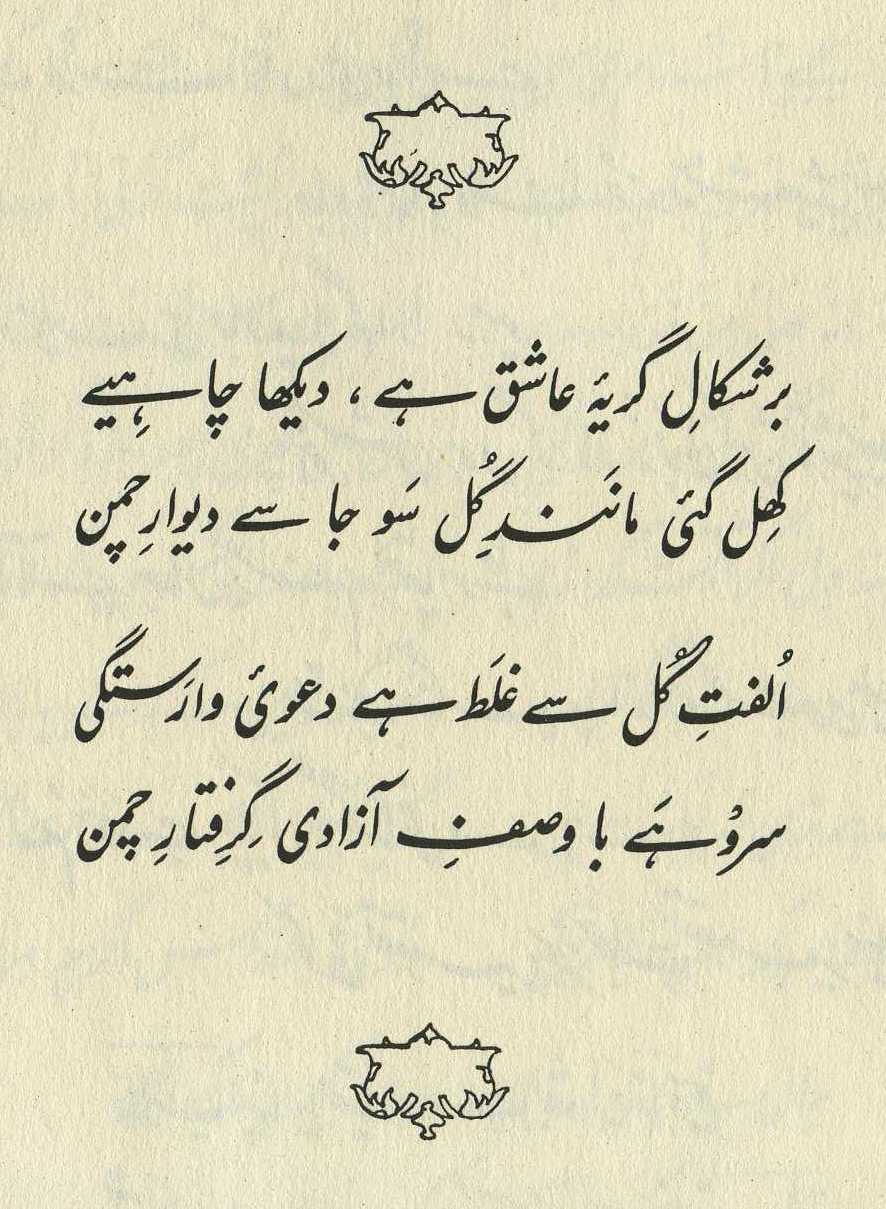
The meaning is that no matter how free and independent of disposition anyone may be, in the world he cannot escape from the snare of love and passion.
==Urdu text: Yadgar-e Ghalib , p. 147
Among the kinds of cypress, one kind is the 'free cypress' []. (96)
== Nazm page 96

He says, no matter how free and detached in temperament someone may be, having come into the world he cannot emerge from the snare of passion and love. And he presents as an example of this, that the 'free cypress', despite its freedom, is held captive by the garden. (145)
The cypress is in the garden, but the poet says that it's mistaken to call the cypress free. It's not the pride of free ones to stay bound in one place. The cypress always remains only in the garden, and why does it remain? Because it loves the rose. (190)
In 'affection for/from the rose', the mention of the rose has come in for wordplay with 'garden'. There's no special reference to the rose. (185)
What a beautiful field of complexities of thought can be generated just by the clever use of the little postposition , with its central meanings of 'from, with, by means of'! Depending on what phrase we take the postpositional phrase to modify, we have quite a range of meanings. And a well-placed contributes to the multivalence:
(1a) -- The claim of liberation from affection for/from the rose is mistaken. One can't ever claim to be free from love for/from the rose.
(1b) -- Because of affection for/from the rose, the claim of liberation is mistaken. One can't claim to be (religiously) liberated, because there's always still affection for/from the rose.
(1c) -- The claim of liberation by means of affection for/from the rose is mistaken. Even love for/from the Rose itself can't liberate one from worldly ties.
This love is 'for/from' the rose, either way, because the in , 'love of the rose', fully admits of both readings. Naturally we think, in the ghazal world, of the 'for' reading as primary, but in this verse it's intriguing to remember the 'from' possibility as well.
Then when we look at the two lines together, we have to decide for ourselves what their relationship is. Do they describe the same situation? If so, then the cypress is the one whose claim of liberation is being considered in the first line. By contrast, if the two lines are independent, then the first states a general truth, while the second seems to provide an illustrative example.
When we consider the second line in more detail, the questions only proliferate. Is the rose part of the garden as in (1a) and (1b), or is the rose a separate being and the garden a world distinct from her as in (1c)? And what is the nature of the captivity-- is it bondage or imprisonment in a literal sense (for a walled garden is a place in which one could be held captive), or merely a metaphor (since not even a free agent could bear to leave the garden)?
And of course we must ask, why is the cypress , or 'free'? The commentators give only a most prosaic reason-- 'free cypress' is the name of a species of cypress. In this case, it's not so hard to do better. The cypress is an evergreen, immune to the cycle of the seasons, and thus part of its traditional identity in the ghazal universe is as a free, independent being; it's sometimes imagined as strolling around at its pleasure. It's also straight like the letter , which occurs twice in the word (and begins the word ) . See Nets of Awareness , Chapter 6, pp. 95-103, for analysis of a series of Persian and Urdu 'cypress' verses.
In addition to its other pleasures, this verse has a smashing example of 'script-play' as well. For its first word, , begins with the three letters that spell out the word , which is so integral to the (sufistic) identity of the cypress in the ghazal tradition. (For more on 'script-play', see 33,7 . And the verse is full of conspicuous long sounds as well.
In short, almost every word in this verse can be placed in more than one different grammatical and semantic relationship to its other words. It's finally impossible to decide with certainty who is holding the cypress captive, and in what sense, and whether the rose and the garden are one entity or two. Needless to say, Ghalib gloried in such verses.
For another but much less complicated verse about a similar false claim, see 47,2 . For another intriguing 'cypress' verse, see 96,3 .
graphics/cypress.jpg