Verse 5x1816aar-echaman
G1
1
it is the time, if the lowly/humble/poor Nightingale would do ' Zulaikha -ness'--
2
the ' Joseph ' of the rose is showing his glory in the bazaar of the garden
'Lowly, humble, submissive; meek, mild; — poor, needy, indigent, wretched, miserable'.
| References | |
|---|---|
| Arshi, Imtiyaz Ali | Ghazal# 93 |
| Raza, Kalidas Gupta | 216 |
| Nuskhah-e-Hamidiyah | 164-165 |
| Asi, Abdul Bari | 167-168 |
| Gyan Chand | 270-271 |
| Hamid Ali Khan | Open Image |
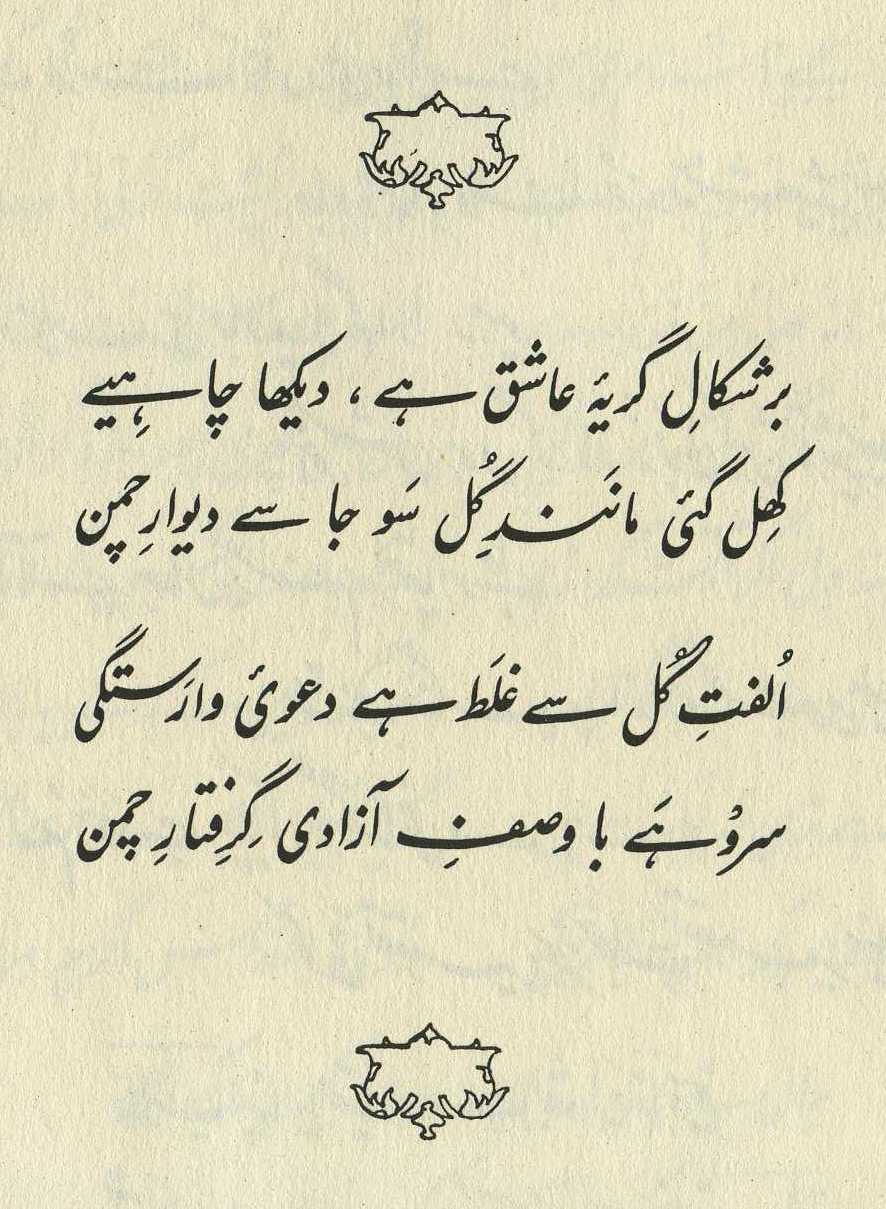
The way that Hazrat Joseph had come into the bazaar of Egypt, and Zulaikha had purchased him-- in just the same way it's that time that the Nightingale ought to become Zulaikha, because the 'Joseph' of the rose has arrived in the bazaar for sale.
== Asi, p. 168
When the rose became 'Joseph', then the Nightingale has the claim that 'I am Zulaikha'-- it is entirely a just claim!.
== Zamin, p. 247
Joseph had come into the bazaar of Egypt for sale. Zulaikha knew his value, and bought him. The flower too is like Joseph, and has come into the bazaar of the garden. It's fitting that the Nightingale, like Zulaikha, would buy it.
== Gyan Chand, p. 271
For background see S. R. Faruqi's choices . This verse is NOT one of his choices; I thought it was interesting and have added it myself. For more on Ghalib's unpublished verses, see the discussion in 4,8x .
The Nightingale is pointedly described as , a word derived from the Arabic root , 'to be still or motionless'. The Persian/Urdu word means 'lowly, humble', and by extension has the sense of 'poor, needy' (see the definition above). It is thus a word that might well describe the wretched state of a true lover like the Nightingale. But how can such a lover adopt the behavior of the rich, aristocratic, arrogant, self-willed Zulaikha , who buys a handsome slave in the bazaar and later treats him with such cruel injustice? Can, or should, the Nightingale even pretend to adopt 'Zulaikha-ness'?
One way to resolve the problem would be to think in Sufistic terms: the Nightingale sacrifices everything, including ultimately his life, in order to 'buy' his beloved. Thus he 'buys' the rose in the same sense that the Moth 'buys' his union with the candle-flame. The doomed Nightingale's later absence from the garden is hauntingly envisioned in M 265,5 .
Another approach would be to recall the full story, from Jami and the folk tradition: how Zulaikha later came to love Joseph in a sincere and humble way, and suffered accordingly. Eventually she was widowed, and Joseph offered to marry her. In some accounts she marries him, with God's blessing (this is Jami's version); but in others she refuses, since her passion was so intense that it had burned away all earthly desire and left her devoted only to the True Beloved.
The commentators adopt another approach: they take 'Zulaikha-ness' to mean simply the act of buying in the bazaar. The rose/beloved can certainly be imagined as coming into the bazaar to be sold; for a striking case in point, see 173,8 .
graphics/zulaikha.jpg