Verse 4x1816aar-echaman
G1
1
{since / to such an extent} it found defeat through the friend/beloved's colorful-styledness
2
the cap of the coquetry of the rose is in the niche of the wall of the garden
'>>To wear one's hat awry; to be proud or vain-glorious'. (Steingass p.1041)
'One who wears his cap awry; a fop, a beau (syn. ): — , s.f. Foppery'.
| References | |
|---|---|
| Arshi, Imtiyaz Ali | Ghazal# 93 |
| Raza, Kalidas Gupta | 216 |
| Nuskhah-e-Hamidiyah | 164-165 |
| Asi, Abdul Bari | 167-168 |
| Gyan Chand | 270-271 |
| Hamid Ali Khan | Open Image |
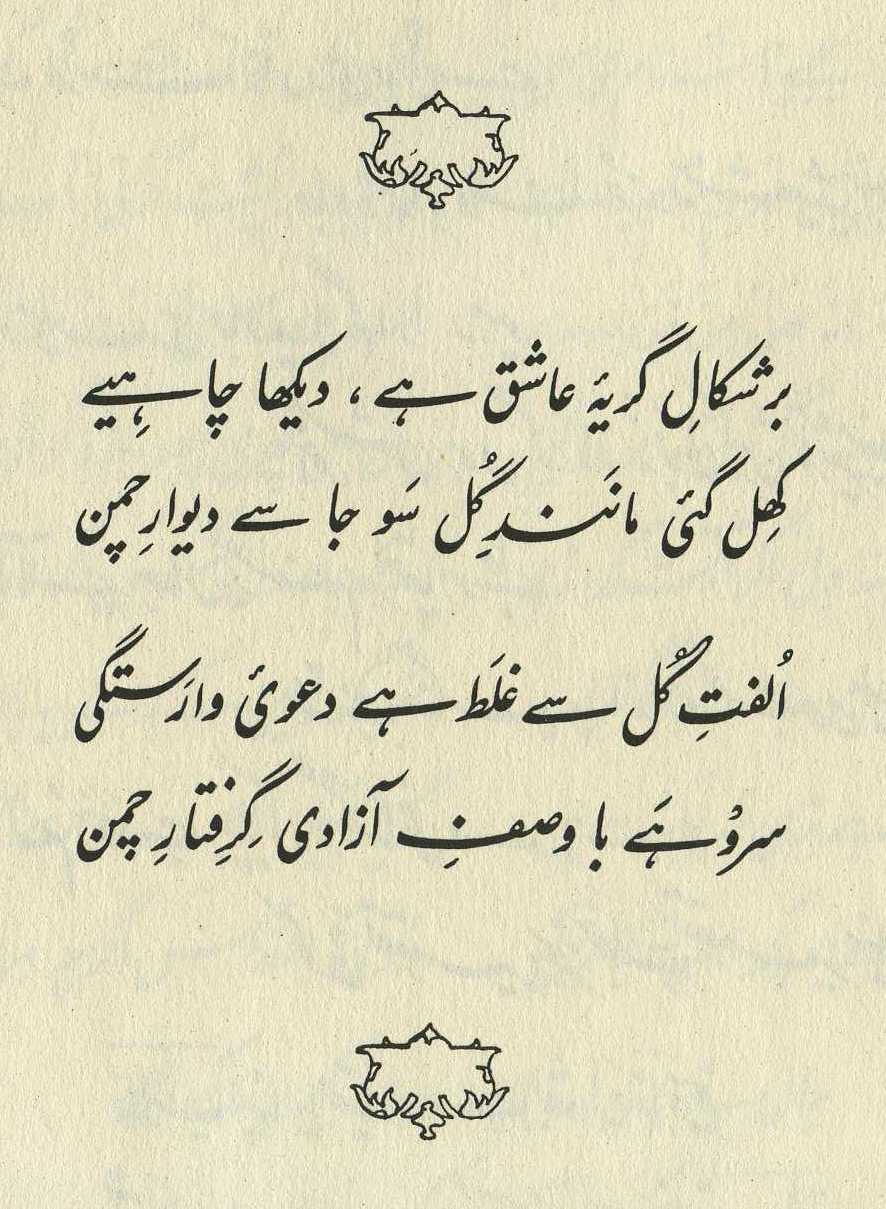
Since it has found defeat through the friend/beloved's colorful-styledness, the cap of the coquetry of the rose has come down and has been placed in the niche of the garden wall. In their spring flourishing, for the flowers to arrive at the wall of the garden is, so to speak, their taking off their hat [] of pride and coquetry, which is a proof of weakness and defeat. For the hat to be taken off is also used with the sense of losing one's honor.
== Asi, p. 168
That is, before the colorful-styledness of the friend/beloved, all the rose's airs and graces have been 'put up in the niche' []-- that is, people have forgotten them.
== Zamin, p. 247
= to forget [in Persian, 'to place in a niche']. In pride and coquetry, the cap is worn askew [], as if the cap is a sign of coquetry. The flower was full of pride at its colorfulness, and it expressed this pride through the stylishness [] of its cap. Through the colorful-styledness of the friend/beloved, the flower was defeated, and it placed its cap in the niche of the garden wall-- that is, now everyone forgot the rose. By the 'cap of the rose' is meant the rose itself. There are two aspects of its being placed in the niche. Either the flower has been uprooted and placed in the niche of the garden wall, or else the rose-branch has grown up and arrived at the niche in the wall-- so that it seems as if the flower has been placed in the niche.
== Gyan Chand, p. 271
For background see S. R. Faruqi's choices . This verse is NOT one of his choices; I thought it was interesting and have added it myself. For more on Ghalib's unpublished verses, see the discussion in 4,8x .
On the possibilities of , see 1,5 . On the nature of a 'niche', see 10,1 .
Alas for the rose-- as usual, the beloved is more 'stylish', more 'colorful'. His or her cap is worn at a more rakish angle, showing more (see the definition above) than the rose could possibly muster. Although the verse doesn't specifically bring in the idea of the rakish angle and 'crooked-cappedness', the association with 'coquetry' can't fail to call it to our attention. And in fact the word is such an uncommon way to describe headgear (it never occurs at all in the published divan ) that it brings its own powerfully idiomatic context with it.
Another instance of the attractive rakishness of , this time on the lover's part: 392x,4 .
Compare a Mir ian example: M 408,6 .
Rakish Persian -wearers (cited by Farshid Emami in a talk about the Chaharbagh in Isfahan, Nov. 2021):
graphics/kulah.jpg
graphics/rakish.jpg