Verse 1after 1826aa;Nkaa
G2
2
it is a single/particular/unique/excellent bouquet in the 'niche of forgetfulness' of us self-less ones
'One, single, sole, alone, only, a, an; the same, identical; only one; a certain one; single of its kind, unique, singular, preëminent, excellent'.
taaq>> : 'An arched building; an arch; a cupola, vault; a recess (in a wall), a niche; a shelf; ... —adj. & s.m. Single, sole; uneven, odd (opp. to ); singular, rare, unique, unmatched, unequalled, unrivalled'.
| References | |
|---|---|
| Arshi, Imtiyaz Ali | Ghazal# 37 |
| Raza, Kalidas Gupta | 369 |
| Hamid Ali Khan | Open Image |
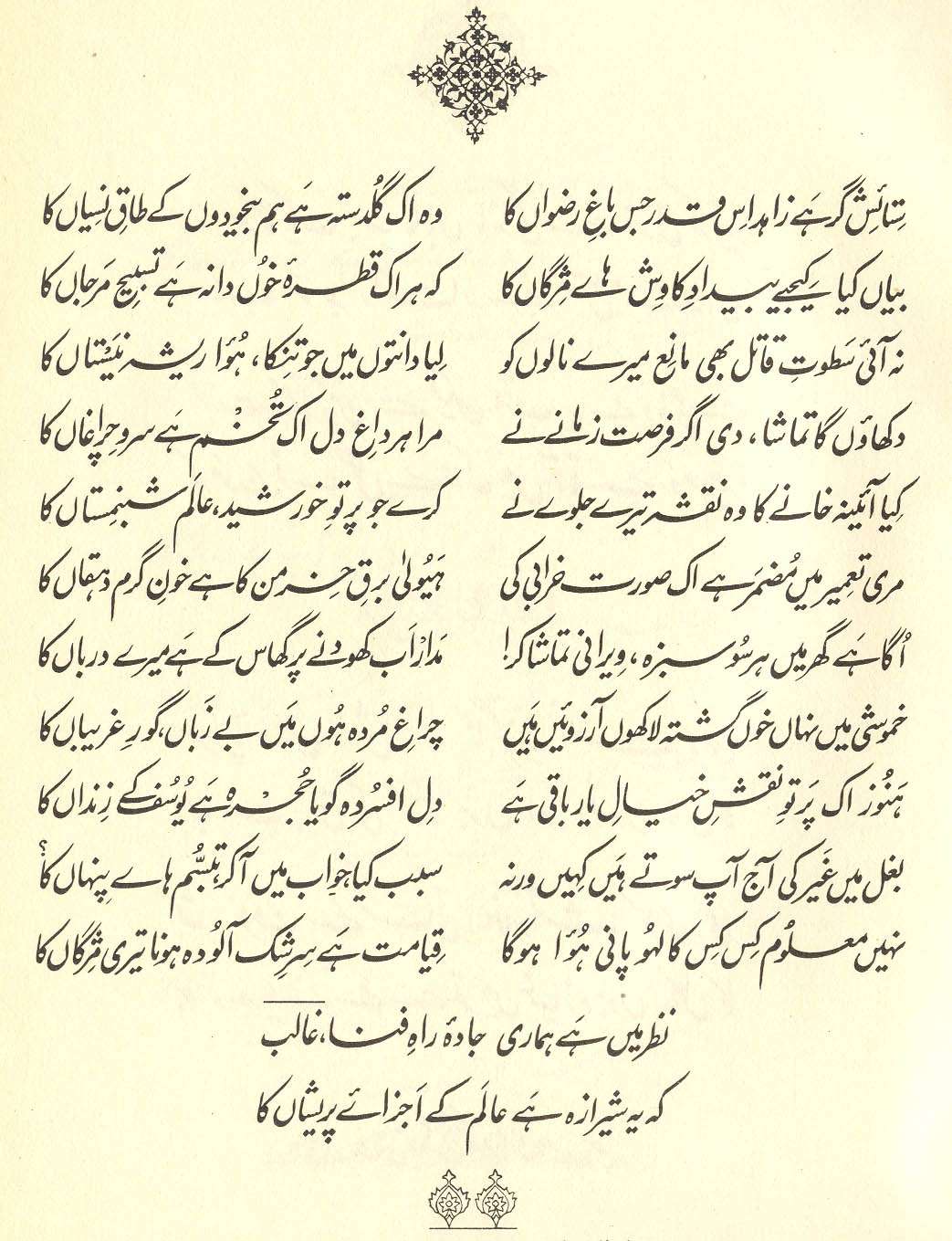
To compare heaven to a bouquet in the niche of forgetfulness of the self-less ones is an entirely novel simile which has never been seen anywhere.
==Urdu text: Yadgar-e Ghalib , p. 139
To 'put something in a niche', or put it 'at the top of the niche', is an idiom for forgetting about it, and to put it 'in the niche of forgetfulness' is even more of an exaggeration. And here the word 'bouquet' has produced this beauty: that people put bouquets in niches for decoration. And the second point is that the Garden has been interpreted as a bouquet in a lowly place; this too is not devoid of beauty. But this beauty is associated with style and rarity []; there is no excellence of meaning. (10)
== Nazm page 10

Urdu text: Vajid 1902 {10}
If we take a superficial look, then [Nazm] Tabataba'i's idea is absolutely correct, that in this verse there's no excellence of meaning, it's a matter only of beauty of expression, and novelty. (It's another matter that beauty of expression is itself in reality beauty of meaning, but here it's not the occasion for this discussion.)
In this verse the beauty of style and rarity themselves are of no common order. To demean paradise with such a suitable word as 'bouquet', and then to do it in such a way that it is lower than the low and to make that very thing a cause of adornment (they arrange bouquets in niches) is no laughing matter. This is a high order of innate wit.... Then look at the use of 'self-lessness' with 'niche of forgetfulness'-- it creates a novel form of wordplay upon wordplay. When we've forgotten ourselves, why wouldn't we forget a commonplace bouquet like Paradise?....
In order to refute this idea of Tabataba'i's that the verse has no aspect of meaning, after reflecting for a bit, a subtler meaning emerges from this verse that has remained hidden from all the commentators. The usual rule is that the thing that we forget becomes nonexistent to us; the forgotten thing is no longer present. The verse's real meaning is that the paradise that the Ascetic goes on and on praising, has for us no existence. We are free from such superficial imaginings as paradise and hell. Our absorption in Reality/God is at such a level that we have moved beyond all thought of punishment or reward.
It should also be kept in mind that 'niche of forgetfulness' is a metaphor; by using it in its dictionary meaning Ghalib has created a 'reversed metaphor' []. This too is a special trait of Mir 's and Ghalib's.
== (1989: 32-33) 2006: 42-43
[A special commentary page on several verses.]
The image of a bouquet in the “niche of forgetfulness” [t̤āq-i nisyān] is a striking one because it has a contradiction at its heart. Logically, we would put something like a bouquet into a t̤āq in order to display it rather than to forget it, as Nazm argues above. In the modern context, it would be like keeping a vase in “the display case of oblivion” or upon “the coffee table of disregard”. The Urdu idiom “to keep something in the niche” privileges the notion of putting something away to ignore it but nonetheless there is a potential for ambiguity because niches are also used for displaying things. Ghalib is therefore explicit in both this verse and 111,2 that the t̤āq in question is one of forgetting.
Although Ghalib arguably handles it with greater aplomb, similar attention to the dual function of a t̤āq as a place to put things away and to keep them visible was operative in Persian poetry. Siraj al-Din Ali Khan Arzu’s Tambīḥ al-Ġhāfilīn [An Admonition to the Heedless, c. 1744 CE], a blistering criticism of the poetry of Arzu’s contemporary Shaikh Ali Hazin, quotes a distich that immediately reminded me of Ghalib’s t̤āq verses. Hazin writes:
kitāb-i haft millat māndah dar t̤āq-i farāmūshī
marā sīpārah-yi dil bas kih nīkū fāl mī bāshad
The book of the seven nations* remaining in the niche of forgetting
For me, a chapter** of the heart would be enough for good fortune [fāl]. (1981: 33)
*That is to say, according to Steingass, “Seven original creeds from which all others are derived.” So we should understand this as the book of original scripture. (Arzu strenuously objects and says that because there are four “mażhab”s [creeds] and seventy-two “millat” [nations], the number seven makes no sense here.)
**One of the thirty sections into which the Quran has been divided.
Here the metaphor of the niche of forgetting is used to set up a contrast between the whole of revealed scripture and a fraction of it that dwells in the heart: I can put away the whole of scripture—I don’t need it, after all—and yet by keeping it on display in a t̤āq, I recognize its value. Indeed, I acknowledge its notional superiority to what I have in my heart (and maybe other people need all of it) but I can’t use it. The contrast between what is contained in a book and in the heart produces a number of interesting possibilities (scholastic learning versus emotion, complexity versus simplicity, external versus internal corroboration of truth, etc).
Hazin’s verse has particular affinities to each of Ghalib’s t̤āq-verses. In {10,1}, the niche is used to belittle something that should not be belittled, in Ghalib’s case the garden of Paradise and in Hazin’s revealed scripture. (Undoubtedly the symbol of the garden of Paradise as a bouquet, which causes Hali to gush with praise in the quote above, adds a level of enjoyment that Hazin’s verse lacks.) In {111, 2}, there is an interplay between memorialization and forgetting similar to Hazin’s verse. There the “bric-a-brac” of by-gone parties both serves as a reminder of how great a time we had but also implies that we should forget it because there is no going back. It is an act of remembering to forget. Likewise, Hazin’s verse asks us to remember that there is revealed scripture but to forget it in favor of what is in the heart. (--July 2011)
The full expression "t̤āq-i nisyān" was used by Arzu in prose and so must have had some currency in eighteenth-century Indo-Persian. In the preface to Ḳhiyabān-i Gulistān, his commentary on Saʿdi’s Gulistān, he writes by way of apology “and this manuscript because of the [unreadable] of circumstance and the changing of night and day for a time remained in the niche of forgetting” [wa ān nusḳhah bah sabab-i tamānʿ-i (?) rozgār-o taḥawwul-i lail-u nihār muddatī dar t̤āq-i nisyān māndah ]. If he were alive today, he would no doubt say the same thing about his email inbox. (--June 2012)
ABOUT THE 'NICHE': See the illustrations below.
This verse is so lovely, so witty, and so complexly enjoyable!
It belongs to a set that I call 'snide remarks about Paradise'; for more examples, see 35,9 . But the verse is careful to emphasize that the snide remarks apply to that particular Garden of Rizvan which the Ascetic praises-- and thus not necessarily to any other. For perhaps the one he's praising is not the real one. It might be only a petty floral vision framed in his own limited and conventional imagination. The relative clause structure makes this possibility quite real, and of course wonderfully piquant.
By turning the (Ascetic's version of the) immortal Garden of Rizvan into a mere bouquet, the speaker also destroys its immortality and condemns it to start withering almost at once. Moreover, if this is one single [] bouquet, the 'self-less ones' probably have others as well, of equal or greater glory. And all of these bouquets, of course, have been tossed aside casually, because those in the self-less state know far more beautiful realities.
Yet apart from this obvious reading of , consider all the others in the definition above. The verse might mean not to dismiss the bouquet so casually, but rather to describe it: a 'certain' one, or a 'unique, singular' one, or a 'preeminent, excellent' one (see the definition above). Any of these readings, needless to say, would give a different, and differently thought-provoking, slant to the verse.
On the 'niche of forgetfulness', compare 111,2 ; for an idiomatic use, see 214,14x .
The semantic affinity between and (see the definitions above) is also remarkable, and doubly enjoyable since the primary meaning of as 'niche' is so apparently unrelated.
ABOUT THE 'NICHE' ( ): A is, in North Indian architectural terms, a niche consisting of a small shelf set into the wall, with a simple or elaborate arch over it. These niches can be used for preservation, storage, and/or display of small objects (often lamps, incense, perfume, flowers, vases, or other decorative items), or can appear entirely as architectural adornments. Other verses: 306x,1 ; 347x,2 .
Here's a classic view of some of the elaborate, purely decorative white marble wall-niches in the Musamman Burj, Agra Fort:
graphics/musammanburj.jpg
And here are many sizes and shapes of niches set into the walls of an old haveli in Sheikhupura, near Lahore; some are very wide and shallow, and are meant mostly to serve as frames for wall-paintings:
graphics/taqwall.jpg
In a less lavish home, with plaster walls, there can still be relatively elaborate niches like this one:
graphics/taqplaster.jpg
There can also be strictly plain and utilitarian niches-- even on an outer wall, for convenient storage of small items needed on the veranda:
graphics/simpson1867.jpg
The niche as a decorative motif:
graphics/taqfloral.jpg