Verse 81833aatme;N aave
G13
1
if it would not be a despoiler/ruiner of honor, the lust for gold
2
why would the beloved-who-is-the-rose come from the garden into the bazaar?
is an archaic form of ( GRAMMAR )
| References | |
|---|---|
| Arshi, Imtiyaz Ali | Ghazal# 206 |
| Raza, Kalidas Gupta | 383 |
| Hamid Ali Khan | Open Image |
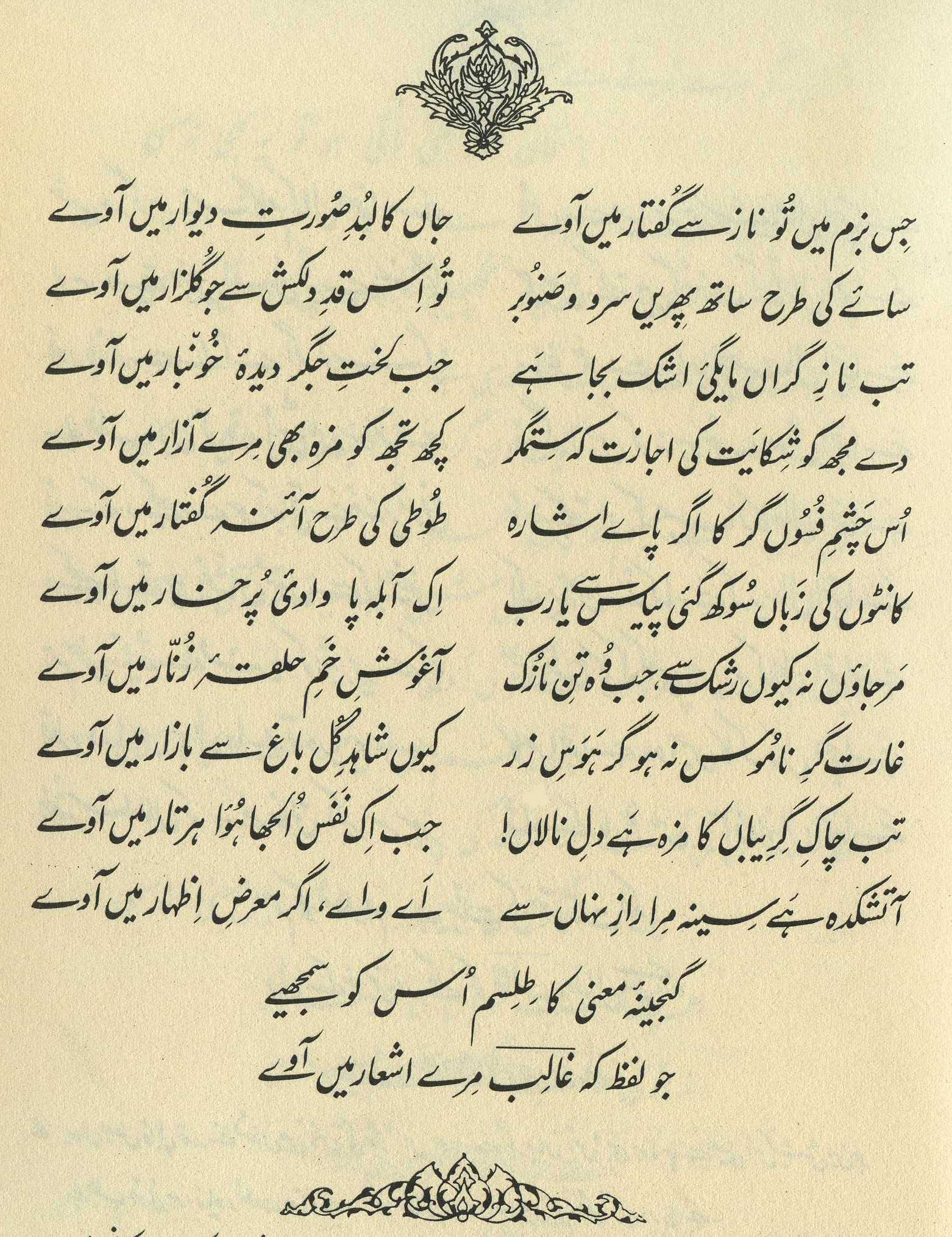
The cause of affinity is that the pollen that is in the rose, they call the 'gold of the rose' []. Consider the intention of the verse to be that the rose blooming and the 'gold of the rose' showing is as if in the lust for gold a hand would be opened out. The outcome of which is that it is necessary to come into the bazaar; otherwise, why is one confronted with the destruction of honor? The bud that was closed like a fist is gone; when the hand is opened to take gold, then the beloved has become a prostitute [] , and honor and pride have gone. (194)
== Nazm page 194

He says, the rose lusts for gold-- that is, the pollen that is in the rose, they call the 'gold of the rose'. Now the rose has a desire for that gold to be increased. Thus from the lust for gold, she was compelled to go into the bazaar to be sold. And in that situation, the destruction of honor is clear-- that is, she's become a public [] beloved. (250)
If the people of the world didn't have a lust for gold, then the beloved-who-is-the-rose wouldn't be compelled to come into the bazaar. That is, only remaining in the garden was good for the rose; there is where it flourished....
[Or:] Mirza calls the garden itself a bazaar, and says, if there were not a lust for gold-- that is, if the rose didn't long for the pollen-- then it wouldn't have come into the garden at all. He has called the blooming of a flower the opening of a hand, and the pollen 'gold of the rose'. That is, if the beloved-who-is-the-rose didn't open its hands and take the gold, then it wouldn't have become a public [] beloved. (339)
The whole verse is , and carefully keeps its parameters as broad as possible. Its best effects are founded on two enjoyable bits of verbal affinity: that pollen is called 'gold of the rose', and that a prostitute is called a 'bazaar' [] woman.
In the first line, it's impossible to say who feels the 'lust for gold', and whose honor is being destroyed; and by no coincidence, in the second line it's impossible to say whether the rose-beloved's 'coming into the bazaar' is a free choice or the result of duress.
In addition, the unusual ' of identity' (in which A 'of' B means 'A who is B') radically identifies the rose itself as a (human?) beloved, thus keeping all our options open.
Here are the main possibilities:
=The rose itself has a lust for gold, grounded in the affinity between gold [] and pollen []. Pollen is golden, so the rose may desire it for that reason. But pollen appears only when the rose is fully blooming, which is the time when it is brought to market; so the rose has prepared the conditions for its own sale in the marketplace.
=Humans in general have a lust for gold, so they brutally rip the richly blooming rose from its honorable home in the garden and sell it in the marketplace; thus they destroy their own honor and/or that of the rose.
=Beloveds have a lust for gold (and other worldly enticements), and this ultimately induces them to sell their honor and move from the privacy of a 'garden' to the public marketplace.
There are also some nice sound echoes: and and and .
Compare Mir 's own elegant treatment of this theme: M 96,8 . Might it not have influenced Ghalib's?
graphics/flowerseller.jpg