Verse 111833aatme;N aave
G13
1
consider it to be an enchantment/talisman of the treasury of meaning--
2
the word that, Ghalib, would come into my verses
tilism>> : 'A talisman; enchantment, magic; a mystery; mystical devices or characters; an image (or other object) upon which such devices or characters are engraved or inscribed (contrived for the purpose of preserving from enchantment, or from a variety of evils, &c.)'.
is an archaic form of ( GRAMMAR )
| References | |
|---|---|
| Arshi, Imtiyaz Ali | Ghazal# 206 |
| Raza, Kalidas Gupta | 383 |
| Hamid Ali Khan | Open Image |
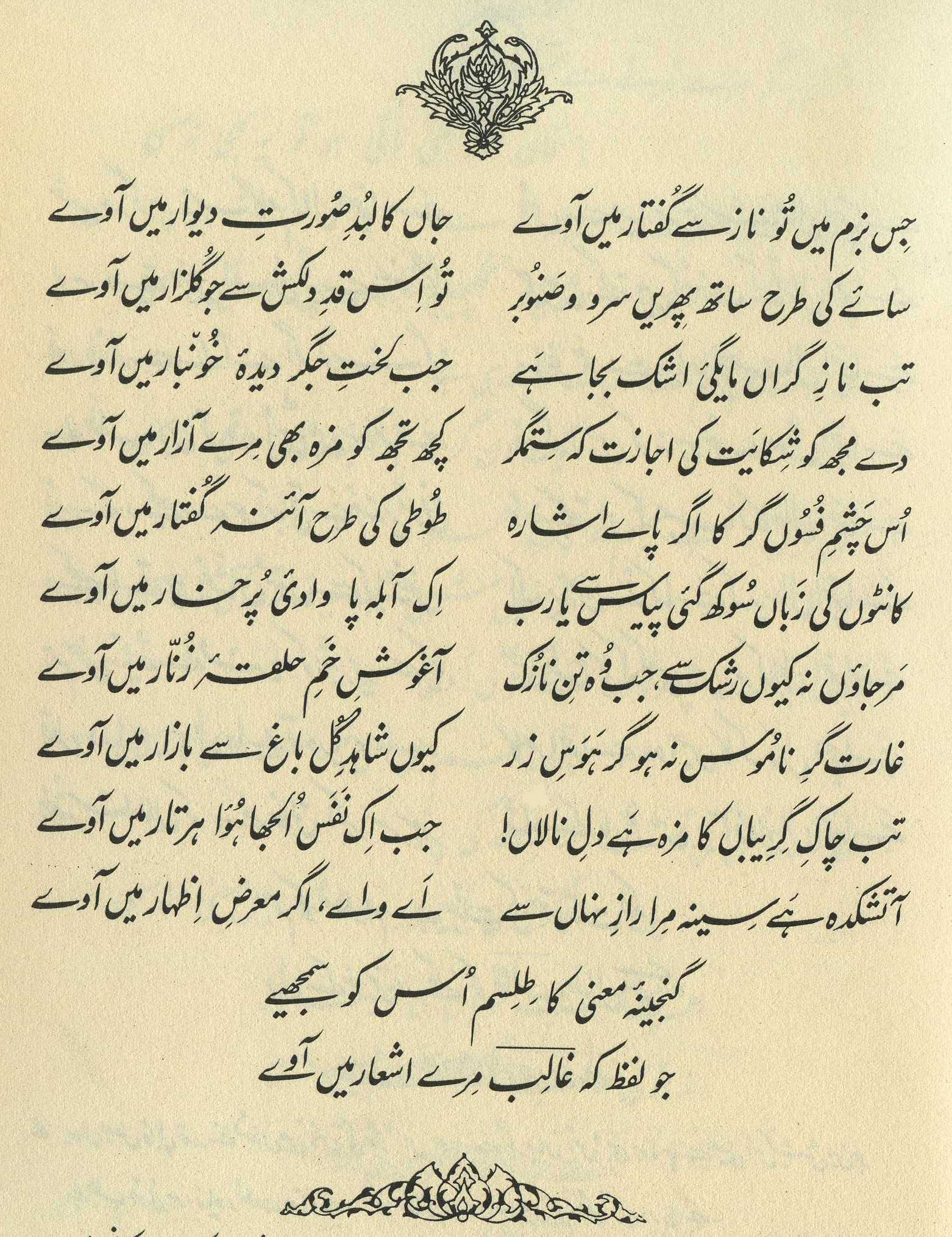
It is a treasury because numerous meanings are in it; and it is an enchantment because various aspects emerge from it. It's obvious that an enchantment is broken with difficulty, and is amazing/stupefying. In the same way, my difficult poetry is solved, and through its meanings astonishment is created. In short, the simile of an 'enchantment' for a word is extremely eloquent []. (194)
== Nazm page 194

The meaning is that my poetry is understood with great difficulty; and after being understood, its meaning creates a kind of astonishment. (250)
An 'enchantment' is a building that, in order to keep a treasury, is made with such devices that the non-knower would not be able to set foot in it; and if he would leave, then he would emerge only by dying. Indeed, the knower reaches it, and also takes out the treasury....
Oh Ghalib, consider the word that would come into my poetry to be an enchantment of a treasury of meanings. That is, my poetry is understood with difficulty. But when it is understood, then one learns that a treasury has been obtained. (340)
The word 'enchantment' [] with its wide range of meanings is at the heart of this verse. The definition given by Platts begins with the idea of a 'tilism' as a 'talisman' (a direct borrowing)-- something to ward off enchantment, along with other dangers, by means of either Divine or magical power. That's a piquant meaning in its own right: such a 'talisman' could be a small object, or even a special phrase, or even a single word-- and a 'talisman of the treasury of meaning' could be any single word from Ghalib's poetry.
But the dominant meaning of 'tilism' in classical Urdu literature comes from the dastan world, and especially from the story of Hamzah . Since I've discussed all this elsewhere, I won't go into it at length ( this account is the most detailed one). The commentators have pointed out some of the associations of a 'tilism', or enchanted world-- amazing, even stupefying, events and sights; mystery; inaccessibility; a general incomprehensibility that reduces one to helplessness; the inability to get out by any normal means.
Nazm suggests that such a 'tilism' is usually made in order to conceal and protect some (magical or other) treasure; this is possible, but by no means necessary. 'Tilisms' can be like labyrinths: a labyrinth may conceal some treasure, or it may merely be designed to create confusion, mystery, helplessness, fear. The difference is that finding the way out of a labyrinth, though it may be magically facilitated, in principle can also be accomplished by human cleverness (a long ball of string, a trail of breadcrumbs, etc.). By contrast, a 'tilism' is a completely magic world, and one can only emerge from it by magical means or by Divine assistance: by finding the right object, by performing the right action, or-- of course-- by saying the right word.
The invocation of a 'tilism' is thus more multi-faceted than the commentators allow, for a 'tilism' is inherently a sort of fake, a simulacrum of a world: the things you find in it are almost never what they seem. When it is broken, the rupture is always sudden and cataclysmic: the 'tilism' bursts like a bubble, and almost everything in it vanishes (though sometimes one particular special thing, the object of the hero's quest, survives).
So in this verse Ghalib has identified his poetry with a complex and morally ambiguous kind of 'enchantment'. And he's left us to revolve all the various possibilities in our mind-- and after they've all revolved once, we have to revolve them again, still without finding any way to pin them down-- lots of revolution, but no resolution. We wander around in the possibilities of this verse the way one would wander in a labyrinth-- or a 'tilism'.
graphics/magictreasury.jpg